snip.....
When you enter an actual displacement of 2.6 L equivalent
displacement becomes wrong.
Your formula for equivalent displacement is obviously wrong.
The volumetric shown efficiency is also too low. It should be at
least 100% for a side
port and 120% for a P-port.
Here is what you get with a VE of 115% on gasoline which correlates
well with what people are getting out of turbocharged 13Bs.
Also a BSFC of .42 is pretty good at sea level for the turbo compound
with a TIT of 1750 F.
Congratulations. Other than the minor problem with the equivalent
displacement :)
-----------------------------------------------------
Op's I just realized that is at zero boost.
There is a serious mistake in there somewhere. That is probably what is
fooling you on the displacement.
Paul Lamar ...No rotor no motor.
Paul,
There is no mistake. Everything calculates perfectly.
What exactly is confusing you? The fact that there is turbine work
and hp even without boost.
Of course there is. Even when the compressor is not called upon to
make boost, there is still flow through the turbine, unless you open
a wastegate.
The spreadsheet treats the turbine and compressor as separate
entities. The compressor is only called upon to make boost when you
increase manifold pressure above ambient.
The turbine always has flow through it because the exhaust keeps
flowing -- even without boost, no?
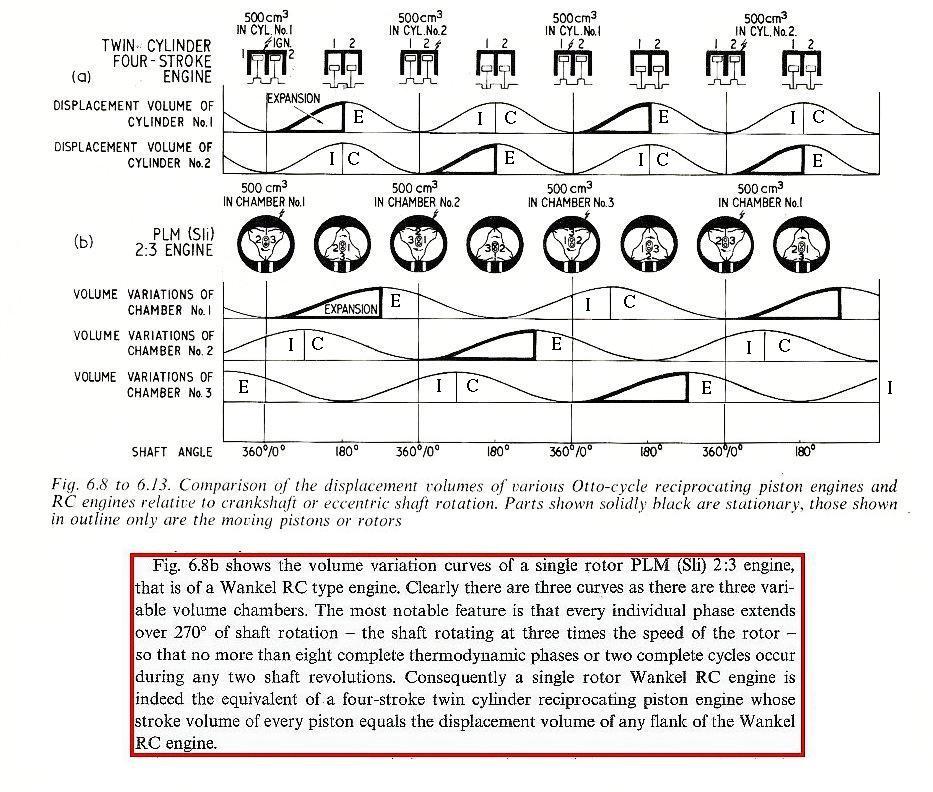
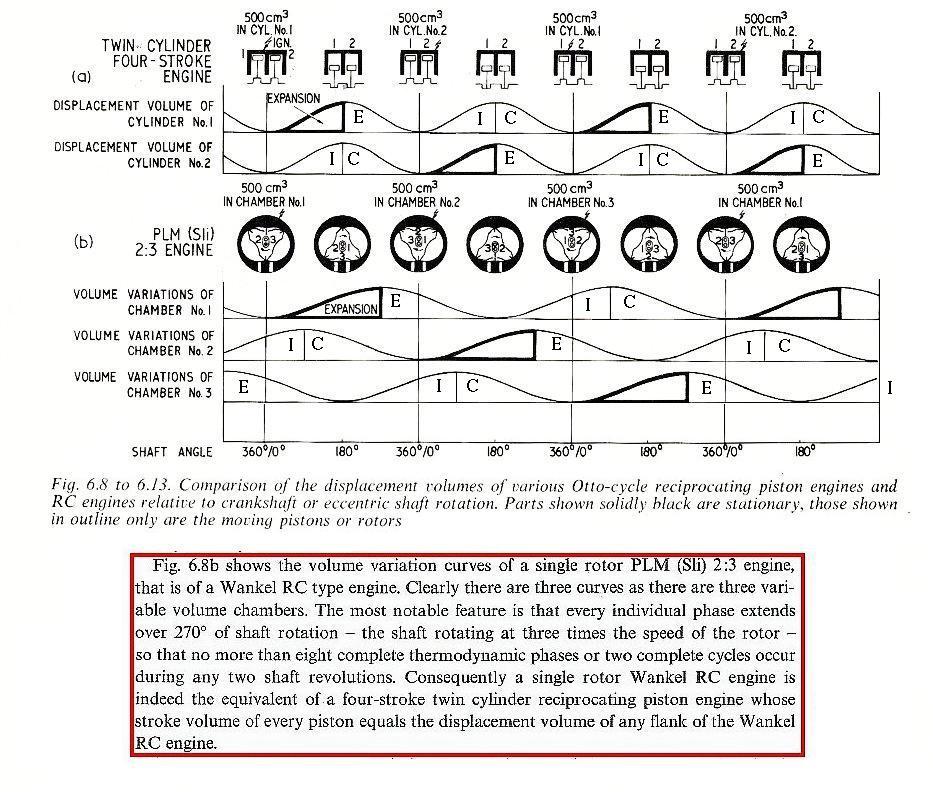
There is nothing wrong with displacement. Equivalent displacement is
double actual displacement.
You entered 2600 cc into actual displacement, for an equivalent
displacement of 5200 cc. This would be a 4-rotor engine. Engine
power, mass flow, etc. are shown accordingly.
As for VE, I've suggested more conservative numbers. I've seen .94
quoted in the literature for a side port, and 1.15 seems to be a
conservative suggestion for p-port.
Anyway, I've increased the range that can be entered, from .8 to
1.2, so you can do as you please.
I've also changed the inlet depression feature to take into account
ram air, if it is present. So now the user can enter values of -2 to
+2. I've also increased the mixture range for ethanol to 9 at full
rich. This is realistic for ethanol.
Please go ahead and verify with your own flow numbers nad charts.
Enter the displacement, VE, etc. and check against your charts.
I've entered the values from your chart in the attached
spreadsheet, version 3.9. Flow comes out to 220 cfm, which is
exactly what your chart shows.
Regards,
Gordon.
This spread sheet should work with any displacement engine you put
in it.
Piston or rotary. It does not. It doubles the displacement. That is
wrong.
This spread sheet is useless until that is fixed. It should not be
specific to
a Mazda rotary. The only difference between a rotary and any other
engine is
VE and RPM. I put in a 2.6L piston engine normally aspirated at 6000 RPM
with a VE of 80% and it gave me 285 HP. NO WAY!!!!!!!!!!!!!!!!!!!!
BTW why limit the engines to 2.6L???
Paul Lamar
Okay, Paul.
I agree the spreadsheet should be usable with piston engines too --
even though we are primarily concerned with the rotary.
Anyway here is v. 3.9.2, which lets you work with piston and rotary
engines on the same footing.
You can see I've added a field for choosing the type of engine. The
input for engine displacement is still based on the "official"
numbers, so that means 1300cc for a 13B. This is how the engine is
officially known and this is the official displacement.
The equivalent displacement is shown and all calculations are based
on that figure. Notice that when you choose piston engine, the
equivalent displacement is the same as actual displacement.
You can see in the example I've entered that this describes an
IO-550 at 2700 rpm. It shows max power of 287 hp, below the 310 hp
at which Continental rates this engine (in fact that is a minimum
individual engines can put out as much as 325 hp).
So this shows my calculations are conservative. I would rather be on
the conservative side than too optimistic.
A couple of other changes:
I switched the SI (System International, or metric) units to
"consistent" units, for example mass flow in kilograms rather than
grams, etc. This is more in keeping with standard practice. (the
actual quantities are still the same of course, just denominated
differently.)
I also made a change to the way exhaust pressure is computed. I now
use a ratio of specific heats that is more accurate for the
temperatures involved. (I had actually done this in an earlier
version, but was running out of space, so I decided to drop a
separate calculation of specific heats).
You can see in the top right side there are three different
calculations for specific heats. This is very realistic because at
any given point in the engine process, temperatures vary widely, and
as a result so do specific heats.
The upshot of this is significant for exhaust flow and turbine
power. Using the actual specific heats has bumped up the amount of
power we see coming out of the exhaust. This is very realistic now,
I believe.
Anyway, I appreciate your feedback and I hope anyone else that tries
the spreadsheet gives me their thoughts.
Regards,
Gordon.
OK here is what I am going to do. I will build a 2000 cubic inch piston
engine and call it "1000 CI". I will then go to the Reno race organizers
and show them the engine. Their rules are 1000 cubic inches max displacement.
I will then insist it is only 1000 cubic inches and demand they let
me race it. What do you think they would say?
There is no need for a type of engine. All engines are the same.
I got to hand it to you Gordon. You are ingenious and relentless when it comes to
avoiding the reality of the situation. I will not publish a spread sheet that
requires the "type of engine." We only need one spread sheet that does both
engines with out specifying which "type" it is.
Mazda needed you around when they were arguing with
the tax collectors :)
I am beginning to think you are jacking me around. I don't think you honestly
believe a 13B is really 1300 cc.
Show me another 1300 cc (79.33 ci) engine that will make 200 HP at 6500 RPM.
Paul Lamar ...No rotor no motor.
The Rotary Engine NewsLetter. Powered by Linux.
ACRE NL web site.
http://www.rotaryeng.net
Copyright 1998-2006 All world wide rights reserved.