> I am hoping you can answer a wankel question for me.
>
> I want to find a Midwest engines wankel, AE-50, and have been unable to
> find one for sale anywhere. I understand that Midwest was bought-out by
> diamond aircraft so there don't seem to be any new, but still need to
> find one used.
>
> Have you any ideas?
>
> Thx,
>
> Steve
>
>Try sending email to Diamond Chris Dries
<c.dries@diamond-air.at>
>Paul Lamar
>Hey Paul,
>I've tried diamond, and they want nearly $20k for one motor. That seems
way
>too expensive.
>Steve
>What is the horse power and how much does it weight .
>Clifton.
>It is about 120 pounds and 100 HP two rotor.
>One of the reasons Diamond is not producing this engine is the fact
>that only reciprocating piston engines are allow in certified S-Light
Sport Aircraft.
>Who would blame Diamond for sitting on this Certified rotary engine under
those
>circumstances.
>I spoke to a person in the FAA about it and he said we literally needed
>and act of congress to get the rule changed. No joke!
>We need to start a letter writing campaign on this. Find out who your
Congress person
>is and write a letter. Lets get the rule changed. Discrimination is the
history
>of the Wankel rotary engine.
>If you write a letter send me a copy and others can use it as an outline.
>Paul Lamar ...No rotor no motor.
Hi Paul,
Any chance of convincing the powers to be that the Wankel is a recip?
The e-shaft has a "throw" ( the eccentric offset) similar to a piston
engine's crankshaft throw. And if it were NOT reciprocating, the shape
of the rotor housing would be perfectly round like a turbine. Obviously,
not a traditional recip, but who makes the detailed definition of what
constitutes a "reciprocating engine"?
Dave M.
I think the FAA person you spoke to may have been misinformed. It's my
understanding that all LSA rules and standards are set by the group of
manufacturers, via ASTM. The LSA rules are different in this regard -- it's
like the FAA didn't want the hassle of regulating them and so agreed that
the manufacturers could just band together and write the rules and regs
themselves. ASTM just helps groups reach consensus and formalize things. I
think you would need to petition the manufacturers, and the best way to do
that may be via EAA.
Michael McMahon
It was a joint FAA/EAA/Manufactures bureaucratic effort all right and the big winner
was Rotax. Rotax probably stacked the deck with Diamond in mind.
However it is cast in concrete in FAR Part 1 DEFINITIONS AND ABBREVIATIONS
http://rgl.faa.gov/Regulatory_and_Guidance_Library/rgFAR.nsf/MainFrame?OpenFrameSet
http://rgl.faa.gov/Regulatory_and_Guidance_Library%5CrgFAR.nsf/0/BD73C51E9C7C3FE2862572960077077A?OpenDocument
Federal Aviation Regulation
Part 1 DEFINITIONS AND ABBREVIATIONS
Sec. 1.1
General definitions.
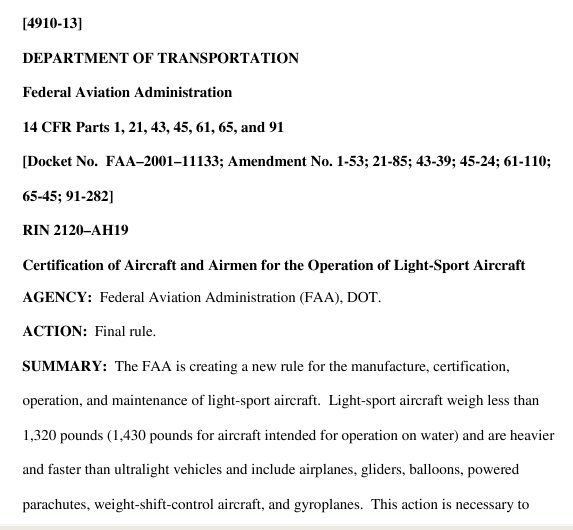
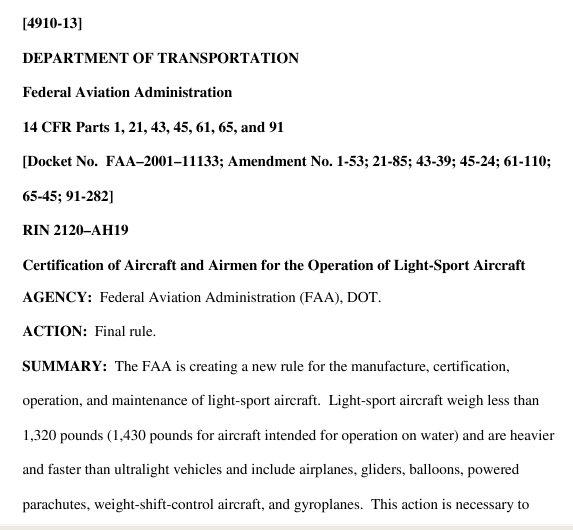
[Light-sport aircraft means an aircraft, other than a helicopter or powered-lift that, since its original certification, has continued to meet the following:
(1) A maximum takeoff weight of not more than--
(i) 660 pounds (300 kilograms) for lighter-than-air aircraft;
(ii) 1,320 pounds (600 kilograms) for aircraft not intended for operation on water; or
(iii) 1,430 pounds (650 kilograms) for an aircraft intended for operation on water.
(2) A maximum airspeed in level flight with maximum continuous power (VH) of not more than 120 knots CAS under standard atmospheric conditions at sea level.
(3) A maximum never-exceed speed (VNE) of not more than 120 knots CAS for a glider.
(4) A maximum stalling speed or minimum steady flight speed without the use of lift-enhancing devices (VS1) of not more than 45 knots CAS at the aircraft's maximum certificated takeoff weight and most
critical center of gravity.
(5) A maximum seating capacity of no more than two persons, including the pilot.
(6) A single, reciprocating engine, if powered.
(7) A fixed or ground-adjustable propeller if a powered aircraft other than a powered glider.
(8) A fixed or autofeathering propeller system if a powered glider.
(9) A fixed-pitch, semi-rigid, teetering, two-blade rotor system, if a gyroplane.
(10) A nonpressurized cabin, if equipped with a cabin.
(11) Fixed landing gear, except for an aircraft intended for operation on water or a glider.
(12) Fixed or repositionable landing gear, or a hull, for an aircraft intended for operation on water.
(13) Fixed or retractable landing gear for a glider. ]
As I said this is going to take an act of Congress to change.
Letters to the EAA won't hurt.
Paul Lamar ...No rotor no motor.
The Rotary Engine NewsLetter. Powered by Linux.
ACRE NL web site.
http://www.rotaryeng.net
Copyright 1998-2006 All world wide rights reserved.