I found another small item to correct. It was really not a big deal, but
if you entered manifold pressures below ambient, the compressor pressure
calculation would show a negative number, which is of course not true in
the real world.
This in turn would lead to very low charge temperatures and would skew
other values.
I have fixed it so that even at low manifold pressures, the compressor
pressure ratio remains 1.
Regards,
Gordon.
Plug in some of these numbers for a four rotor and see what your
spread sheet comes
up with. Also you need a look up table for VE verses RPM.
Paul Lamar ...No rotor no motor.
Paul,
There is pretty good agreement with the Lemans engine data. See for
yourself.
At 8000 rpm, standard temp, 29.92 MAP, air-feul ratio of 12, the
spreadsheet shows 630 hp, just below the 653 hp shown on your chart.
This is at VE of 1.2, compression ratio of 10, and evaporative
cooling of 0.5, and no inlet pressure loss.
At air-fuel ratio of 16, the bsfc is 0.46, which is what your chart
shows at the efficiency oriented setting.
I think this is pretty close. If anything, my calculations are a
little on the conservative side, just like I said.
About the VE varying with rpm. Yes, I agree this is what actually
happens. However, the VE curve is fairly flat in the range of 6000
to 8000 rpm, which is what we are most concerned with in an aircraft
engine.
Still, if I had the data to consturct a lookup table I would be
willing to give it a shot.
As it now stands though, there is pretty good agreement with the
Lemans engine.
I have attached a copy. I have also limited the air fuel ratio to a
leanest maximimum of 17. Even if you can run the engine leaner than
that, it could be that thermal efficiency would have already topped out.
This is version 4.1.1.
Keep the feedback coming...
Regards,
Gordon.
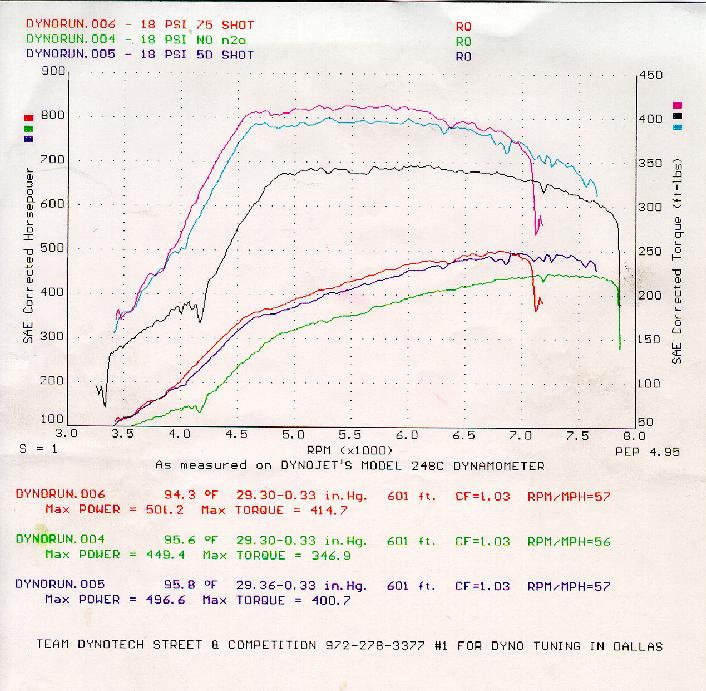
OK try the green curve with 18 psi boost and no NOS.
Paul Lamar ...No rotor no motor.
The Rotary Engine NewsLetter. Powered by Linux.
ACRE NL web site.
http://www.rotaryeng.net
Copyright 1998-2006 All world wide rights reserved.