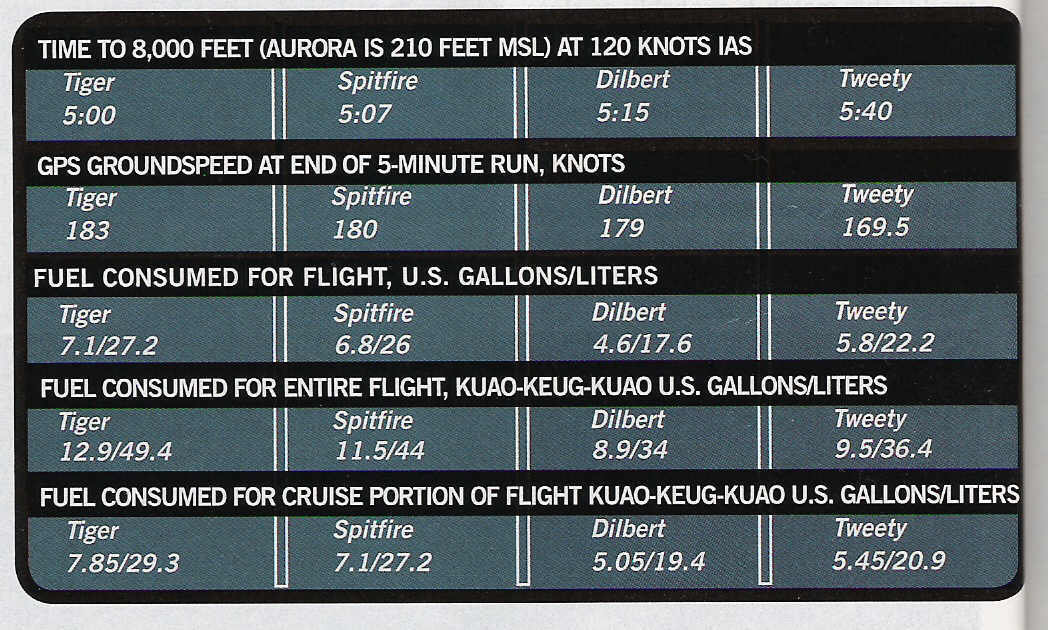
Doc, more info on the Power Sport p-port fuel burn.
Old message.
----------------------------------------------------------------
> Vans chose the speed at 150 kts,
> Vans decided the planes should fly at 2500 prop speed.
> The Lycoming need the 2500 prop speed to reach 150 kts.
>
> The Powersport [p-port] engine RV's will fly their 150 kts at 2100 prop
speed.
> Because the Powersport engine makes 450 lbs/ft of torque at the prop
> at 2400 prop with the engine turning 5490 rpm, We CAN reduce the
> prop speed to 2100 RPM And still out power the Lycom. Engines.
>
> I don't believe that Vans was slighting the fuel burn test. It just did
not
> occur to them that the Powersport engine could match their speed with the
> prop turning so slow.
>
> The main point of the Vans test to us was to prove Powersport engines
really
> do make more power. Van's interest was performance in all areas.
>
> Vans reported the Powersport engines out climbed and out ran the IO-360
> listed at 200 hp. and the Vans Special Built Fanuc 0-360.
>
> Before the tests I asked what mods that special built engine had.
> Vans offered no details other than a $8,000.00 fadec system and
> other things. So I asked how many of your customers have a similar
> equipped engine. Vans said their might be only 1 other.
>
> The questions Vans have repeatly asked the Subaru's are:
>
> 1) Why no Subaru or any other engine other than Powersport has
> ever flown to Vans and flew tests against them.
>
> 2) Why no builder with a Subaru engine has even answered
> Vans question as to their flight performance.
>
> 3) Van's have asked many times Please come and show us what is the
> performance of your engine. Vans said NO one except Powersport
> has ever showed up!!
>
> It's really easy to burn less fuel. Make less power, don't climb
> or fly fast. Then you don't need to have a large 3 blade prop.
> Don't need large air inlet or outlets for cooling. You don't
> need to worry about the exhaust temp. or flow rates.
>
> Exhaust:
> The exhaust system at the Vans fly-off did not have the completed
> upgrade tips. Their for the sound was 91 DB. Recorded at take-off
> 50 ft under. Current Powersport exhaust now is 81 DB, full power
> take-off 50 ft under. Those of you at Oshkosh, (who were close
> enough) to hear the 2 Powersport RV-8 will attest to the great
> sound. I received ALL positive comments. Most said they sound
> like a Quiet Turbine engine. Even some Lycoming guys asked
> if we could make their engines sound like that.
>
> The pilot fuel trim feature was added for exhaust and other
> development. It allows a 5% trim. The ECU's hold lamdia .94 at
> full power takeoff to lamdia 1.00 through 20,000 ft. with no
> pilot trim used.
>
> [Lambda 1.00 is 14.7:1 air fuel ratio) Lambda .94 is therefore
> 13.8:1 which is not quite best power. Best power happens
> at 12.5:1. The rotary will continue to run up to at least
> 18:1 observed on the Mazdatrix dyno and 200 degrees F lean
> of peak. Best BSFC is around 16.6:1. (1.13 Lambda) This is
> exactly what I thought was wrong with the Power Sport FADEC.
> Tracy Crook cruises at altitude at up to 200 degrees F lean
> of peak and with more spark advance and burns about the same
> fuel as a leaned Lycoming. It is thought that the reason
> this is possible is because the rotary is a rotating combustion
> chamber engine and the rich fraction of the mixture is thrown
> outboard toward the spark plugs due to centrifugal force.
> This makes the rotary naturally stratified charge.
>
> BTW Klaus Savier LSE also uses the same techniques but is
> unable to lean the Cont. O-200 to 200 F lean of peak.
> See the attached mixture chart from The Sky Ranch Engineering
> manual for more info. PL]
>
> Pilot trim was requested and granted for the following reasons.
> At ALT 75% power could still be WOT. If you come to a mountain
> and want best power it occurs at 10% rich = .9 lamdia. But best
> fuel burn is 10% lean This was a way for the pilot to tell the
> system what he wanted. This also allows the customers who do not
> purchase our tuned exhaust system to fine tune to the exhaust
> system what he actually built. He can record the deviations he
> had. We can then make the changes he wanted to his mapping.
> Our customers do not fly and need to trim our engines!!
>
> [Can you clarify this Ray? Is the trim 5% or +/- 10%? PL]
>
> Vans has had many years to perfect their best cruise and cooling
> Powersport has not. Powersport's 1st cowling had lots of problems.
> The worst one is the outlet and exchange width was the same as Vans.
> Our mistake, because it needs to be the same width as the working
> width of the coolers.
>
> Now we have enlarged and reshaped the cooling duct of our cowling
> to cool our 215 horsepower for ground and VX climbs. Next refinement
> is our new cowling now permits the oil cooler to be under the engine
> and allowing the water rad. to be moved to a more optimum low angled
> location. A point that Paul has correctly pointed out for years! Our
> earlier cooling duct cowling was not built wide enough. We will add
> a flap can be opened during taxi and VX climb. Then after a VX climb
> the trailing flap (Not built yet) can be reflected inward to reduce
> the height of our opening. This increasing the exit airspeed and
> reduce the cooling drag. Presently The RV-8's have no flap
> and are over cooling at cruse and thus a drag penalty toward
> fuel burn and speed.
>
> The 2 RV-8 tested have not moved their coolers to those locations
> yet. When they do they will fly faster and burn less fuel.
>
> Here is the performance as recorded by our 2 California customers
> RV-8 builders 1 year ago. They were not trying to improve the fuel
> burn or embellish it. They did not list the lower cruse RPM burn
> performance.
>
> These do not have the coolers moved, they do not have any cowl
> flap or the mods I have explained above.
>
> Aircraft Kit...............................Vans RV-8 (2004)
> Engine Cowl Designer.......................Chris Armstrong
> Engine Cowl Builder........................James Aviation
> Engine.....................................Powersport Rotary
> Propeller.................MT Model# 18B Electric Constant Speed
> Hp.................................215 @ 6000 ERPM/2620 PRPM
> FADEC System...............................Powersport
> EFIS System................................Dynon Model D10
> Nav & Eng Display..........................Powersport
> 2:29:/ Reduction Gear Drive................Powersport
> Interior Upholstery........................Classic Aero
>
> VNE 222 EW 1080
> VSFR 57 MGW 1800
> VSFE 53 Est. Time TBO 3000 HRS
> Wt 1480# T/O Dist 191' @ SL (70degrees)
> Acceleration Time.....1.8 sec. 2000 ERPM to 6000 ERPM
> Initial Roc 90K 2750 FPM
> Normal Climb 115K 1850 FPM
> Time to Climb to 8,000'@115 Kias .5 Min 7 Sec @ 1515lbs
> Time to Climb to 10,000'@115 Kias .6Min 47Sec @ 1515lbs
>
> Cruise @-------temp 68 degree F
> @ 8000--65% 5100/2300rpm 150K 200 Tas--10.4gph 19.23mpg
> @12000--65% 5100/2300rpm 140K 200 Tas-- 9.6gph 20.83mpg
> @8000---75% 5400/2400rpm 156K 208 Tas--11.2gph 18.58mpg
> @12000--75% 5400/2400rpm 147K 210 Tas--10.5gph 19.96mpg
> @8000---85% 5700/2500rpm 159K 212 Tas--11.9gph 19.82mpg
> @12000--85% 5700/2500rpm 151K 215 Tas--11.2gph 19.22mpg
>
>
> N559 JC Jim Clark Owner/Builder
> N838 SJ Jerry Gustafson Owner/Builder
>
>
> Ray Richardson Owner Power Sport
-------------------------------------
The Rotary Engine NewsLetter. Powered by Linux.
ACRE NL web site.
http://www.rotaryeng.net
Copyright 1998-2006 All world wide rights reserved.