Paul,
You know how Rotax engines have those nifty automatic altitude
compensating carbs? Well this can be done manually too using a simple
needle valve mounted to your panel.
This would be a natural for the p-port engine. Just hang one large-bore
carb off each intake tube. The 44 mm Mikuni VM round-slide carb can be
bought for about $100 on ebay and will flow more than enough for a
P-port engine.
Here is how it works in a nutshell. Rather than venting the float bowl
to the atmosphere, you run an air line from your needle valve to the
float bowl. The needle valve's other line is connected to a tee -- one
end of the tee goes to a port on the carb that sees venturi pressure,
which is lower pressure obviously. The other tee goes to the airbox and
sees atmospehric pressure.
When the needle valve is closed fully, the venturi feed is shut off and
the float bowl only sees the atmo pressure from the airbox. This is the
full rich position and is how the carb would work normally. As you climb
the airplane to altitude you back off the valve knob, which allows the
lower venturi pressure to come in and lowers the float bowl pressure,
thereby leaning the mixture.
The Rotax system works exactly like this only the needle valve is
incorporated into a diaphragm that moves the needle valve up and down
according to density altitude. It is US patent 5021198:
*http://tinyurl.com/26gnxj*
**
You can cobble together a manual adustment system yourself by purchsing
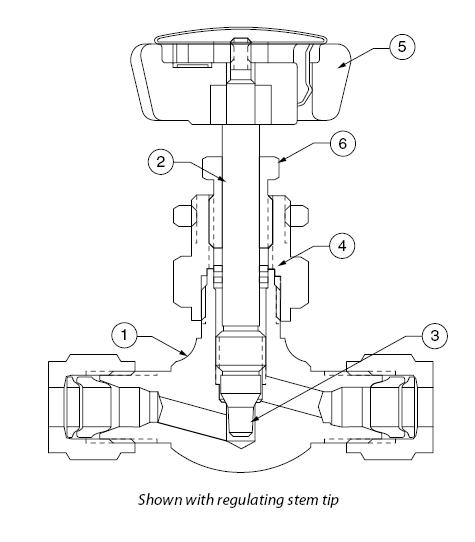
a needle valve like the Hoke unit pictured, or you can buy a system
ready made for two carbs. There are a couple of sources -- one is a
Green Sky Advnetures, a Florida supplier of Rotax gear for ultralights
and the other is Holtzman Engineering, which makes the same thing for
snowmobiles (the original idea was for automatic altitude compensation
was for snowmobiles that operated in high mountains).
http://www.greenskyadventures.com/bing/HACmanorder.htm
http://www.holtzmaneng.com/
The first picture shows page one of the patent for the Rotax automatic
altitude compensator. The drawing on the left shows the diaphragm in two
different positions. The chamber on the bottom is sealed at standard se
level pressure. As you climb into lower pressure air, this chamber
expands (as seen in the right half of the cutaway) and pushes up the
needle, exposing the lower pressure air coming from the carb venturi.
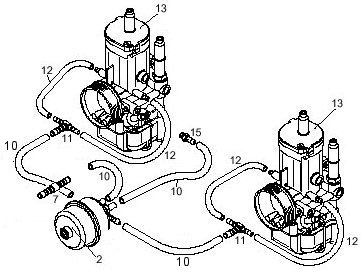
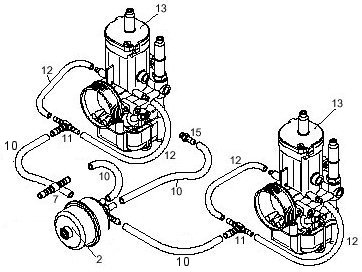
The second picture shows how the air lines are plumbed with two carbs on
a Rotax.
Picture three shows the tap in the Bing carb for the venturi low
pressure. As far as I know only some Bing carbs have this. However, it
is possible to drill and tap into venturi air on most Mikunis, Keihins,
etc. Probably Webers too. The Holtzman website has a pdf instruction
sheet on how to tap various carbs for this.
The fourth picture is the manual adjustable system sold by Green Sky.
You can see the needle valve and the various fittings. They sell for
under $200.
The fifth picture is a Hoke needle valve meant for air instrument lines
that would probablyu work great if you wanted to make your own. You
could probably buy this valve and the various fittings for less than $50.
Two carbs with this simple mixture control would be a very simple and
reliable way to go. I am also working on a flywheel magneto setup that
would be driven by a set of points for each of the four plugs. It would
go on the accessory side of the engine. I will put together a drawing at
some point...
Regards,
Gordon.
The Rotary Engine NewsLetter. Powered by Linux.
ACRE NL web site.
http://www.rotaryeng.net
Copyright 1998-2006 All world wide rights reserved.