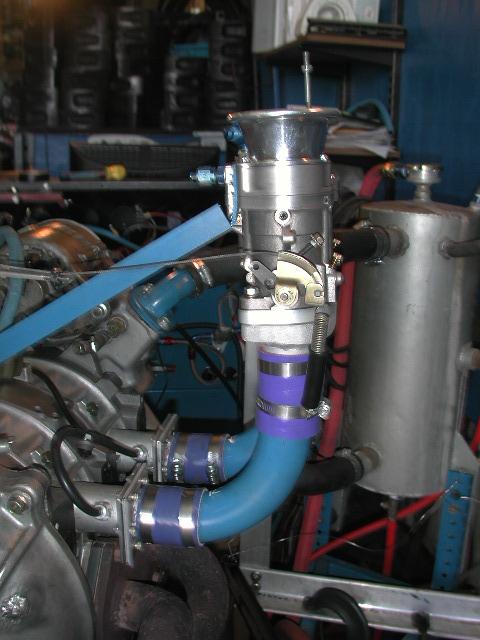
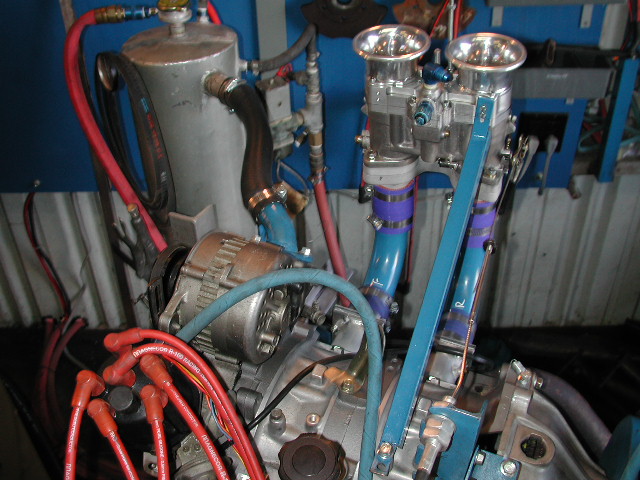
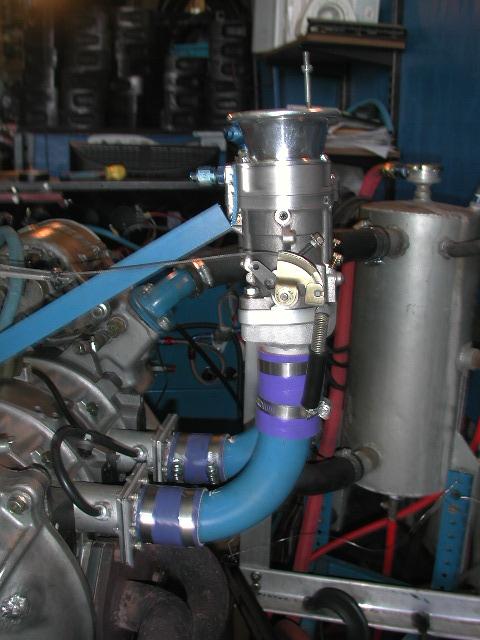
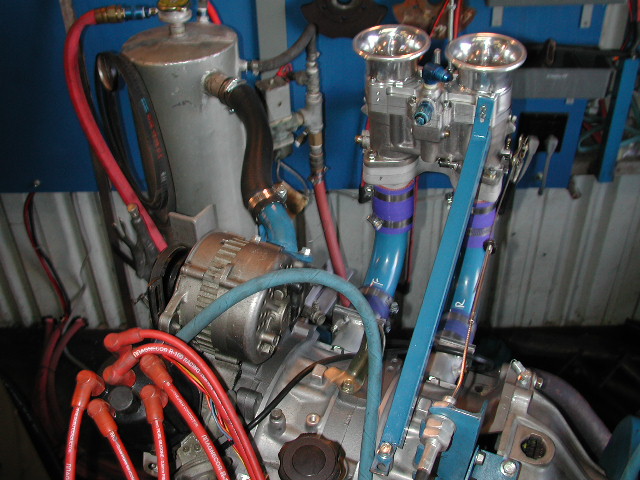
>> This is how our intake ended up. Milo
>
> Milo,
> Are they just cones you have welded on to the intake tube - will
they do
> the
> same job as the bell shaped ends. The sharp edge will ( I
believe) cause
> some turbulence of the intake
> George ( down under)
George I think you are right. With the bell mouths the runners are 15.75
inches long. We will be running on an un instrumented test stand
first, so
this is our first attempt. If we can get @200hp out of our RX-8
engine, we
will be delighted. Heck, we do not know if the engine will even run yet,
lots of work ahead of us. Milo
15.75 inches is too short for 6500 to 7000 RPM Milo.
What you need is 25 to 28 inches.
I don't think you will see anything near 200 HP at 6500 to 7000 RPM.
However if you want to test it on a dyno the Mazdatrix dyno is
set up for rotaries. You just bolt them in and run them.
As far as I know the Mazdatrix and the Racing Beat dyno are the only
ones set up for rotary engines in the US. Most other rotary shops use
chassis dyno's. I could be wrong but I have yet to hear of one.
If anybody knows of other engine dynos set up for rotaries please let
me know and I will pass the info on the next time the subject comes up.
Power Sport had one but I don't know what happened to it.
Paul Lamar ...No rotor no motor.
Milo,
Nice work on that RX8 engine. Hope it runs well for you.
About the horsepower, I just ran a few figures throgh my Turbochart
spreadsheet. I don't know what the exact volumetric efficiency of
the six-port RX-8 is, but I would guess it is no less than 100
percent. So using that value, the spreadsheet shows 226 hp at 7000
rpm and a best power air-fuel ratio of 12.5 at standard atmosphere
an no intake restrictions.
Another figure for VE that I've heard mentioned is 94 percent -- but
I believe that is for the 13B engine. If we use that figure, the
calculator shows 212 hp at 7000 rpm.
I think this spreadsheet is a little conservative, if anything. It
jibes pretty well with real-world hp data I got from Paul and Doug
Fir on several different engines.
Regards,
Gordon.
That 100% figure is for an optimized intake manifold length.
Nobody so far has built an RX8 intake manifold near optimized
length to my knowledge.
Racing Beat put the stock RX8 high power engine with the complex stock
manifold on their dyno and got only 232 HP at 8500 RPM. Probably around
190 HP at 7000 RPM. Mazda is now claiming 238 HP at 8500 RPM.
The first attachment is what is involved with the stock manifold.
I think your simulation is too optimistic Gordon.
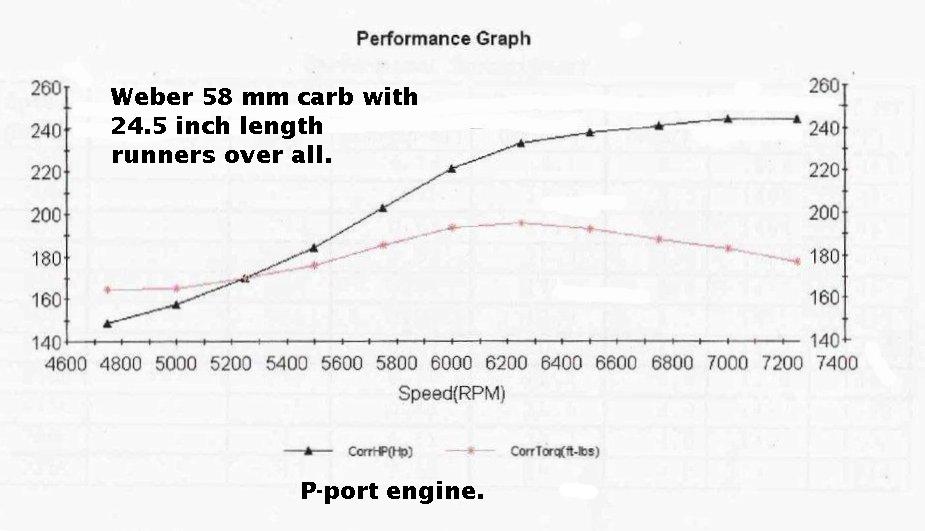
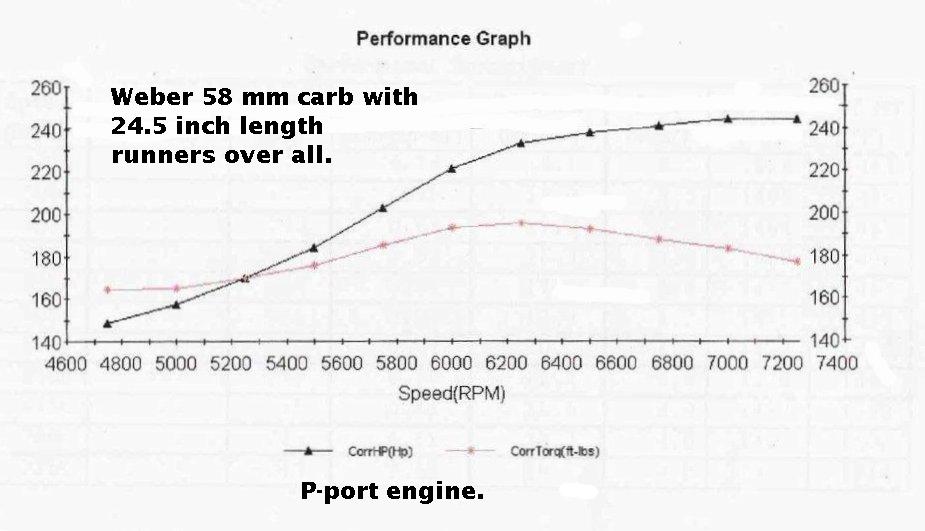
Here are our dyno curves for the Weber equipped P-port
second gen engine. Best BSFC occurs at the torque peaks.
I am building an RX8 engine version
as we speak. We will test it on the Mazdatrix dyno.
Jim Poole is building a special cutter to cut the cost.
We hope to get the cost below $100 each for the two inch P-port bores
in each housing.
Paul Lamar ...No rotor no motor.
Paul,
I found an article about a guy who used a scan tool to download the
data from the RX8 mass air flow sensor and then used that to figure
out the engine's volumetric efficiency. He got 94 percent.
*http://tinyurl.com/276hyy*
**
About that dyno run, what was the air fuel ratio? If they were using
the stock ECU, it probably wouldn't let them run a mixture rich
enough for best power.
Also using the stock air filter means you could probably not get
manifold pressure much over 29 inches of mercury. So if I plug AF of
14.7 and MAP of 29 into the spreadsheet we get 236 hp at 8500 rpm.
At 7000 rpm hp is 194.
Anyway, the P-port is obviously going to give a lot better VE than
.94. Also it will be easier to make a nice manifold of the proper
length runner.
Making exhaust for the Renesis engine is harder though, with those
square ports. But I saw on that Dr. Gas website that they have some
nice oval to round transitions that could work nicely.
Regards,
Gordon.
Those are rectangular exhaust ports on the RX8. The Dr. Gas transitions
are not constant area however you may not need constants area when
the gas is flowing from small area rectangular to larger area round.
Paul Lamar ...No rotor no motor.
Yes I meant rectangular, Paul.
It looks like it should be possible to lightly grind the port
opening to an oval shape to match the tubing. Use three of those
transition bends and from there you are just working with round.
About those hp figures on my spreadsheet. My previous numbers
included an evaporative cooling effect, which may or may not be
present in the actual engine to some degree.
If we leave that out, we get 238 hp at 8500 rpm and 29 inches of
manifold pressure. This is at best power AF ratio of 12.5. This
number sounds pretty close to those dyno results at Mazdatrix. At
7000 rpm power is 196 hp.
If using a 2.85 reduction gear, 7500 engine rpm would give 2632 prop
rpm. At 7500 rpm the engine should put out 210 hp according to the
calculator.
The RX8 engine obviously likes to rev with those light rotors --
with a Ford 3.17 gear ratio 8500 engine rpm would give 2681 prop
rpm, and 238 engine horsepower.
It'll be interesting to see what power figures you come up with the
p-port RX8. Even with a conservative VE of 1.1, the spreadsheet
shows 287 hp at 8500 rpm, 29,92 MAP, 12.5 AF ratio.
Regards,
Gordon.
The fuel air ratio was close to 12.5 to one because that is what the
guys always tune the Weber for. They usually could care less for anything
other than max HP. The dyno numbers are always automatically corrected
to standard conditions by the computer control.
Those inserts are cast Inconel and harder than all get out but they can be ground.
Yep. I can hardly wait but we won't run it over 7500 RPM on the
dyno and the power will start dropping off about there due to the long 25" runners.
The same as in this power curve. We will duplicate this intake system
as close as possible. My guess is the restricted RX8 engine side exhaust will
cost us as much as 10 HP at 7500 RPM. I will be pleasantly surprised
if this is not the case. The 3.17:1 PSRU is a rare animal so I am not planning
on running shorter intake runner tubes.
BTW if anybody wants to test a slide throttle fuel injection system let me know
and start working on it now. We can test your system on the dyno by swapping
the carb system for your system after we test with the carb. This should happen
within about a month or two. Perhaps Tracy's system with auto tune might
work better on the dyno this time around. The first time we tried it
it did not have auto tune and it was too time consuming (money) to tune it
for dyno load.
Paul Lamar ...No rotor no motor.
The Rotary Engine NewsLetter. Powered by Linux.
ACRE NL web site.
http://www.rotaryeng.net
Copyright 1998-2006 All world wide rights reserved.