> I am going to try this on the up coming RX8 P-port engine on
> the dyno.
>
> Attached is a chart (DRILL2.TXT) for a linear increase in area
> along with the drill diameter necessary to drill that area.
> The first column is the area of the hole and the second
> column is the drill size.
>
> The idea here as the slides moves more towards WOT
> the port area and air flow increase. This requires more
> and more fuel. The amount of fuel injected is proportional
> to the area of the vertical small hole in the slide.
> There fore the fuel holes will get bigger and bigger as
> the slide moves more toward WOT. Leaning will
> be done by the pressure regulator.
>
> Next step is plot the port opening as a function of slide
> travel. Not necessarily linear.
>
> If this works it is a super cheap, low pressure fuel injection.
> Very similar to the Ellison throttle body and Posa aircraft carbs.
>
> Paul Lamar ...No rotor no motor.
Paul,
The standby joke in the engine ECU business is that "someday, someone
will invent a system that adds fuel in proportion to air...."
I guess we all know what the answer is.
For the life of me I cannot figure out what all this wool gathering
about some drip feed F.I. system.
I'm sure you are all smart enough to figure out that all of this
hardware, in any point on the matrix of simplicity, cost, and/or
complexity exists already, and at a far higher stage of development
that you'll ever get to even if you spend the rest of your waking
hours on it.
Please find something to do that would be meaningful.
Avoid reinventing everything from some misguided sense of low cost
justification.
I am going to just scream if I see one more hare brained idea on this
supposedly enlightened forum.
Reeves--
You have got to keep the big picture in mind.
We have had less than sterling luck with ECU systems. Aircraft
piston engines
have an overwhelming advantage. They will still run after the electrical
system fails. If there was such a thing as a side draft aircraft
carburetor
I would use it with the p-ports. The rotary does not lend itself well
to the standard updraft aircraft carb. The Weber 58 MM side draft is
nice
but there is no leaning and they are expensive. Perhaps Gordon's
carb leaning
scheme will work with the Weber 58 mm side draft.
Timed EFI is over kill for an aircraft engine that runs at a constant
speed and load for hours on end. EFI was primarily developed for smog
reasons and not increased efficiency. Think of the slide throttle
as a variable venturi.
Paul Lamar ...No rotor no motor.
Actually I'm not sure if my leaning scheme will work with Webers,
Paul. They are not variable-venturi carbs, and the leaning system
uses venturi vacuum.
I know it will work with all the variable venturi carbs like the
various Bings, Mikunis, Keihins, etc. -- all of these are
side-draft, btw, so they will work great with a P-port manifold layout.
I'm not sure why you need a 58 mm carb. The P-port tubes are 2
inches diameter, right? That's 51 mm, so I don't think you need a
bigger carb than the size of your runner?
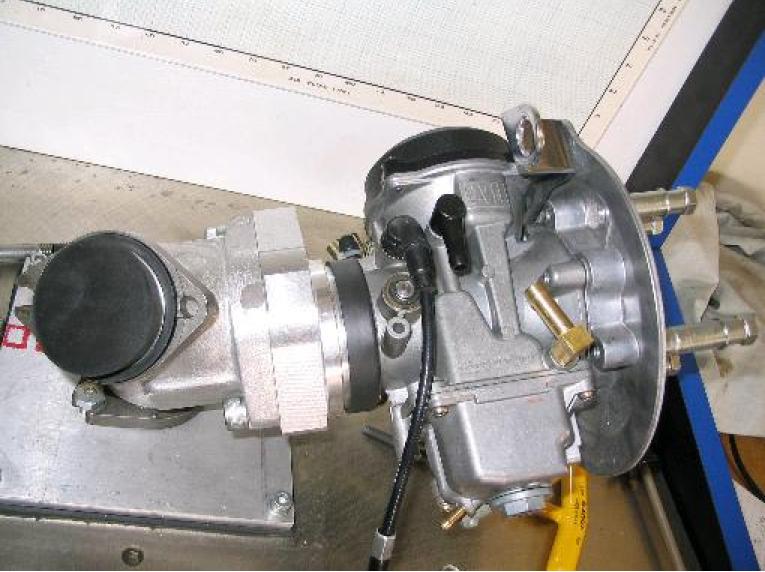
What about the Keihin 51mm? This is available as a Harley
aftermarket item and they go on eBay for about $500 new. The neat
thing about CV (constant velocity or constant depression) carbs is
that they meter fuel very precisely under all conditions, the next
best thing to EFI.
These types of carbs (but made by Bing) are used on Rotax
4-strokes -- with the automatic altitude compensating
system described earlier. I have logged quite a bit of time on
Rotaxes and can tell you these carbs work great. Even the turbo 914
engine uses them -- interestingly in a blow-through configuration.
The float bowls are pressurized by venting them to the airbox.
The Rotax 2-strokes use round-slide Bings -- Mikuni's VM series are
pretty much the same. These are also very trouble free and work
great. They too will work with the automatic or manual leaning system.
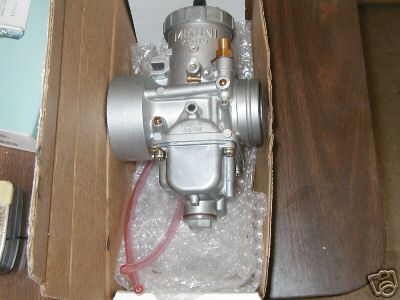
The Mikuni flat slide carbs will also work with the leaning system
and these smooth-bore carbs flow very well. These are used on
Harleys too so they are plentiful and can be had reasonably.
Btw, a 48mm Mikuni HSR flat-slide will flow more than a 51mm Keihin
CV -- but my choice would be the Keihin, based on my experience with
the constant depression carbs on the Rotax.
Any of these will flow well over 200 cfm each, which should be more
than enough. A p-port 2-rotor will only move about 400 cfm at 7500,
even if we assume a VE of 1.2.
A budget choice would be the VM 44mm round-slide, which can be had
for about $100 each on eBay. Any of these will work just as well as
Webers and all can be easily made mixture adjustable.
Regards,
Gordon.
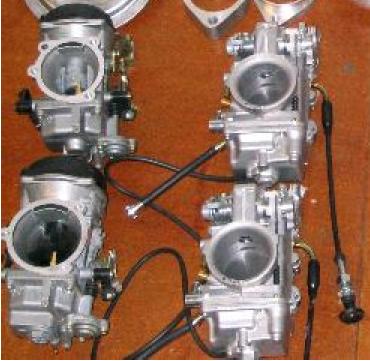
None of the variable venturi side drafts are really big enough as
far as I know. We need 58 mm. The Keihen CV 51 mm might get over 200 HP.
Two of them of course.
Paul Lamar ...No rotor no motor.
The Rotary Engine NewsLetter. Powered by Linux.
ACRE NL web site.
http://www.rotaryeng.net
Copyright 1998-2006 All world wide rights reserved.