Well, it's deja-vu all over again. Once again I am lining up to get the
engine (re)installation wrapped up over a holiday weekend. Once again
my final task is to fill the engine with coolant. Once again I find
coolant dripping onto my shoes as I fill the engine. And once again I
undo hours of work to rip the intake manifold assembly off the engine to
physically inspect the rotor chambers.
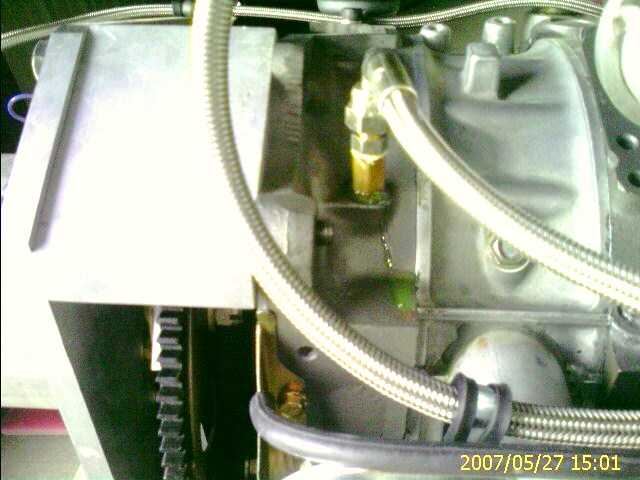
This time it seem the new end housing & new air vent fitting is
leaking. Much worse than the exact same leak which was deemed to
require a new end housing in order to resolve. In this case, it appears
sealing the vent port consisted of smearing a small bead of JB weld
around the outside of the fitting. This JB weld chipped off with a
finger nail. What remains (about 60-degrees worth on the surface) is
obviously not enough to keep the fitting water tight. This really makes
me especially furious, because this weak seal could /would easily have
failed after the vibrations of a few hours in flight -- leading to
coolant at 30psi being sprayed all over the hot exhaust leading to who
knows what.
Pic attached - lousy quality, but my cell phone is what I had at hand.
Mark (Rocky Mountain High)
Don't panic Mark :)
Will it unscrew or is it JB Welded in there?
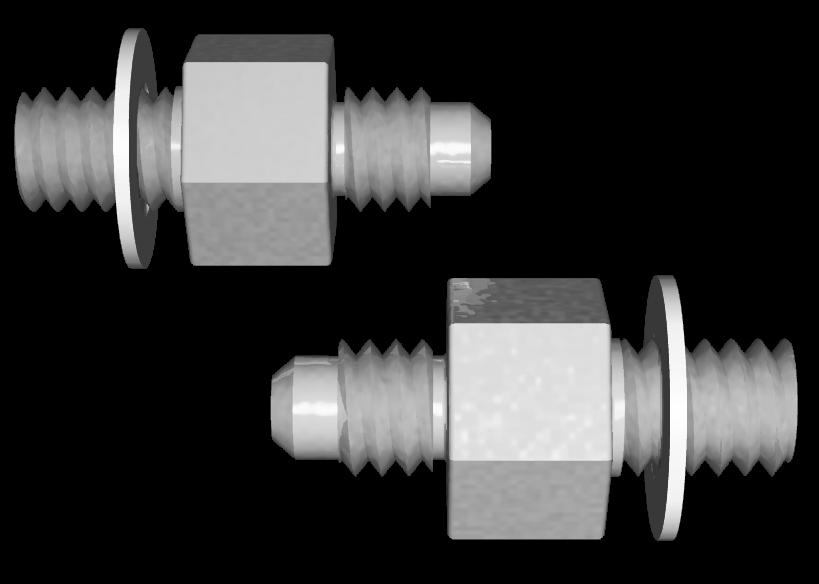
As I recall Dave put in a straight threaded fitting that should have had
an O-ring or aluminum washer under it. Can you see the O-ring?
If it unscrews no big deal. Replace the O-ring.
It should look like the 3D on the bottom. If no groove
for the O-ring the wrong part was used.
Also an aluminum crush washer might have been used instead
of the O-ring. In that case no groove is necessary.
Take it out. Clean it up and take a close up picture
of the bottom of the fitting and the top of the end
housing where it screws in. The top of the cast iron
should be smooth so the O-ring or the crush
washer can seal properly.
------------------------------------------------
It looks like brass. If it you twist off when you try to unscrew
it no big deal. Drill it out and re tap it for a straight
thread fitting. Either 3/8 national fine/course or 7/16
national fine/course straight threads. The fine or course
depends on the fitting you get. Get a thread gage
and the fitting before you drill and tap it to be sure
it fits. There are a zillion fittings out there.
Use a steel or stainless steel fitting.
McMaster Carr also has a wide range of SS and steel fittings.
The reason it cracked the first time was a tapered thread
pipe NPT fitting was used. That stresses the cast iron and causes
it to crack if over tightened. My fault for suggesting it in the first place.
I should have known better. A straight thread does not cause that problem.
It screws in just like a bolt. Unfortunately the term "straight" is sometimes
used in the fitting industry for AN to AN or NPT to NPT adapters
so watch out.
If worse comes to worse you can make one out of a 3/8th or 7/16 bolt.
Weld it to a steel AN hose male fitting and drill a hole
all the way through.
------------------------------------------------
There is also a trick to keep shavings out of the water jacket.
After you twist off the brass fitting stuff a bunch of string in the hole.
After you drill and tap you can fish it out with tweezers along
with the metal chips.
Paul Lamar ...No rotor no motor.
The Rotary Engine NewsLetter. Powered by Linux.
ACRE NL web site.
http://www.rotaryeng.net
Copyright 1998-2006 All world wide rights reserved.