>
> > Mikuni HRS48 is looking good. I'll mount the carbs close
to the
> engine
> > for good idle and low profile and use a 25 inch long stack.
> > Mikuni claims 120 HP per carb which is perfect for our use.
> > If a Mikuni can live on a hog it can live on a rotary.
> >
> > If this works it is a major breakthrough for the rotary in
> general.
> > I would not be a bit surprised if it finds it way into car
> racing.
> >
> > Mikuni is in my neck of the woods so perhaps I will hit
> > them up for some test 48 mm carb loaners.
> >
> > Paul Lamar ...No rotor no motor.
>
> Hello Paul,
> How are you going. I have been of the list for some time now
> but dave
> has passed on your email. I have mounted two Mikuni on the
> renises for
> my Mustang. I did not need to go to the bigger ones for this.
> the best
> price I found was from
www.easternperformance.com
<http://www.easternperformance.com>.
> all the flow rates are at another site.
> What ignition are you going to use? i was looking at using the
> same
> system as the Jabiru uses on this. I have a Harley direct drive
> alternator to mount also.
> I have been working on the lightning with the 8 5100 Jabiru
> engine in
> of late but will go back to the Mustang again. I am a lot
> happier now
> that I have descended with the high pressure fuel supply.
> I have also had this project on hold as the RAA in Australia
> get its
> new regs in place to include the Mustang
> Regards Don
>
> --
> Best regards,
> ddunbar WA
>
>
> We are doing fine Don. We just got a new Golden puppy.
> BTW Robin and I might visit next month. I would like
> to explore WA some more.
>
> Yes I know. Here are some old pictures you sent.
>
> Don't expect a lot of power if your using the Mikuni with the
> side port RX8 motor. The hot tip is a p-port engine.
> I would swap these for the 48's and p-port the engine. It is
> real easy
> now that Mark Steitle has figured out how to tig weld them in.
> This is a piece of cake for the highly skilled people you have
> over
> there.
>
> You don't have to use the power and fuel burn if you don't need
> it.
> Also the extra power will pay off big time when cruising at
> 10,000 feet because you are down to about 60% power anyway.
> In other words starting with 240 HP at sea level you will
> have 144 HP at 10,000 feet where the aerodynamic drag is
> much much lower. Mount the 48's close to the block for a
> better idle. Don't fool around :) Jump in! The water is fine :)
>
> Ignition:
> A multi spark capacitor discharge ignition one per spark plug
> has an advantage for a rotary as it will fire through a fouled
> spark plug. If you burn any 100LL the plugs foul sooner rather
> than
> later.
> If you use one per plug the RPM at which they fail to fire
> multiple times is doubled as that number (about 4,000 RPM) is
> given
> for a four
> cylinder engine that fires twice as often as a one rotor engine.
> It will also fire a leaner mixture so you can cruise with a
lower
> fuel burn. MSD Part number 6200. Don't worry about the total
> power consumption as each unit is using half the power as a four
> cylinder
> unit single unit would be using.
>
> The easy and simple way to trigger it is use two mag pick ups
> mounted
> 180 degrees from each other and make a new steel trigger wheel.
> Mount the new trigger on the outside of the RX8 e-shaft pulley
> as it is easier to fabricate brackets and clear the belts.
> Thanks again to Mark Steitle for this tip.
>
> Fire leading and trailing plugs at the same time around 20 to 30
> degrees BTDC.
>
>
http://www.msdignition.com/ignition_4_6200.htm
>
> Paul Lamar ...No rotor no motor.
>
> Paul,
>
> I don't think the MSD is going to fire more than one spark above
> 3000 rpm, which is what it says in its literature.
>
> Even with one box per rotor (or even one box per spark spark
> plug),
> there is not enough time for multiple sparks. The fact that you
> have
> less cylinders to fire does not change that.
>
> Let's say the engine is running 6000 rpm. That's 100
> revolutions per
> second, or 360 degrees of rotation every 10 milliseconds.
>
> The spark duration from the MSD is 20 degrees, or 1 /18'th of a
> revolution. That works out to 10 milliseconds divided by 18
equals
> 0.5 milliseconds for the spark itself. Trying to cram in
multiple
> sparks in that short a time would only be counterproductive
> because
> you are shortening the time that spark is present.
>
> Also, I'm not clear on whether you are proposing to use one MSD
> box
> per spark plug, or one box per rotor. I would think you could
use
> one box per rotor and use a coil with two towers two fire both
> spark
> plugs in a rotor at the same time.
>
> Btw, this would also work with my flywheel magneto. Just use two
> charging coils on the stator -- one each going to an MSD box.
Use
> two magnetic triggers 180 degrees apart to trigger the boxes.
And
> use two of those twin-tower coils.
>
> You could do the same thing with two sets of points and not
bother
> with the MSD boxes. I still like this method better because its
> simpler, less stuff to fail and you will get a very hot spark.
>
> The point of CDI is to get a big jolt of voltage to the coil
> primary
> side very quickly. The charging coils on the flywheel magneto
will
> put out higher voltage the faster the engine spins -- like any
> magneto.
>
> Depending on the number of windings on the stator coils, you
could
> easily get 400 volts at 6000 rpm, which is what the CDI box
> puts out.
>
> The other point of CDI is to get that voltage to the primary
> windings of the spark coil very quickly. Here again, my scheme
is
> just as good because the dwell time (points closed) is so long.
>
> The points only are open for 20 degrees of revolution. The
> rest of
> the time current is flowing from the charging coil on the
> stator to
> the primary winding on the spark coil -- 340 degrees. At 6000
rpm
> that is 9.5 milliseconds. So the primary has all the time it
needs
> to be fully charged with high voltage.
>
> There is zero advantage to the CDI system. The CDI system is
good
> when you have multiple cylinders and the time gets very short
for
> the primaries to charge up. Plus -- unless you have a magneto
> -- you
> only have a piddly 12 volts going to the primaries.
>
> This is not the case here. You have high voltage going to the
> primaries and a very long duration time.
>
>
> Regards,
>
> Gordon.
>
> BTW the chart I uploaded was wrong on the duration of the
> spark. It came from Heinz Heisler's book and there
> are frequent errors in the illustrations. The decimal
> point was missing. Heisler had it correct in the text
> but the illustration was wrong. Here is the corrected version. I
> double checked the Bosch Automotive Handbook for the corrections.
> Sorry about that I misled you. It is getting so I have to check
> everything in Heislers book.
>
> "I don't think the MSD is going to fire more than one spark above
> 3000 rpm, which is what it says in its literature."
>
> It depends on the size of the capacitor and the output resistance
> of the power supply charging the capacitor. The traditional
> value for the capacitor is is one micro farad with 400 volts
charging
> it. That is the capacitor used in this third chart yielding
> a .35 ms spark duration.
>
>
> As I recall and if memory serves me correctly the energy is
> proportional To voltage squared times 1/2 capacity. E = 1/2 x C x
V^2
> which gives 80 mj.
>
> It is possible MSD is using a smaller, faster charging capacitor.
> MSD uses 460 to 480 volts. 470 squared is 220,900 while 400 squared
> is 160,000 of course. MSD claims 100 mj and 12 sparks maximum per
> firing event.
>
> However it is also possible to design a high RPM MSD
> ignition system using multiple smaller capacitors that are charged
> in parallel and fired in sequence with .1 ms or shorter spacing.
> The pulse
> transformer coil must be designed accordingly. I can't say
> for sure MSD are doing that as I have never ever seen inside of
> one of their boxes let alone the skematic.
>
> I was thinking of one MSD unit per rotor to keep the cost reasonable
> but Racing Beat is using one per spark plug.
>
>
> Paul Lamar ...No rotor no motor.
Mikuni slide carbs and capacitor discharge ignition---I have the
feeling that we (the rotary movement) have taken a very long and
tortured path to get to this simple and elegant combination. I know
I can get comfortable with this set up. Jerry
Don't get too comfortable. I just checked on the price
at my local motor cycle shop and the Mikuni 48 mm are $500 each :)
If I had a dyno I would still be working on the slide throttle carb.
If I can promote the loan of a couple of Mikuni's I'll test those
on this P-port RX8 engine go around.
Maybe Bill Jepson knows somebody and he can get a discount.
Paul Lamar ...No rotor no motor.
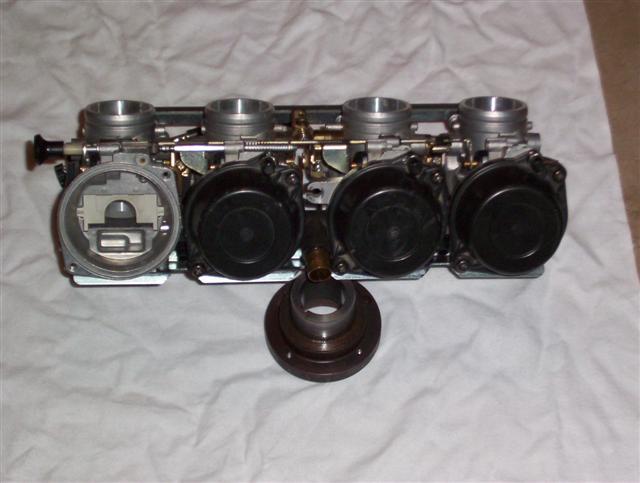
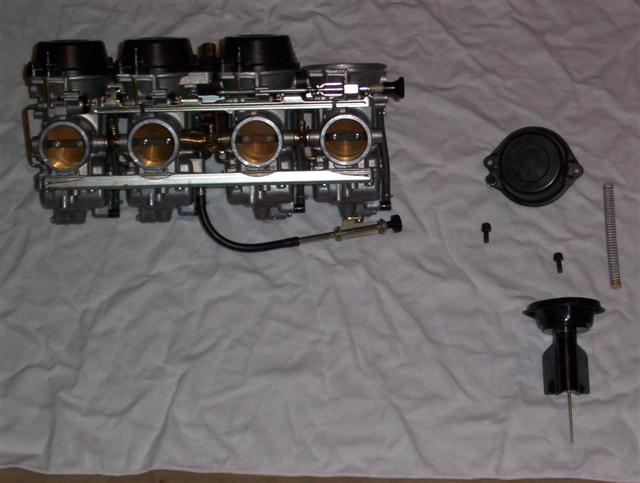
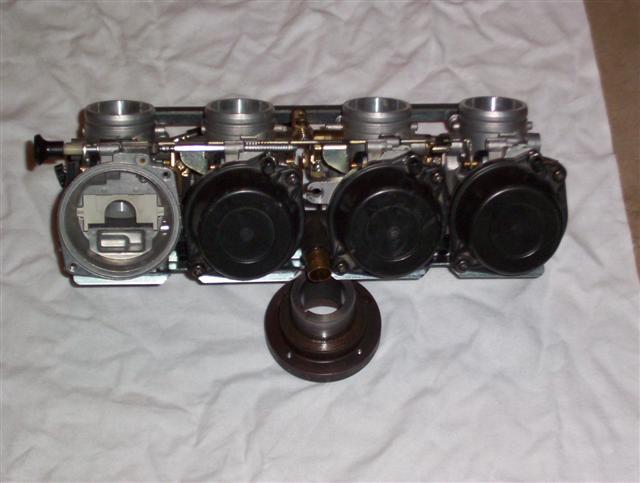
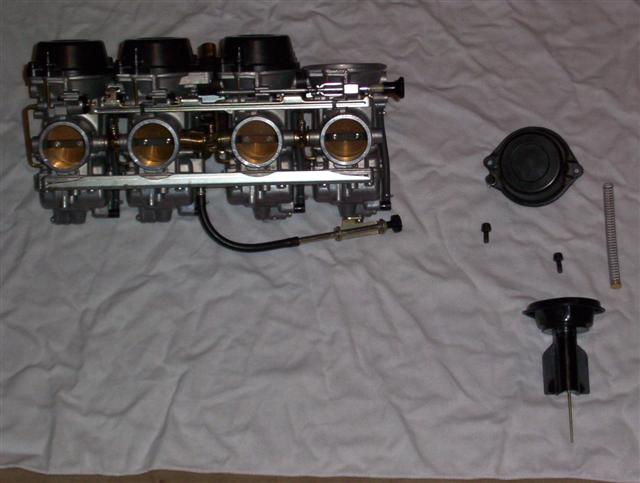
FYI, I put Mikuni carbs (48mm throats) on my 13B and I test fired it
about 6 months ago. I was really impressed on how the carbs worked
without even tuning the carbs (jets) and timing. I found four used
carbs for about $300.00 CDN and rebuilt them. There is one concern with
using these carbs; ethanol mix fuel may ruin the diaphragms. I will
also need to add a primer.
Ignition is based on Terry's EC1.
I've attached pics to this e-mail. Note, things have changed with the
water plumbing and I am still working on the muffler since the pictures
were taken. So be warned ;o)
Cheers,
Burck
Wow four 48 mm and it runs. Holy smoke! I think you are a bit over carbed :)
That says a lot for Mikuni carbs.
That is a wonderful fantastic price on four 48 mm carbs.
Is that $300 CDN each or $300 CDN for the lot?
I would love to find a price like that.
Paul Lamar ...No rotor no motor.
Sorry Paul (and all),
I'm somewhat embarrassed, I was at work when I quoted you the throat size
and I thought they were 48mm -- but actually they were 38mm(I bought them
August 2004). They came from a Suzuki GSX and GSX-R series bike.
I looked at the bill and the cost was $350 CDN for a bank of 4. For those
who are curious, I bought them at:
Edmonton Cycles & Salvage
9753 - 62 Avenue
Edmonton, AB
T6E 0E4
Ph: 780-434-2737
It's a rough looking store, but the people that were extremely helpful.
Cheers,
Burck
I think you are going to get a fair amount of power out of that system.
I would lengthen the tubes another few inches. I see those are the butterfly
type.
Paul Lamar
The Rotary Engine NewsLetter. Powered by Linux.
ACRE NL web site.
http://www.rotaryeng.net
Copyright 1998-2006 All world wide rights reserved.