I'm thinking 1.75 in runners might suit our rpm better.
Ta, Dave McC
There is a big difference in the port area.
1.75 OD is is really 1.625 ID. Area is 2.07 square inches.
2 inches OD is 1.875 ID. Area is 2.76 square inches.
My guess is HP would be less than 200.
Here are the Lemans curves.
--
Paul Lamar ...No rotor no motor.
Hah! no diameter graph this time! :)
Your guess is < 100 hp/rotor ?
Looking at the torque curve, I cannot see a lower torque at 6000 rpm
with 1 3/4 runners, if anything, it could be higher due to higher
induction velocity.
Is Suzie any kin to Mikey? She sure is a cutie Robin don't look
too bad either! :)
BR, Dave Mc
Perhaps the torque will be higher at 6000 RPM but I am certain
torque and HP would be lower at 7500 RPM. The only way you could take
advantage of more torque at 6000 RPM is with a variable pitch
prop and that would be manifested in a slightly better BSFC.
I would have to try it on a dyno with different length runners
basically repeating what Mazda did to know for sure. I can't afford
the dyno time so I will stick with what Mazda came up with. We know it
works as we already tested our copy of the Lemans configuration.
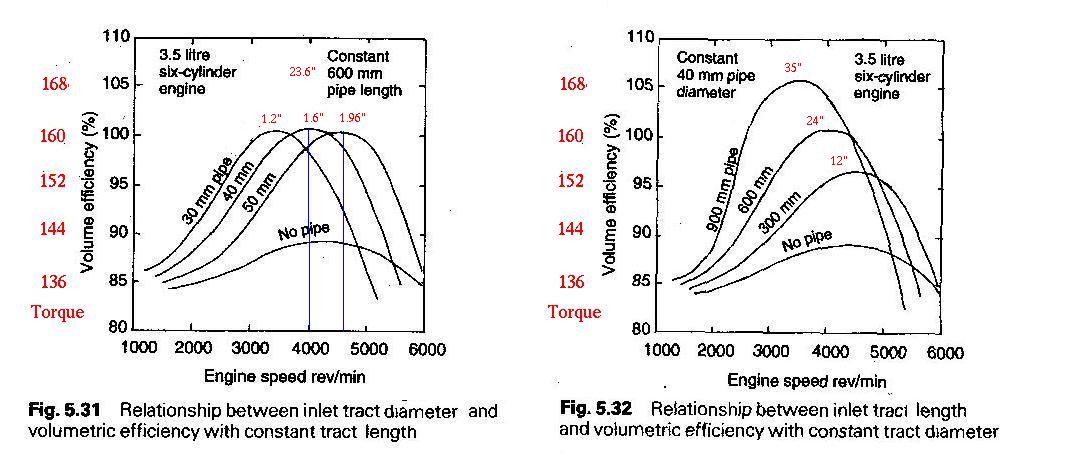
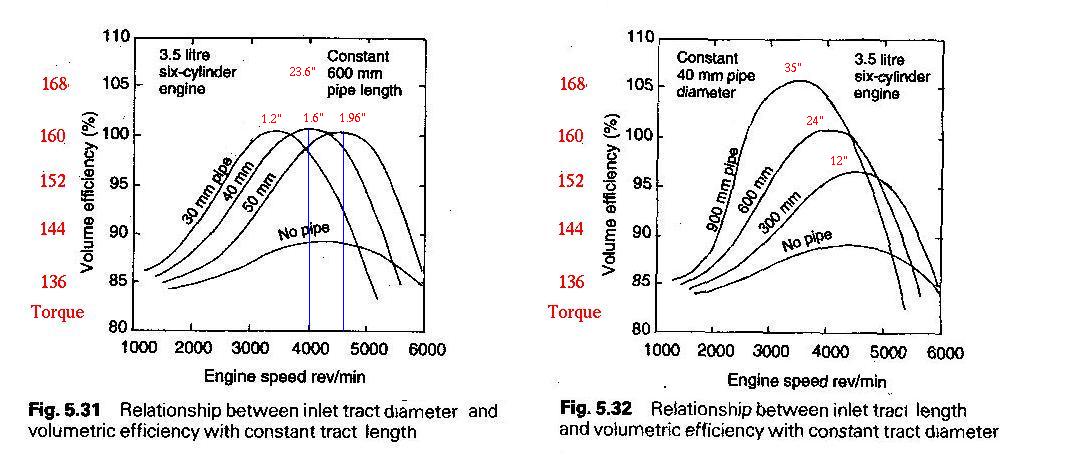
Well the diameter graph I have is for a six cylinder engine.
Here it is. I am not sure it can be exactly applied to the rotary.
I would consider it for trends and principles only.
Suzie had other parents.
Paul Lamar ...No rotor no motor.
The Rotary Engine NewsLetter. Powered by Linux.
ACRE NL web site.
http://www.rotaryeng.net
Copyright 1998-2006 All world wide rights reserved.