snips...
"torque peak is above your cruise rpm"
"peaky power curve"
What is peaky about these power curves?
We don't have a P-port with a narrow power band let alone "very narrow"
band or torque with "peaks". It is probably difficult to build a rotary
with a narrow power band. I don't know how to build one.
If you know how to build one please tell me :) I might find a use
for it :)
The Power Sport engine is using a smaller runner. Probably around
1.75 inches.
HP is well down from the 1 7/8 ID runners we used on the ACRE engine.
Max torque in the Power Sport engine is less than 200 foot pounds about
the same as ours. However power is off by 30 HP compared to the ACRE
engine.
6000 RPM is the optimum cruise RPM for the rotary. That is where the
bearing loads and the BSFC are a minimum.
Paul Lamar ...No rotor no motor.
Paul,
I'm glad this topic has come up.
I must admit I have been a little troubled about the question of
port timing and how it relates to power band.
The question of power band in a piston aircraft engine is very
important. Aircraft engines have very mild valve timing in order to
have usable power across a wide band of rpm. Even if you could do
it, putting a wild cam into a Lycoming would be an extremely bad idea.
So what about the rotary? I found some numbers on port timing on
Paul Yaw's website:
http://www.yawpower.com/dectech.html
We see here that the more aggressively ported engines have huge
amounts of overlap between intake close and exhaust open. The Mazda
factory P-port has 148 degrees. I think on a piston engine this kind
of valve timing would be considered extremely aggressive and for
race track only. (I'm no racing expert but I suspect this amount of
overlap would result in an engine with an extremely narrow power band).
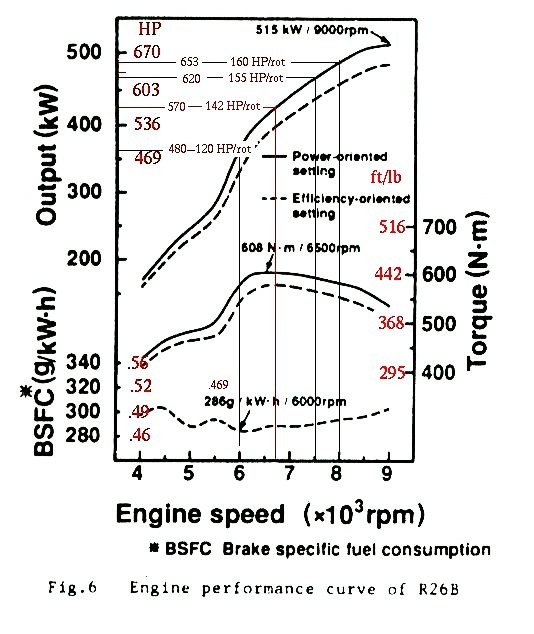
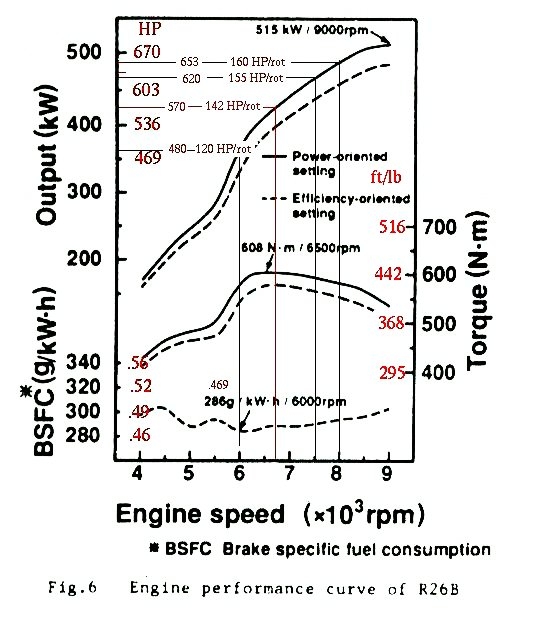
Yet, when we look at the power curve of the Mazda Lemans 4-rotor
engine, we see a fairly broad power band. This is quite amazing
really, and one of the aspects of the rotary that I don't quite
understand.
Still, if we look closely we see a fairly steep rise in the torque
curve starting at 5500 rpm, until 6200 rpm at the torque peak. From
there the torque is pretty flat until past 8000 rpm.
I don't think this is the powerband we want for an aircraft engine.
We can do better.
Now look at the Powersport curve compared to your p-port. Both
curves are flatter than the LeMans engine, but the Powersport curve
is in a lower rpm range and has a solid 20 ft/lbs torque advantage
from 4600 rpm, right through 5800 rpm. The torque is almost
completely flat from 5000 to 6000 rpm. Only past 6000 rpm does it
begin to fall off.
This is exactly what you want in an aircraft engine in my opinion.
Using the 2.85 reduction gear, the range from 5000 to 6000 engine
rpm is going to be about 1750 to 2100 prop rpm. That is right where
you want to cruise for maximum bsfc.
Also your engine will feel very much like a traditional piston
aircraft engine in that it will power up very quickly from that
middle rpm range. That's not the case with an engine with a
power band in a higher rev range.
My own thoughts are that I would use the 1.75 inch ID runner and
place it a little higher in the housing so that the overlap will be
minimized. Maybe I'm wrong on this, but I'd rather err on the side
of caution.
Btw, the Powersport engine makes 215 hp at only 6000 rpm. This is
very good power. Look at my spreadsheet that you've been dissing so
heartily...At 6000 rpm, the VE would have to be 1.16 to make 214 hp.
Don't tell me this isn't pretty near spot on. Now plug in 7500 rpm
and see wht that gets you -- 267 hp!
The Powersport gear reduction is only about 2 to 1 . That's why they
run at lower rpm. But the engine obviously is capable of making very
impressive power with a lower ratio reduction drive.
Regards,
Gordon.
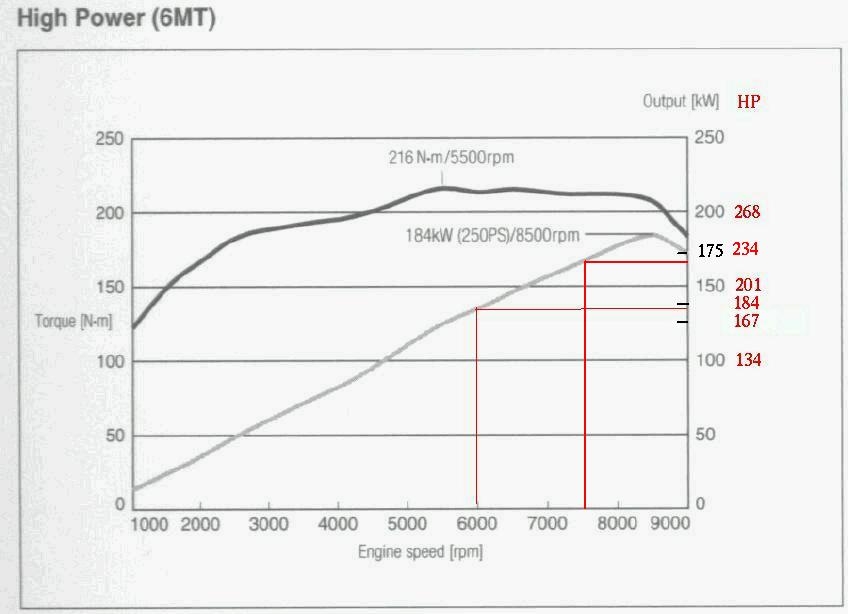
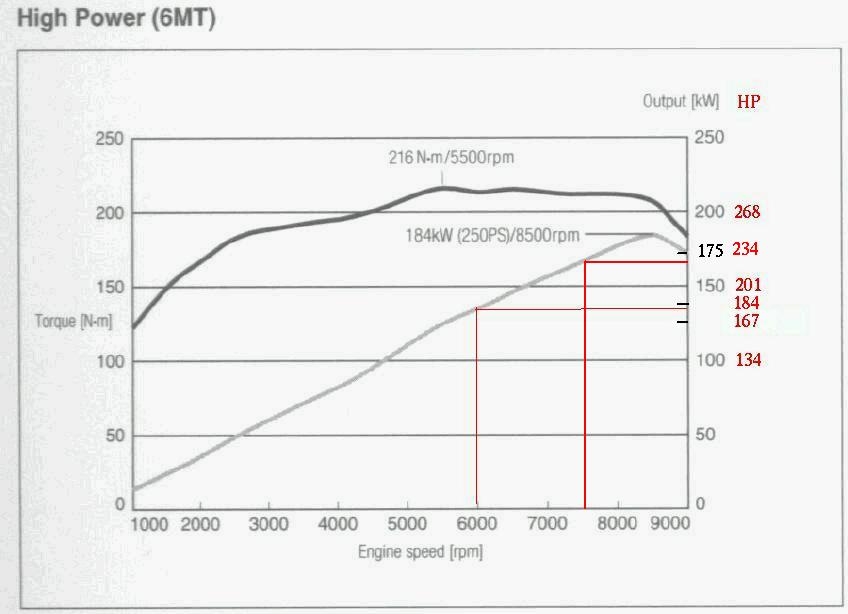
PS: I've included the power curve for the stock RX8 engine. It has a
very nice flat power curve from 3000 rpm to past 8000. I wouldn't
want to mess that up by adding lots of overlap.
------------------------------------------------------------
We are not talking about cars here. You are back to talking about
torque here. I thought you agreed. Airplanes fly on HP.
3000 RPM in an a rotary aircraft engine is idle. Totally useless.
That is a prop RPM of about 1000. 5500 to 7500 RPM is the range
of rotary aircraft engines and that is plenty broad enough.
You are projecting car results
on aircraft engines. There is a world of difference. As I said there
is a mechanical connection between car speed and engine RPM.
In a car, low RPM torque is everything for the average driver.
Especially when you want low fuel burn on the freeway and the engine
is geared to do 80 MPH at 2000 RPM. I recently mentioned all this before.
The stock RX8 manifold is a very bulky and complicated device. In effect
it has variable length runners and timing. Totally unsuited to aircraft use
as is the side porting.
The Lemans engine had variable length runners.
Absolutely useless for fixed pitch props but with
variable pitch props you can optimize the fuel burn over
a wide range of cruising speeds and engine RPMs.
Paul Yaw is focused on car engines.
I am obviously not making head way here. I don't want to
see any more messages on torque. If I do I won't publish them.
This is wasting my time and boring the readers. I gave everyone the
opinion of a true rocket scientist and aircraft designer on the
subject of torque in airplane engines and people ignored it
or don't understand it. I am sorry. I gave it my best shot.
Paul Lamar ...No rotor no motor.
The Rotary Engine NewsLetter. Powered by Linux.
ACRE NL web site.
http://www.rotaryeng.net
Copyright 1998-2006 All world wide rights reserved.