Paul,
I think everyone can agree that the rotary conversion needs a
cost-effective fuel system that does not involve spending thousands of
dollars.
When we start with a stock Mazda engine we have an immediate problem
with cowl clearance with the bulky intake manifold. This can be solved
two ways -- either fabricating a new low-profile manifold, or cutting
peripheral ports into the housing and adding a couple of tubes onto
which we can mount two motorcycle carbs.
If we don't want carbs, two runners can easily be made that loop over
the top of the engine. Similarly for the carbs, the velocity stacks can
loop over the top.
I think the p-port is a very attractive option in this regard, in terms
of time and effort -- compared to fabricating an intake manifold with
four to six runners. Plus you get a good shot of extra power in the bargain.
Now that we have air, a lot of options have been suggested for fuel --
everything from your slide throttle carb, to EFI, to mechanical
injection, to motorcycle carbs, to the picaxe with mass flow sensor (and
I'm probably leaving out a few others).
You have complained about the high cost of the motorcycle carbs. The
Mikuni HSRs can be bought new on ebay for $370 apiece. That's less than
$750 for the two. The Keihin CV 51s go for about $450 apiece.
Is that too much? How much does an aftermarket ECU cost? More than that.
Even the smallest Ellison costs $825 -- you would need two.
Now what about your ultimate DIY ideas -- the slide carb and the picaxe
computer. The slide carb sounds like a fine idea, but this is hardly a
proven carburetor. It has never even run on an engine, we don't even
know if it is going to leak fuel, much less how well it will actually
meter fuel.
Yes, with a fuel injection system, using the slide throttle just for air
is fine. But as a carb, this is a long-term development project at best.
Are you really saving anything if you spend many hours tinkering with
this and getting it to work.
And what about the picaxe? This uses the mass air sensor to meter fuel.
What happens if the sensor fails? Your engine stops, that's what
happens. At least with the mega squirt and Tracy's box they are not
wholly dependent on a single sensor. And this too is something that's
going to require a lot of hours to develop, write the code, build the
box with connections etc.
Neither of these options is even remotely realistic for the average
amateur airplane builder who simply wants a reasonably-priced engine
that is going to run dependably from the get go.
Even a megasquirt or an aftermarket ECU is not ideal, in my opinion
because it relies on the electrical system for getting fuel to the
engine. This may be fine for your car, but it is not great for a flying
machine.
I think you would be doing the whole rotary community a great service if
you concentrated your efforts on building and testing a p-port engine
with motorcycle carbs and a flywheel magneto. This would be a true
aircraft engine using proven, simple technology -- and people would then
have a viable option to a Lycoming, which is mostly what they want.
Regards,
Gordon.
Nice summary. A couple of corrections. You don't need a mass air flow sensor
with the PICAXE as you can use the same solid state manifold pressure sensor Tracy
uses. The PICAXE is so cheap ten can be bought for the price of Tracy's system.
However it requires a bit of computer expertise to use them. Same goes for
the Megasquirt but it is a bit more overkill and a lot more expensive than
the PICAXE.
I am not really serious about the dual carb system using the slide throttle and needle
valves. It would require a total redesign and much R&D. On that we agree.
Changing Doc's oblong slide for a round hole slide with the ramp system
is my leading choice. That was the very first idea way back when. That combined
with some sort of adjustable fuel pressure regulator is super simple and no
functionally different than dual Mikuni 48 mm. It uses regulated low pressure
instead of vacuum to inject the fuel. I will probably test it on the RX8 p-port
engine.
Forget smaller carbs. If you are going to go to the trouble of building a p-port why
shoot your self in the foot by going to smaller carbs to save a few bucks. I don't
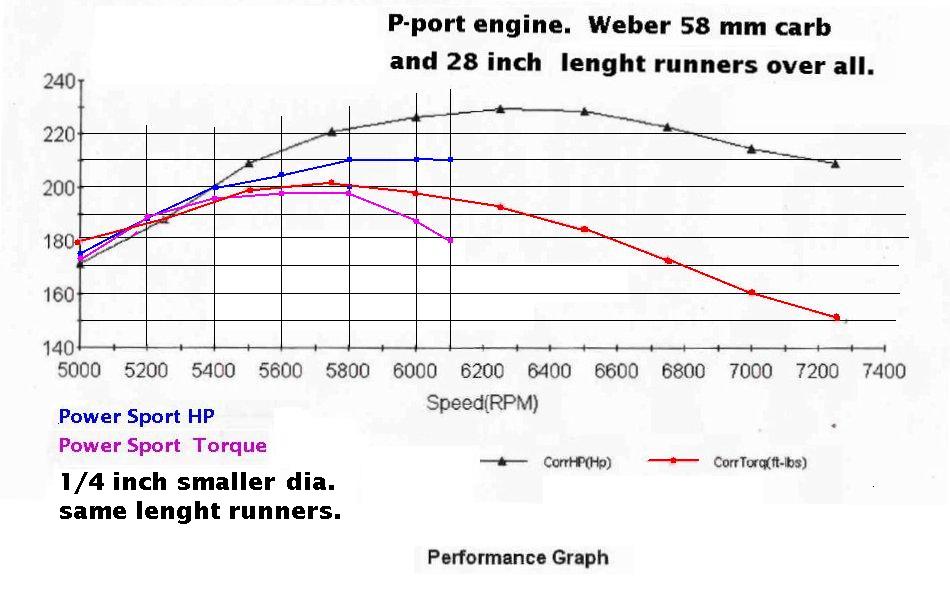
recommend any carb shy of 48 mm as you will take a big HP hit. See the enclosed
dyno chart for both the Power Sport p-port engine with 1 3/4 inch dia. 28 inch long
runners and the ACRE p-port engine using the 2 inch dia. 28 inch long runners.
Carbs also have the drawback of having to devise a way of leaning them.
The Mikuni 48 mm is also not easy to tune with several jets that must be adjusted
in size. In fact most carbs are over kill as far as the accuracy of the
mixture over a wide range of conditions that are not found in aircraft use.
One example is the accelerator pump. Aircraft engines do not accelerate
at the same rate as car engines due to the rotational inertia of the prop.
Aircraft engines spend the vast majority of the time at WOT with one load.
Starting mixture enrichment can be accommodated by increase the fuel
pressure.
BTW turn the engine over with the starter BEFORE turning
on the electric fuel pump or the engine will flood.
With Teflon O-rings the round hole slide with the ramp system will seal
perfectly however sealing perfectly may not be needed as the only way for
leaking fuel to get out is into the engine. No different than the slide throttle
with electronic fuel injection. Same situation.
Paul Lamar ...No rotor no motor.
The Rotary Engine NewsLetter. Powered by Linux.
ACRE NL web site.
http://www.rotaryeng.net
Copyright 1998-2006 All world wide rights reserved.