I calculated the air opening area of the slide in .2 inch travel
increments.
I then attempted to match the fuel flow to the slide opening area.
Roughly speaking it takes 27 .013" dia. holes variably spaced
along the tube. Each hole passes enough fuel for 4.45 HP at 2 psi so
27 holes is 120 HP per runner. 240 HP for the p-port engine.
As Ben Ellison says this causes a stepped ramp digital supply of fuel.
In other words the engine goes from rich to lean and back to rich as
the
slide moves. The problem is severe in the first one third
travel of the slide throttle. Ellison largely got around this by
using much
smaller holes and many more of them. My guess by looking at them is
they can be
as small as .1 mm or around 6 thousands of an inch. He probably has
close to 100 holes in his tubes.
BTW I can't for the life of me figure out how they can make a drill that
small but they do. Airgas sells them for $45 each.
More, much smaller holes, soon becomes a problem in a single row as
the holes
get too close together. Two or more staggered rows are used in the
Ellison.
The first 3rd are a single row. The next third is a staggered
double row and the last
third is a staggered triple row. None of this is shown on any
Ellison websites.
Of course this further increases the cost.
I talked to a friend of mine that owns an NC shop here in Santa
Paula that
has experience drilling small holes. He says there must be a close
fitting
brass rod in the brass tube or drill breakage occurs frequently. At
$45 a crack
you don't want this to happen. Then you have the problem of pressing the
sacrificial brass rod out of the nine inch long 1/8 inch diameter
tube. Not
an easy thing to do. That too requires special tooling that supports
the outside
of the tube. Perhaps this can be done better with a laser.
I can see why Ellison is charging $850 for his aircraft carbs. It is
also rapidly
talking me out of this approach. Not a show stopper yet however as I
have
yet to investigate the laser option.
-----------------------------------------------------------
I am sure this outfit can do the job. I'll know more about the cost
on Monday.
http://www.calasers.com/gallery.html
--
Paul Lamar ...No rotor no motor.
Here's some text describing the surface of the TKS weeping wing surface:
"The outermost layer of the sandwich is a piece of airfoil-shaped
titanium from 27 thousandths to 35 thousandths of an inch thick. It has
been perforated by laser-drilled holes that are 0.0025 inch in diameter,
with 800 of them covering each square inch."
Don't know if there are any challenges to laser drilling a tube.. Will
the laser pierce both sides of the tube? Would that be a problem? Like
you talked about with a conventional drill, maybe insert a sacrificial
rod inside the tube?
Matt-
I am worried about the cost. I suspect it will be too high.
BTW I happened to go by the largest pick a part
junkyard in the world in San Fernando CA. I stopped in and bought a Ford
Escort mass air flow sensor just in case this Ellison copy does not work
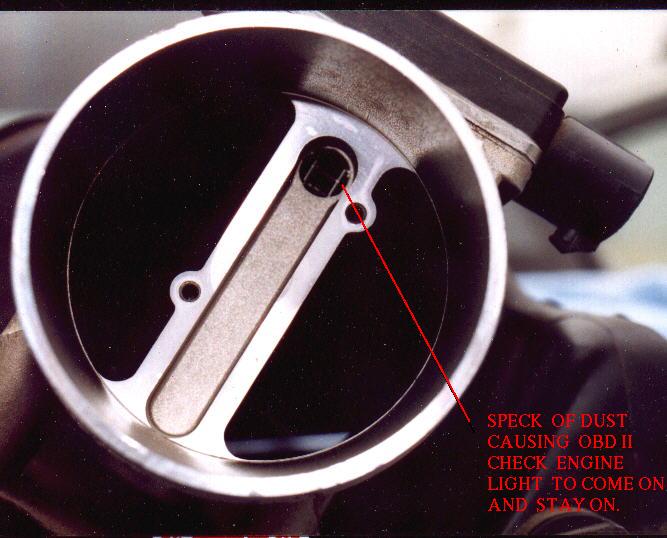
out due to the cost. I paid $39. The ID is a monstrous 2.75" ID. or 5.939 square
inches. Two 1.875 ID tubes that we are using now on the p-ports have total area
of only 5.52 square inches.
There is no better way to measure the air flow going into an engine
than a mass airflow sensor. Over 12 million of them are sold in the US
every year. There probably is not a car or motorcycle in the world
today that does not use a mass airflow sensor. If I wanted the sensor
alone without the housing it would have been $5.
Manifold air pressure alone becomes less
sensitive as the throttle becomes wide open. Throttle position is not
the whole story as the throttle can be wide open and the air density
low. A venturi is a sensor device that works well but there is a manifold
pressure and airflow loss through a venturi. Venturis are great on carbs because
they do double duty. They sense the airflow while at the same time
sucking up fuel from a float bowl. Unfortunately suitable carbs for
p-port engines are too expensive at around $500 each.
That brings me back to the PICAXE system using a mass air flow sensor
instead of a manifold air pressure sensor like Tracy uses.
I am going to check on the cost of drilling a bunch of tiny holes
in 1/8th inch brass tubes and if that is too expensive I am going
to do more R&D on the PICAXE system controlling the fuel pump directly.
The mass airflow sensor can be mounted almost anywhere in the system
and two can be used for a modicum of redundancy. One for each runner.
They are best placed at the intake end of the runners.
The large one I have I would use on the intake to the plenum just like
it was used on the Ford Escort. I'll have some more pictures on it
tomorrow as I forgot to bring my camera.
Paul Lamar.
The Rotary Engine NewsLetter. Powered by Linux.
ACRE NL web site.
http://www.rotaryeng.net
Copyright 1998-2006 All world wide rights reserved.