> Paul,
> Is there any effect on the metallurgy of the liner due to the heating
> during
> the welding process that could adversely affect the apex seal sealing
> and or
> wear?
>
> Joe Berki
> Limo EZ
>
> I can't detect any. The apex seals cannot seal in this area as they
> are wide open on both sides as they pass over the intake port.
> That is why the differential pressure from chamber to chamber is
> zero in this area. Tig welding is a very localized heating process.
> Obviously the steel must be heated to melting temperature but
> a few hundreds of an inch away the aluminum is not melted.
>
> This process flies in the face of intuition. The metal has a
> worse time of it down by the peripheral exhaust ports where
> the heat can be 1800 F for thousands of hours.
>
> Paul Lamar ...No rotor no motor.
>
> Paul,
> I do question the fact that the welding process causes the inclusion
> of chromimum. The hard chrome process which coats the liner will be
> fused into the weld. This could cause a brittle weld. There may
not be
> enough inclusion to be a big factor but very small amounts can change
> the metalurgy. I'm not chemically astute enough to tell you how much
> might be needed to cause a problem.
> Bill Jepson
>
> Yes it changes the 304 Stainless Steel or mild steel to chrome
molly :)
> If you start with 4130 tubes you get chrome chrome molly :)
>
> What do you get when you weld mild steel to SS?
>
> Answer: No problems:)
>
> What do you get when you weld mild steel to 4130?
>
> Answer: No problems:)
>
> There is near zero load on the tube and it never gets over 200 F
> if that.
>
> We are not talking about stressing the part to 65,000 psi.
> It will be lucky to see 600 psi.
>
> Paul Lamar ...No rotor no motor.
Bill, Paul
What is the largest P-port across you have seen? Here is the
challenge as I
see it. If you want a Leman style 2 inch ID port then that is 50.8mm
(close
to 51mm)
If the SUS 304 pipe goes all of the way through and has a wall
thickness of
1.5mm or 0.06" then that will bring the outer edge of the insert to
54mm in
diameter. Assuming an expert weld in the widest part of insert then
about 1
mm on each side of the insert will be added. This welded area will be
harder then the rotary housing wall because of chrome migration during
welding. Buffing the weld out it will widen the port even more. Softer
metal sands faster. OK you have a super technican perform the
operation and
mask carefully. Still it is conceivable that the widest unsupported
seal
area will be about 57 to 58mm wide. That leaves 11mm on each side to
support the seal in that area. Is this enough?
Doug
Well first we are using 2 inch OD .065 wall (but I am thinking I will
use .049 wall on the RX8 engine) 2 inches is 50.8 mm The housings is
80 mm or about
14.6 mm each side to support the apex seal.
The peripheral exhaust port used in the millions
for 35 years or more has about .7 inches or 17 mm on either side.
So far 14.6 mm seems to be enough but make it less at your own risk.
I am thinking of using 2 inch ID 2-1/8 OD tubing but only beyond the
slide throttle. I will then have a slight venturi effect for
the mechanical fuel injection.
--
Paul Lamar ...No rotor no motor.
Does anybody have a plot showing contact pressure between the apex seal
and housing as it traverses the housing? I would guess that the highest
pressures are seen immediately after the combustion event - kind of like
rings in a piston engine maybe.
Matt-
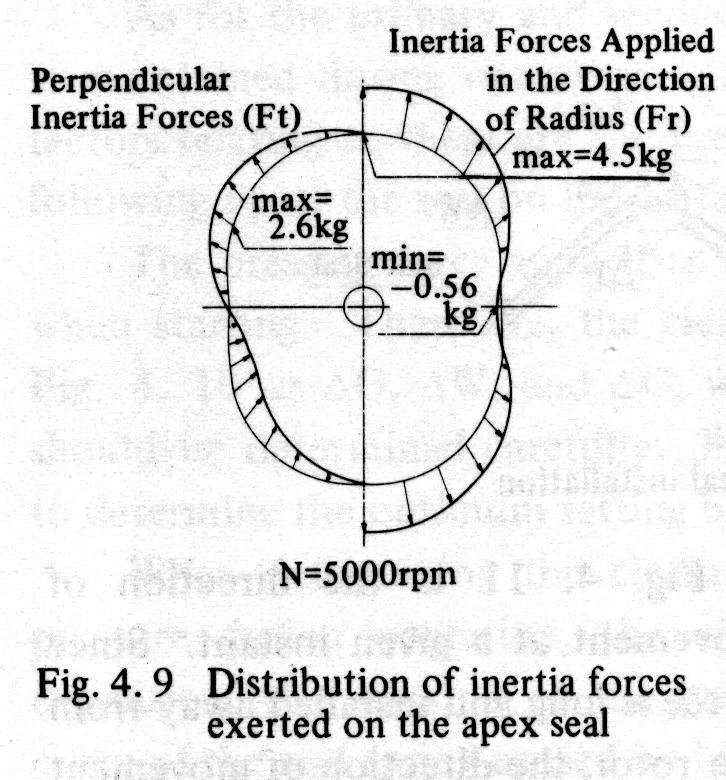
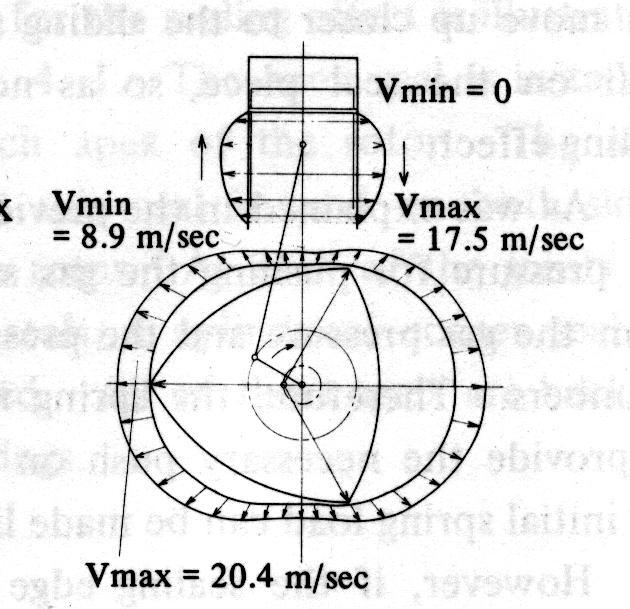
Yes here is some data on that subject.
The neg radial forces are called "jumping over the hump"
and are overcome with spring pressure.
This scan is from:
* This book on the rotary is also called "ROTARY ENGINE"
by Kenichi Yamamoto published by Sankaido Co. Ltd.
Second edition published in 1981. This is an updated version of
the first "ROTARY ENGINE" book. Confusing eh what? This book
has a much greater emphasis on emissions.
Which you can download in pdf form from:
http://www.wankel.net/~krwright/cars/rx7/manuals.html
Paul Lamar ...No rotor no motor.
The Rotary Engine NewsLetter. Powered by Linux.
ACRE NL web site.
http://www.rotaryeng.net
Copyright 1998-2006 All world wide rights reserved.