than 11,000 RPM. That of course does nothing for you. This is an
over
simplification of course so unless you dyno this engine no telling
what
is going to happen.
I WILL say you will not get as much HP at 7500 RPM or 6500 RPM as
you would get if you had just four long pipes of the right
length,
a plenum
and this throttle body.
You want the torque peaks in the 5500 to 6500 range. That yields
the
best cruise BSFC and the best power in the 6500 to 7500 RPM range
for aircraft
use. You get that with the pipe lengths in the 25 to 28 inch long
range. These
numbers are also somewhat dependent on the inside diameter of the
pipes. A
smaller dia. pipe moves the torque peak down. Larger pipe dia.
moves it up.
Matt put it very succinctly awhile back but I lost the message.
Do you remember that Matt? Can you upload it again?
BTW NACA ducts are not recommended by NACA engineers for carb air.
You need a true ram air scoop.
Paul Lamar ...No rotor no motor.
Steve,
I can't see into the TB throat very well, but it appears there is a step
just past the butterfly. If that's the case I would try to get that
smoothed out as much as possible to promote good airflow. Just an
observation.
Mark St.
Thanks to all for your input.
I am prepared to start over if there is any doubt that I will not get
the 160 HP to 180 HP @ 6,500 RPM that I am looking for. I think that I
am hearing some doubt. If I really clean up the inside and provide all
the air it wants is there any chance I will be happy with it?
Also this airplane was setup for a carburetor originally. Since I could
not get a return line to the fuel tanks or the header tank I found a
dead end regulator from Marren Fuel Injection that requires no return
(it is clearly seen in the photos). Is there any reason to be concerned
with this setup?
Thanks,
Steve
160 HP should not be a problem.
--
Paul Lamar ...No rotor no motor.
Paul,
Okay, I can't stand it! I have a beautiful airplane almost ready to fly
and I don't want to skimp on the power plant. I ordered what I think I
need to build the runners and dynamic chamber, but now I'm not sure it
will all fit under the cowl. How important are size and shape of the
chamber? and I am shooting for 28inches on the runners right? How about
the significance of where I install the injectors?
Sorry I'm a pest!
Steve Denny
No problem Steve. I'll work with you until you have something you like.
Thats is why I am here.
Forget the dynamic chamber. The runners would have to be only 12 inches long
as that is probably very difficult to convert to actual hard ware.
The Mazda versions are designed for torque at 3000 RPM which is useless
in an aircraft. Use some 2 inch OD tubes on the outer ports
and 1-3/4 OD or 1-7/8 OD on the two center housing ports. Make
them about 28 inches long but design it so you can change the length
a few inches one way or the other. Put a plenum on the end.
If you use a 4 inch round tube plenum and weld the runners in you get
a fair transition so you may not need trumpet mouths on the
ends of tubes where they enter the plenum. Your throttle body
looks fine. Cold ram air is very important. However if you
have a dusty runway you will need a filter some place.
The injectors can go anywhere. There has been reported a slight
BSFC advantage if the injectors are mounted out near the plenum.
Others say no.... mount them close to the engine.
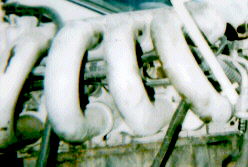
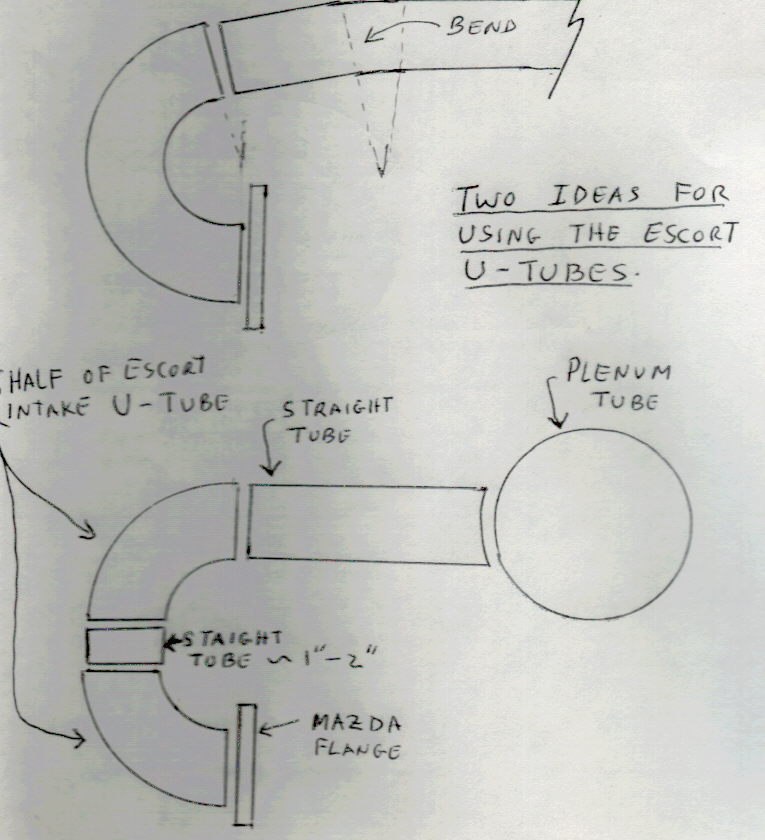
This Ford Escort manifold is the right idea but the runners
are too small.
Put a power bulge on the cowl if necessary :)
Paul Lamar ...No rotor no motor.
The Rotary Engine NewsLetter. Powered by Linux.
ACRE NL web site.
http://www.rotaryeng.net
Copyright 1998-2006 All world wide rights reserved.