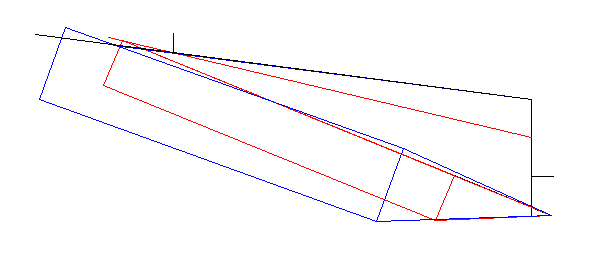
Some history on my installed rad, from a previous writeup. The
volume of
the core area of my rad is around 422 cubic inches, plus the 27 cubic
inches of the cabin heat rad plumbed to the heater port:
Originally I had probably the smallest installed rad volume of anyone
flying a rotary. I was running the stock porting '86 NA 146HP
engine to
about 5400RPM cruise, less in climb, probably only developing about
120HP. I have a 1 x 3 x 9 (27 cubic inches) cabin heater core
plumbed to
the engine heater port that bypasses the thermostat. My main rad
during
the low power period had overall dimensions of 2 x 13W x 17L, with 2"
being the thickness of the tanks. The actual core was more like 1.25"
thick. So the core itself was 13 x 13 x 1.25 or 211 cubic inches. I
donot have a coolant temp readout in degrees. I have the actual
instrument panel gauges from the 1986 RX-7 installed in my
airplane. In
the 2nd gen RX-7 the normal coolant temperature is about 1/4 to
1/3 up
from the bottom of the "normal range". Because of the thermostat it
never varies from this in the car unless there is something wrong,
like
a coolant leak and resulting loss of coolant. With my original small
rad, I did see elevated temperatures on hot days during extended
climbs,
the gauge would indicate about 2/3 the way up in the "normal"
range. It
would not run away or go above this level. I've never bothered to
find
out what the upper and lower limits of the RX-7 gauge are in real
Fahrenheit temperatures, but that data can probably be easily
obtained
from the maintenance manual, other sources, or testing the stock
sensor/gauge against a thermometer.
After converting to PSRU/prop December 2004, I could now rev the
engine
to 5400 RPM in climb and 6400 in cruise with my fixed pitch prop.
Anticipating more heat with the additional power, before summer
arrived
I installed a new double-pass rad that doubled the core volume of the
original. Two 2" tanks at the front, one 4" tank at the rear, and
two 13
x 13 x 1.25 cores in between. Now, on the hottest days I can climb
full
power with no limit on duration, and the temperature indication never
budges from the 1/3 point on the gauge. Just like in the car!
So about 450 cubic inches of radiator core will be more than
sufficient
to cool your 146HP rotary. Scale accordingly for more installed
power?
Paul Lamar ...No rotor no motor.
Paul,
That double row core, does it have an air gap between the cores and
if not,
would a gap, say 1" be something which is good or bad. I suspect it
would be
good as this gap even at 1/4" to 1/2" would help balance the flow
through
air pressure.
I have been toying with an idea of a round radiator that would sit
behind
arm pit scoops, into cowl bulges or be suspended from wings like
remote fuel
tanks. The problem would be the manufacturing of something like this.
George ( down under)
It must have some gap or heat would be transferred from the hot
side to
the front side which is not what you want.
The gap can be 1 inch but probably 1/4 inch is all that is required.
I talk about cross counter flow rads in my book.
I don't know what you mean about balancing the air flow.
What goes in the front comes out the back. Matter (air molecules) can
neither be created nor destroyed except in a nuclear reaction.
Paul Lamar ...No rotor no motor.
I have a double core C & R radiator that has .625" space between the
cores. C & R did a lot of testing to determine the optimum space.
Jerry
Can you take some pictures for us?
I'll believe the 5/8th inch when I see the raw data. Sounds like a
marketing ploy to me.
That is probably the only way they could build it.
I think they got the idea from Al Gietzen who got it from Fred Mareno.
I was publishing stuff from Fred on it as far back as Oct 1999. The
only rad guy I
contacted with the idea was Ron Davis as I recall.
Do you recall Al if you contacted C & R?
-------------------------------------------------------------------------------
-------- Original Message --------
Subject: Cross counter flow rads.
Date: Mon, 07 Aug 2000 07:50:08 -0700
From: Paul <rotaryeng@earthlink.net>
> > A cross counter flow rad is one in which hot coolant is first
> >passed down the back side set of tubes and then up the front side
set of
> >tubes in a two row rad configuration.
>
Al Gietzen wrote:
>
> If you can find someone to make this configuration, at a reasonable
cost,
> let us know. The only radiator builder that I went to for quotes
that would
> even said they could do it was Griffin. I specified that
configuration when
> I ordered the radiator, and what I got was was conventional
two-pass. When
> I called them I was told they couldn't fabricate the end tanks with
the
> baffles in the 'long' direction.
>
> Al
Two thin one row cores back to back will work Al. It is an advantage
but to some
it may not be worth the extra hassle. Best to get stock cores and find
a good welder and have them made. I have some friends who own a rad shop
up here in Santa Paula. I will see what he can come up with for one
row cores. We also have a few talented welders up here.
Paul Lamar
The Aircraft Rotary Engine Newsletter. Powered by Linux.
http://home.earthlink.net/~rotaryeng/ http://www.linux.org
C&R built mine from drawings I sent them. The tanks are about 2" thick
and the cores are standard, I think 1.25" thick. Might be metric.
This would make the space between the two cores approx. 0.75".
Perry
When did you send them dwgs Perry? I know it is in the airplane
but did you take any pictures before you put it in there?
Paul Lamar ...No rotor no motor.
I installed the psru and prop December 2004. I knew I need more rad
since I was developing more power, but it was fine for the winter. I
ordered the new rad early 2005. I sent them the 3D view that you have,
with overall dimensions of 13.5 inches wide by 17.5 inches long. The
ports are 1" NPT, on the right side forward faces of the dual tanks at
the front. Ideal for connecting to the waterpump, as shown on the page
http://www.bridgingworlds.com/LEZ13B/LEZ13B.htm. I know it took them a
couple months to get started on it, they said they were busy. By
April-May 2005 I had to call them a few times to get it moving, as I
wanted it installed for summer flying. I think I received it by May 17
2005 because I have a sketch drawing with that date (screen capture
attached), showing how I had to make the inlet ramp much longer, and
move the rad aft, because the overall rad thickness increased from 2" to
4". Unfortunately I didn't take any photos at the time, I was in a bit
of a rush to get it installed because of the warm weather and a trip to
Kansas July 2005. That was the last engine install mod made, pretty much
just been flying it ever since, only maintenance now. 660TT, 500SMOH.
Perry
Ah Ha so that is where they got it :)
Paul Lamar ...No rotor no motor.
The Rotary Engine NewsLetter. Powered by Linux.
ACRE NL web site.
http://www.rotaryeng.net
Copyright 1998-2006 All world wide rights reserved.