The first production run of slide throttles is complete. I will be
shipping them out starting next week. As soon as I do, I will post some
pix of them.
The machinist has the drawings for the 20B slide throttles. I expect he
will be making a prototype sometime in the next week or two. Any
interest?
Doc Custer
Retired Software Engineer and sometime Audiologist
Here is what it looked like at Sun n Fun.
Paul Lamar ...No rotor no motor.
Those are the prototypes. The production models are lighter by removing
the
rectangular end and making it rounded. Also slightly shorter. And the
cover
plates are now 0.125 instead of 0.250, a good saving.
Anodizing is optional.
Doc Custer
Retired Software Engineer and sometime Audiologist
If you don't mind Doc I am going to make a new Teflon
slide and use your housings to test the mech fuel injection
on the p-port RX8 dyno engine. Other than a couple of 1/16th holes
in the spacer nothing else will be modified.
Paul Lamar
OK with me. I have thought some on this. Here are some of my thoughts.
The Teflon has a much higher coefficient of expansion than AL. I found
that
the Teflon expands 0.02 inches in 2.5" more than the AL when heated to
200F.
I would recommend that you reduce the width of the slide to permit this
expansion and install springs between the edge of the slide and the inside
of the spacer so as to force the slide up against the fuel hole. This will
allow a better seal between the top of the slide and the point where the
fuel enters the slide throttle. Of course it would be better to enlarge
the
spacer and covers, but that means a whole new throttle. Maybe you can put
the springs where they won't interfere with the induction holes.
I also used 0.01" total clearance between the slide and covers, i.e.,
0.005
on each side. This amount is for heat expansion and the Teflon tends to
curl
slightly and without this clearance the slide tends to be hard to move,
especially when hot. This gap may not interfere with the sealing of the
fuel.
The Teflon I get varies in thickness from batch to batch, even though it
is
all 3/8" nominally. I specify the clearances and provide the Teflon to the
machinist, so the spacer thickness varies from batch to batch. I think the
Teflon in the throttle you have is 0.400" and there is no clearance built
into the spacer, so Teflon 0.390" would be good, if you can find some. I
think the side clearance is not critical as long as there is enough for a
pure throttle. A carb might be different.
Incidentally, coarse 3M scotch brite works great for deburring Teflon
after
machining. It doesn't tend to gouge like a deburing tool.
Good luck. I think you will have a difficult time with sealing.
Incidentally, my machinist friend needs a carb for his truck. He is also
thinking of doing what you propose, only with a single hole. I'll let you
know what he finds out and vise versa.
Doc Custer
Retired Software Engineer and sometime Audiologist
Good advice. Thanks Doc.
Well if worse comes to worse and I don't have room for a race track
shaped groove and Teflon O-ring around the slot I could go to a 1/2 inch
thick slide. I was thinking of a flat or wave spring, like the apex seals,
under
the Teflon slide.
BTW the O-ring groove is not shown yet in these 3D's.
Why don't you guys fly cut the Teflon to all the same thickness?
Paul Lamar ...No rotor no motor.
I asked the machinist why he didn't surface mill or grind the Teflon. It
seems the Teflon "crawls" in the tooling because it is so soft even with
light cuts. The softness also causes clamping problems. He made a special
"jig" - he called it "tooling" to prevent this effect. The results speak for
themselves - a precision part.
The art of being a machinist is the shop knowledge of what tooling is needed
to hold the work piece and how to make it if it isn't a stock piece of
tooling. It is bad news if the work piece shifts in the tooling or bows up
or ... well you get the idea. Especially if it isn't repeatable. Teflon
crawls erratically. I once had a lathe and a mill and my results were circa
1940, not what I wanted. So I decided I would be a really good software
engineer and let the guys who know what they are doing be the machinists. I
did like making parts though. I am still tempted to buy another lathe ...
Oh, well.
The kind of spring I was thinking of is shaped like a recurved bow as in
archery. Put two or three in the bottom and they will force the Teflon up to
help seal the sliding joint.
I hope the O-ring works. And you have a lot of success. How are you going to
deal with the left over fuel in the system after the engine shuts down?
Maybe a positive shut off valve right at the slide throttle?
I know my machinist is interested in the problem. As I mentioned previously,
he plans on making one for his truck instead of buying a new carb. Would you
like to be put in touch with him?
Doc Custer
Retired Software Engineer and sometime Audiologist
There are several ways of machining soft thin material.
One is a vacuum plate. Another is double back adhesive tape which
of course will not work with Teflon.
IMHO a vac plate would work with a couple of large diameter locating
pins that just fit in the 1.875" diameter holes in the Teflon. Tooling :)
I have a vac pump.
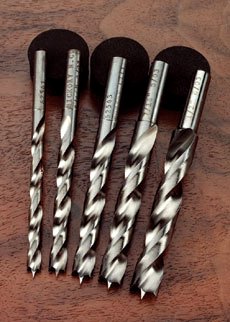
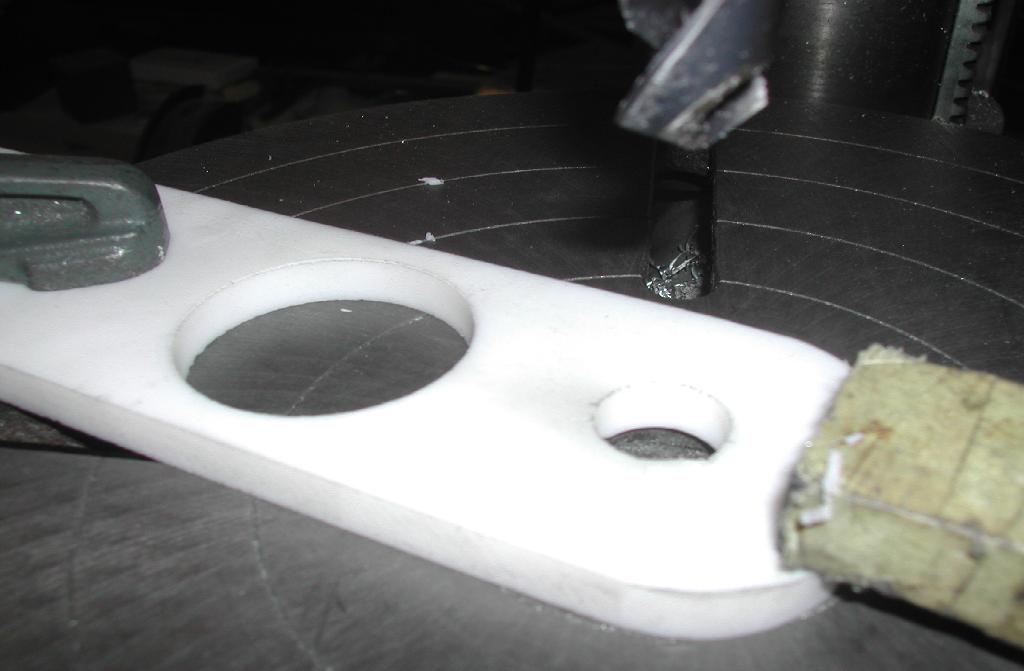
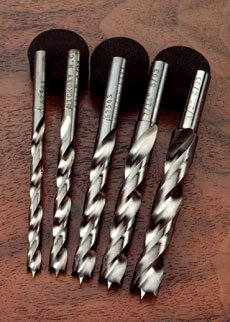
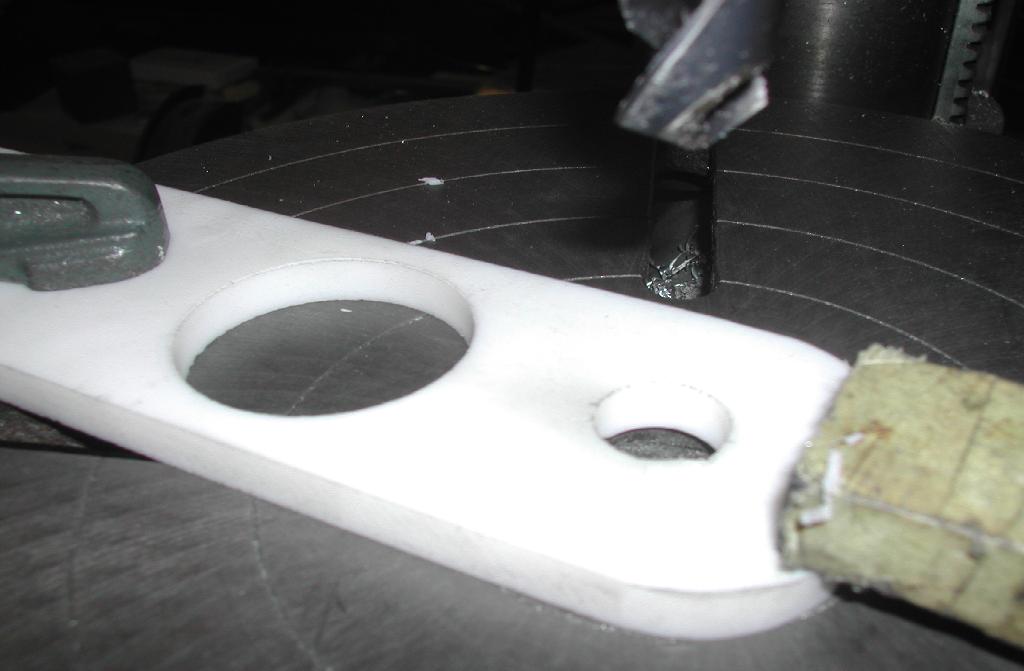
I had a few problems myself. Here is what I did. Somebody recommended
Brad point drills. I suspect the shape of the cutting tool has
a lot to do with it. Larry do you have any ideas on cutting
Teflon?
I think I will shut off the fuel pump and let it run out of fuel.
--
Paul Lamar ...No rotor no motor.
The Rotary Engine NewsLetter. Powered by Linux.
ACRE NL web site.
http://www.rotaryeng.net
Copyright 1998-2006 All world wide rights reserved.