Andy,
Good analysis! My new 1800 Suzuki is a high compression MC and after
initial
wear-in with a good quality mineral oil, they switch to a synthetic
blend.
Advice to me that full synthetic is wasted in anything other than racing
application.
So what's regarded as a synthetic blend i.e. what is in this type of oil.
George ( down under)
Hi George,
Unfortunately there's no formal industry definition of what constitutes a
'synthetic blend' oil. We as customers really don't know what's in the
blend...and marketers generally don't want to tell us. That's the short
answer...
Entering geek-land...
Quick background - Group I, II, and III oils are refined petroleum. Each
gets more processing. Group IV is 'man made synthetic' PAO. Group V is a
'catch all' that includes a number of petroleum products, and includes the
ester-based synthetics (like the polyolester used for jet engine lube).
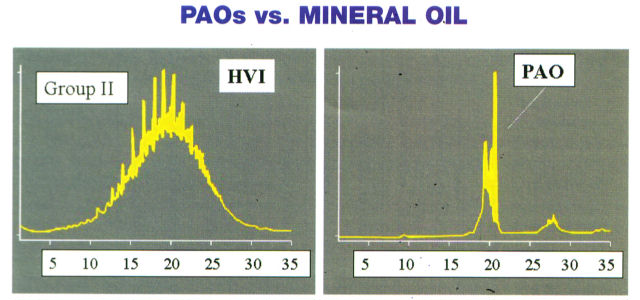
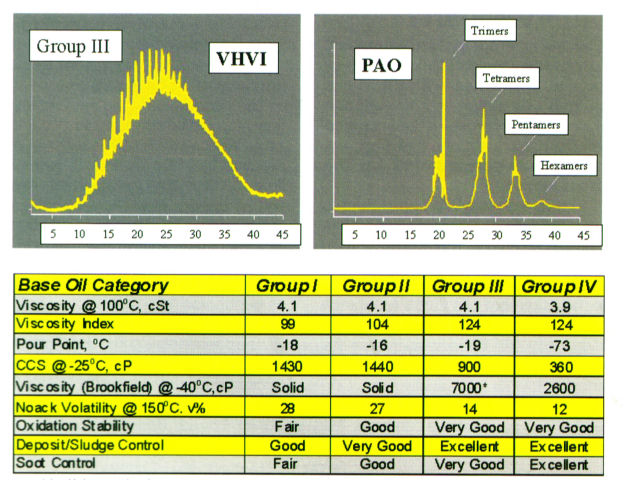
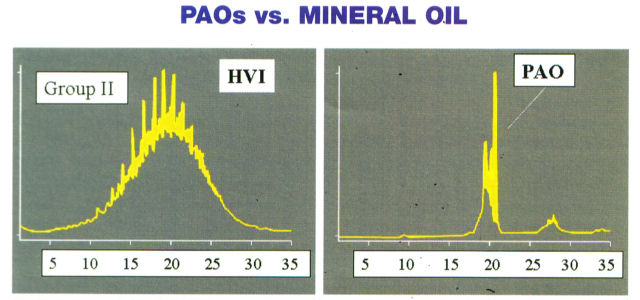
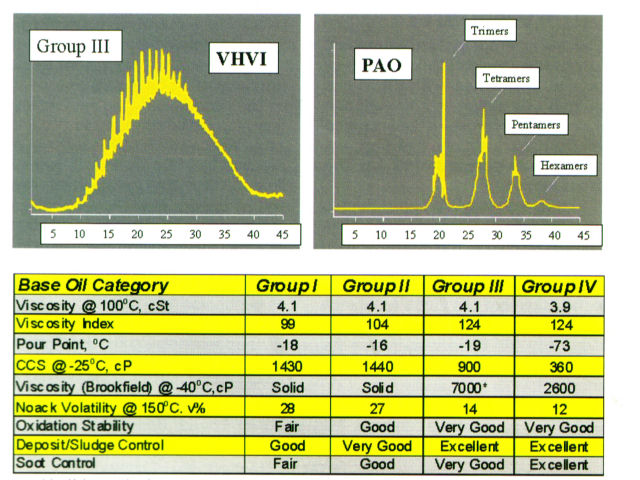
(Group III performs better than petroleum, but not as well as PAO or ester.
The pictures give a better comparison.) Formulated oil is about 70-80% base
oil and 20-30% additives. The additives (detergents, dispersants,
anti-wear/anti scuff, acid control, viscosity improvers, pour point
depressants, etc.) are blended into a carrier oil. Generally, we're only
talking about the base oil when talking about petroleum, blend, or
synthetic.
In North America, a product labeled 'synthetic blend' can be up to 99%
petroleum fortified with as little as 1% of Group III, PAO, or ester. The
best blend I know of on the US market is about 20% synthetic. To add insult
to injury, some companies are using pure petroleum base oil and selling the
product as a blend because the additives are 'synthetic'...gotta love
marketing...
In the rest of the world, a blend is usually any combination of Group I, II,
or III, that's fortified with some amount of PAO or ester (or both). Group
III isn't considered synthetic outside of North America.
Man-made synthetics have uniform molecular structures and are tailor-made
for their purpose. They have no impurities or left-over substances to
degrade their performance. Petroleum has a wide assortment of molecular
structures. Oil flowing thru passages tends to stratify by molecular size.
Uniform fluids tend to have a more turbulent flow. The 20 to 40 degree
cooler temperatures seen in gearboxes running synthetics comes from a
combination of lower friction (less generated heat), and that the turbulent
flow is better at moving heat away from bearings and gears and carrying it
to the case or water jacket.
Marketers will often push a customer toward a blend because, while there may
or may not be any performance improvement, there's generally more profit on
the blend.
Thanks George,
Andy Hecker
The Rotary Engine NewsLetter. Powered by Linux.
ACRE NL web site.
http://www.rotaryeng.net
Copyright 1998-2006 All world wide rights reserved.