> SCROLL DOWN TO READ IT ALL.
>
> I was unable to get the slide throttle to run without surging at low
> idle settings w/ Tracy Cooks ECU. gigo I figure taking more samples
> would give me gigigo.
> I would like to contact anyone out there who is actually running a P
> port engine to swap info.
> I next tried a throttle body located away from the engine and this
> solved the pulsing vacuum problem. I can run the engine above
3000 rpm
> w/ no surges but below 3000 rpm the engine surges and runs rough no
> matter what the mixture setting. Is the p port able to idle and
who has
> one running? I know Mark has one and said it also runs rough
below 2800
> rpm.
>
> John Prendergast
>
>
> You asked this same question back on the 19th of June John
> and I suggested using a large vacuum can to smooth out the pulses.
>
> Moving the slide throttle away from the rotor housing
> won't work as it will destroy the idle and the same pulsing
situation
> applies.
> In other words the pulses of air pressure are still there.
>
> Here are some of the responses in back in June 19th.
>
> Paul Lamar
>
>
****************************************************************************
>
> -------- Original Message --------
> Subject: Slide throttle/ecu compatibility
> Date: Mon, 18 Jun 2007 15:22:27 -0700 (PDT)
> From: John Prendergast
> To:
rotaryeng@earthlink.net
>
>
>
> Has anyone used the p port slide throttle with Tracy Cook's ECU?
> After changing my engine to the P port configuration with the slide
> throttle mounted close to the engine the ECU does not work. There
is no
> good pick up point for the manifold pressure sensor hose. The hose
> connected between the engine and slide throttle gets the rapidly
> fluctuating impulses and also fills with fuel from the injectors.
> Are there any engines running with this ECU and slide throttle
set up ?
>
> John Prendergast
>
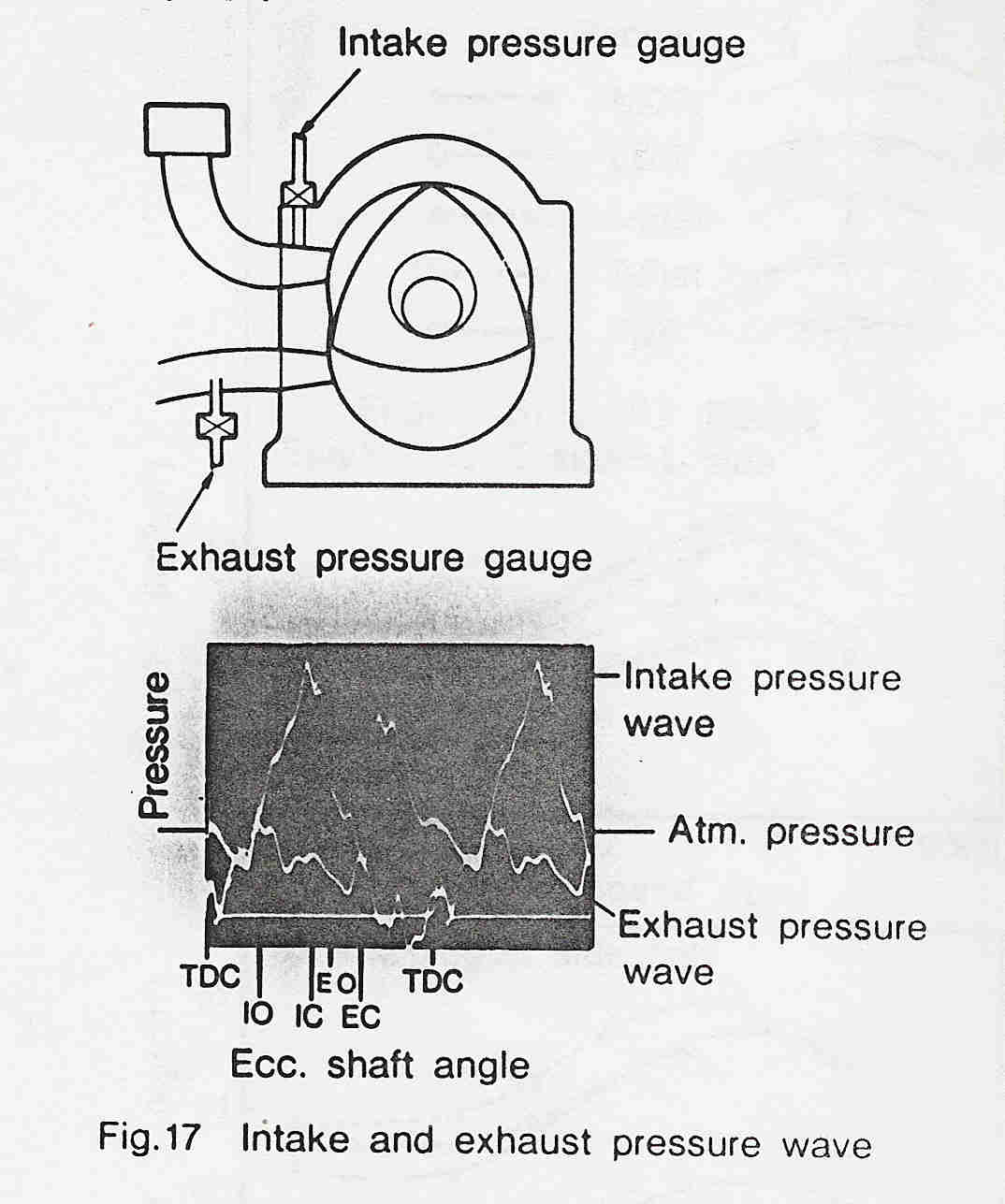
> I agree with you on the pressure waves.
> Try smaller hoses feeding into a large can located some distance
away.
> What you are interested in is the average pressure and not the
> instantaneous
> pressure. I am amazed the gage is responding that fast. Is it
silicone
> fluid filled?
>
> What size hoses are you using now?
> We used soft silicone hose which is very flexible. A restrictor
in the
> hose
> will
> also work. Drill a small pin sized hole through a piece of
aluminum or
> plastic rod
> that fits in the hose. You have got to get rid of those pulses
> as no telling what the pressure sensor is reading as it is only
> sampled for a few millionths of a second. Only Tracy knows when.
>
> The first length of the hose could or should be larger
> so capillary action of the fuel will not occur. If the hoses
> are coming out of the top of the intake tubes the fuel should drain
> back out no problem.
>
> Does the hose come off the top of the tubes? We did not have
trouble with
> fuel in the hoses as far as I could tell.
>
> Mark Su, Please check and see if you are getting fuel in your hoses.
>
> Perhaps we can talk Tracy into a mass airflow sensor mounted on the
> input to the plenum. Mass air flow sensors put out a zero to
> five volt signal just like the pressure sensors. However they have
> a long time constant as they basically measure temperature of a
hot wire
> and that does not respond to rapid changes in air flow. It
automatically
> averages out the air flow velocity.
>
> BTW what does your mixture look up table look like? Perhaps you can
> share yours with Mark Su to get him in the ball park
> as your engine is running.
>
> Paul Lamar ...No rotor no motor.
>
> ****************************************************************
>
>
>
>
> -----Original Message-----
> From: Rotary Engine [
mailto:rotaryeng@earthlink.net]
> Sent: Monday, June 18, 2007 7:34 PM
> To: AARotary Engine
> Subject: Slide throttle/ecu compatibility
>
>
> Has anyone used the p port slide throttle with Tracy Cook's ECU?
> After changing my engine to the P port configuration with the slide
> throttle mounted close to the engine the ECU does not work. There is
> no
> good pick up point for the manifold pressure sensor hose. The hose
> connected between the engine and slide throttle gets the rapidly
> fluctuating impulses and also fills with fuel from the injectors.
> Are there any engines running with this ECU and slide throttle
set up
> ?
>
> John Prendergast
>
> Mark Supinski is trying as we speak. Any day now. We had it running
> on the dyno
> but I ran out of dyno money before we got it tuned properly. The
> engine would start easily
> and run but the mixture was all over the map..pardon the pun.
>
> Since then Tracy has changed
> the computer a lot. I suspect the problem may have been >>when<<<
> Tracy was sampling the
> intake manifold pressure. He only takes one sample per rev so it is
> only a few
> microseconds long. IMHO many samples should be taken and averaged.
> The same thing
> might be possible by hooking up the two pressure taps, one from each
> rotor,
> to a vacuum can to smooth out the pulses. Slide throttles don't give
> good
> intake manifold pressure signals when they are wide open as there is
> little
> pressure loss in the intake system. That is why they make more power.
> All of Tracy development has been done with a plenum on the end of
> the tubes
> sampling the pressure just after a single throttle body.
>
> If your vacuum lines are filling with fuel something is wrong with
> where
> they are mounted. We did not have that problem. Here is a picture of
> our set up. Can you send some pictures of yours? Where are your
> injectors located?
>
> You can also try the apex oil injector ports in the rotor housings
> for a place
> to sample the intake vacuum... if any :)
>
> Paul Lamar ...No rotor no motor.
>
> The injectors are located in a similar position as in your pictures
> except the elbows go forward and then down to clear the cowling. The
> vacuum pick ups are located between the slide throttle and engine.
> I believe the compression wave generated is causing the problem. The
> vacuum gage shows such a rapid large fluctuation at the low rpm range
> that it would destroy the gage in short order and stops fluctuating
> after a short period when the hose fills w/ fuel. The ECU T's off the
> same hose which of course could not function properly with these
> conditions.
>
> The Slide throttle plate is so close to the engine that I believe the
> pressure wave bounces off the almost closed plate causing the rapid
> fluctuations and the pushing of fuel into the hose.
> With the original configuration the throttle body was farther away
> allowing a larger volume of air to modulate these vacuum and
compression
> wave pulses and the injectors were located at the engine not
before the
> vacuum pick up point as it is now.
> John Prendergast
>
> ----------------------------------------------------------
> I agree with you on the pressure waves.
> Try smaller hoses feeding into a large can located some distance
away.
> What you are interested in is the average pressure and not the
> instantaneous
> pressure. I am amazed the gage is responding that fast. Is it
silicone
> fluid filled?
>
> What size hoses are you using now?
> We used soft silicone hose which is very flexible. A restrictor
in the
> hose
> will
> also work. Drill a small pin sized hole through a piece of
aluminum or
> plastic rod
> that fits in the hose. You have got to get rid of those pulses
> as no telling what the pressure sensor is reading as it is only
> sampled for a few millionths of a second. Only Tracy knows when.
>
> The first length of the hose could or should be larger
> so capillary action of the fuel will not occur. If the hoses
> are coming out of the top of the intake tubes the fuel should drain
> back out no problem.
>
> Does the hose come off the top of the tubes? We did not have
trouble with
> fuel in the hoses as far as I could tell.
>
> Mark Su, Please check and see if you are getting fuel in your hoses.
>
> Perhaps we can talk Tracy into a mass airflow sensor mounted on the
> input to the plenum. Mass air flow sensors put out a zero to
> five volt signal just like the pressure sensors. However they have
> a long time constant as they basically measure temperature of a
hot wire
> and that does not respond to rapid changes in air flow. It
automatically
> averages out the air flow velocity.
>
> BTW what does your mixture look up table look like? Perhaps you can
> share yours with Mark Su to get him in the ball park
> as your engine is running.
>
> Paul Lamar ...No rotor no motor.
>
> -------------
> I don't have a P-port or slide throttle but had a similar problem of
> lessor
> degree. I have a short intake manifold on a 20B, with a 3-barrel
TB - one
> for each rotor. The MAP pressure ports are on the side of the
barrels,
> just
> downstream from the butterfly shaft. The secondary injectors are
in the
> TB
> just upstream of the butterfly.
>
> Three issues - the pressure pulses aggravated rough running at
low speeds,
> the MAP referenced fuel pressure regulator (sensed off the same
line)
> caused
> rapid pulses in the fuel pressure; and, I noted fuel in the MAP
sensor
> line.
> I filter the pulses by adding volume using a fuel filter, and an
orifice
> (I
> don't know how big, maybe .015). The fuel filter can is for an
> application
> that bypasses fuel back to the tank (mine is used in an older
Dodge van),
> so
> it has three connections allowing one to drain off any fuel that
> accumulates
> in the line. I have found that the fuel in the line occurred
mostly at
> lower power running on the ground. In flight I find very little,
maybe
> 1/2
> teaspoon after a few hours of flight, probably accumulated during
taxi.
>
> Al
***************************************************************************
I am running the single rotor PP with a carb. The slide is 8" from
the rotor
housing surface. Idle is at 1300RPM and stable, with good throttle
response.
MAP is unreadable at idle, inspite of having a .040 hole in the manifold
and a long hose to the gauge. MAP does read fine from 2000RPM up.
A smaller pick-up hole and a damper vessel, of may be a quart, as
Paul [and Al]
suggested, could solve the problem using MAP for FI.
FWIW.
Richard Sohn
N2071U
Paul
I have tried all the various setups that were suggested and could not
get the Slide throttle p port combo to run steady below 3000 rpm. I
tried connecting the two ports, restricting the lines, large vacuum can,
check valve. The check valve dampens the vacuum pulses but the vacuum
gage shows what is going to the ECU and does not output logical vacuum
vs throttle info as you get w/ the throttle body mounted away from the
engine.The hoses are connected on top, fuel pressure is steady 36 psi
and not connected to vacuum.
Good to see that a single rotor w/ carb works. It would be great to find
someone who has a working P port FI where I could follow there lead.
John Prendergast
*********************************************************
Check valve? Where is the check valve?
Where do you live?
Run the engine at a steady 3000 RPM, 3500 RPM, 4000 RPM, 4500 RPM
and 5000 RPM. Record the vacuum readings at each RPM. And let me know
what they are?
Do you have EGT thermal couples and gages? If so record the EGT for
front and rear rotors at each RPM.
Do you have a wide band mixture monitor? If so record the readings at each RPM.
(Run only unleaded auto fuel for initial testing and set up.)
Do you have any other kind of mixture monitor? Record that if available.
These are basic tools needed by any EFI system.
Please take some pictures of the vacuum can and send them to me.
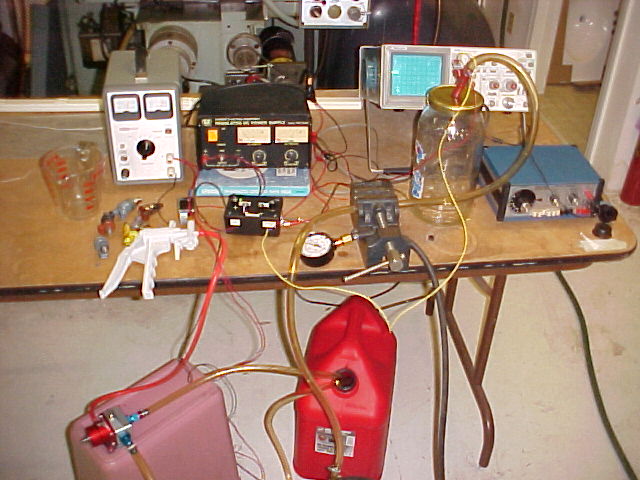
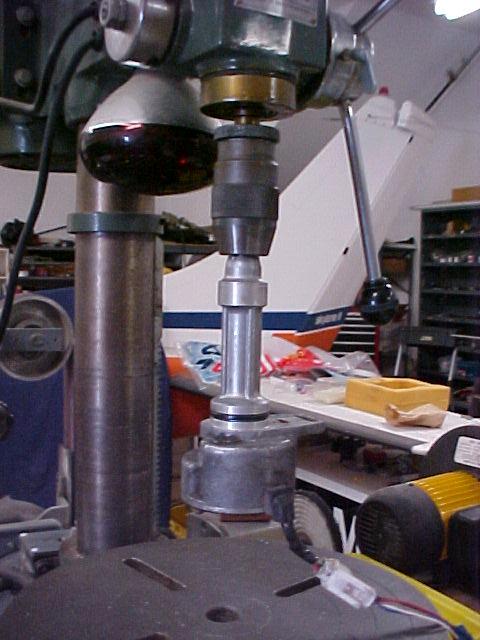
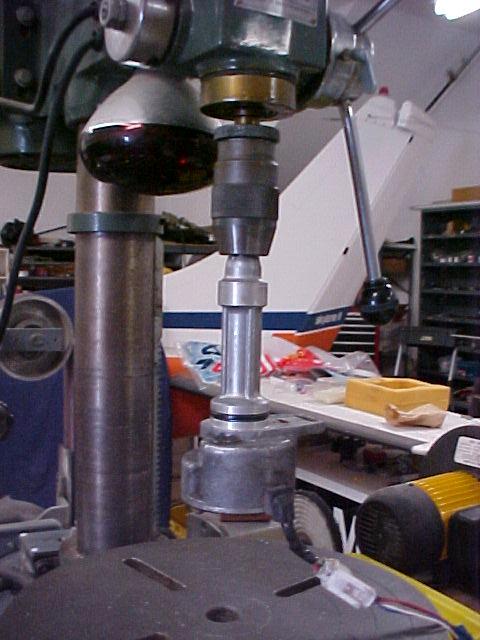
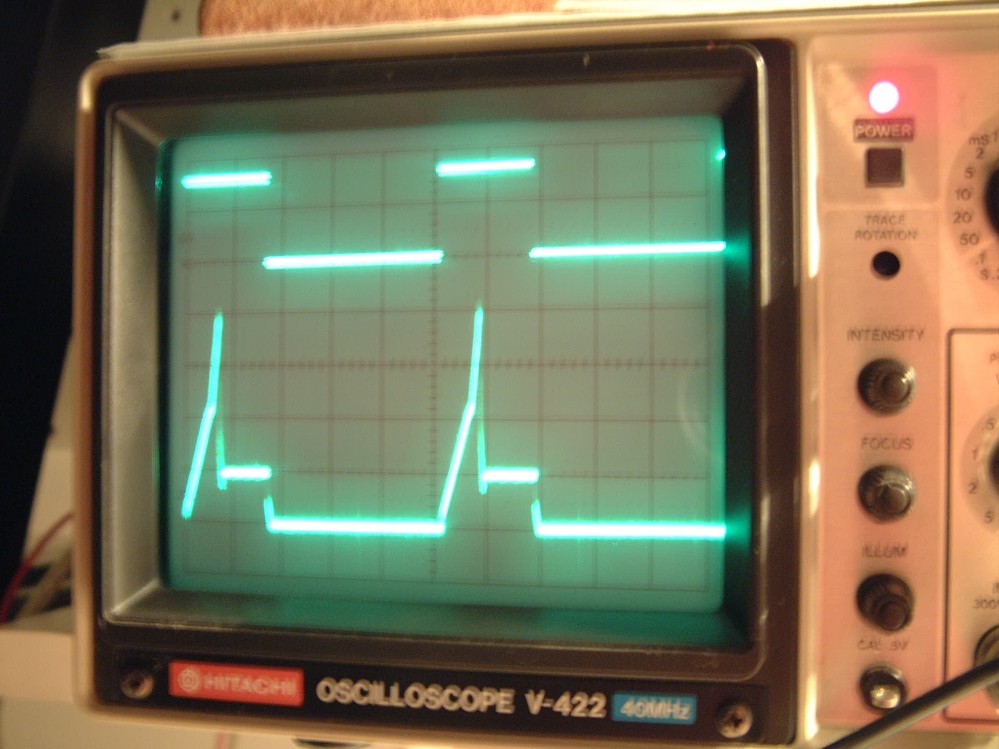
What kind of crank angle sensor are you using? You can set the
EFI up on the bench and run the 2nd gen crank angle sensor with a drill
press to simulate a running engine. Use this vacuum pump which
you can buy in any automotive parts store to simulate
the vacuum to Tracy's computer. Place the injectors shooting
into jars and measure the amount of fuel you get out of each one
of the four.
It is possible your primary injectors are defective.
If all else fails you can take the injectors off and all
the plumbing and wiring and send it to me. I'll test it for
you. Tracy won't be back in Florida for another three weeks.
I don't need the crank angle sensor as I have one.
Paul Lamar
The Rotary Engine NewsLetter. Powered by Linux.
ACRE NL web site.
http://www.rotaryeng.net
Copyright 1998-2006 All world wide rights reserved.