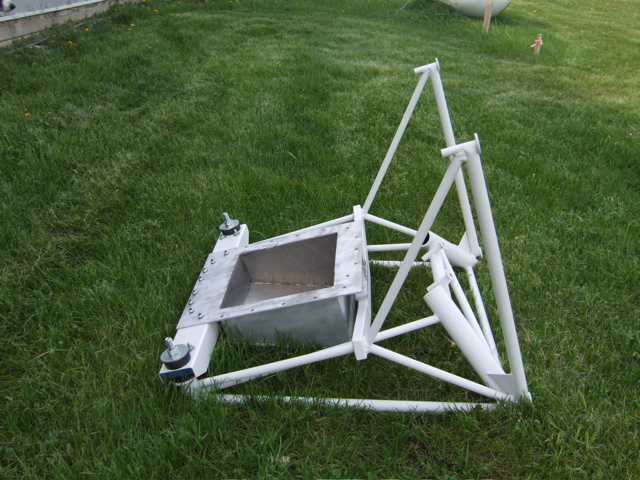
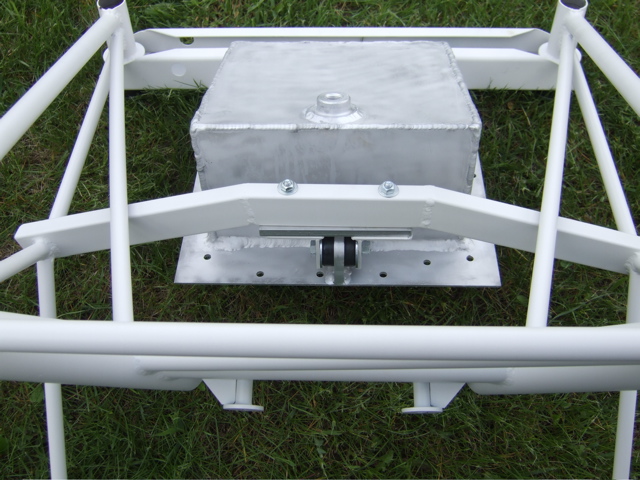
> Ken,
>
> That mount is interesting and the one that peaked my
interest the
most I
> must say. The frame behind the mounts appears super strong. I
especially
> like that you brought a pipe in tension to the Bell housing end
of the
> engine. This is good for a static down force obviously but I'm
trying to
> figure out the load paths with a side to side movement or
negative force
> stall. Correct me if I am wrong please but wouldn't the approx.
35 " moment
> still fulcrum directly at the rear rubber mounts?
>
> Doug
Hi Doug,
Yes, side loads on the engine will create side loads on the engine
'sandwich'. However, I will not routinely be performing any
but the
most gentlemanly of aerobatics so the side loads will only be
encountered if I screw up a maneuver; hopefully this won't happen
often! If this turns out to be a problem I think the engine will
develope coolant leaks rather than have a catastophic failure. I
settled on this design because a RV-4 firewall is only 24" wide
and
I REALLY needed to get the motor mount tubes away from
potentencial
exhaust pipe routing.
Ken Powell
C150 / RV-4 under construction
I know your engine mount predates the latest s-beam/rear beam
designs. Here is one for the
RV-4, (Paul's drawing of course.) It does clear a space for the exhaust.
Jerry Hey
I don't mean to be too critical but that mount is missing two
fuselage attach points and a lower cross member.
The RV-4 has two attach points at the top of the gear leg sockets
that connect to the tunnel in the middle of the fuse. That's tied to
the front of the spar and from the back of the spar runs to the back
of the passenger seat, all part of the structure. It is in tension
on landing and keeps the wheels from buckling backwards. I realize
this is in support of the Lycoming mount and this mount is different.
The lower cross member takes the brunt of the landing forces that try
to spread the wheels apart. The lower firewall doesn't have the
structure to take that load. This looks like the left gear leg would
pivot at the top of the socket with out the lower cross member tying
to the opposite side.
Just my .02.
Mike
Mike McGee, PE, RV-4 N996RV, O320-E2G, Hillsboro, OR
13B in gestation mode, RD-1C, EC-2
Mike wrote:
"The RV-4 has two attach points at the top of the gear leg sockets
that connect to the tunnel in the middle of the fuse."
Not to worry Mike they are there in the real mount.
Just not shown in the 3D.
Here are some pictures of the actual mount. You can also see the "missing" cross
tube. Usually what is done by Jerry is a stock RV4 mount is modified without touching
the landing gear part except the tubes connected to the Lycoming ring
are cut off and tubes specific to the rotary mount added. I don't always
put those stock RV mount tubes in the 3D's. Jerry knows what to do.
In the future I will make sure I put them in.
This one looks like a copy however. Jerry Hey built it so he should comment.
Actually the tubes running from the top of the leg sockets forward to the rubber
bushing cups are more than capable of taking the leg socket fore and aft loads
and transferring them back to the fire wall hard points through the top and
bottom side tubes. When a wheel hits a pot hole the mass of the engine is
a major factor so this way is actually better than feeding the loads first
into the aluminum fuselage and then back out to the mass of the engine. It is
a subtle design feature but always think of where the major masses are
and what the shortest load paths are.
Jim Griswold was very familiar with this principle and that is why the Questair
Venture nose gear is mounted directly to the bottom of the engine.
It is also why every rear engine race car in the world has the
rear springs and shock absorbers directly connected to the engine
transmission package for the last 40 years. I was one of the pioneers
in this design principle.
I am glad you brought this up Mike as it gives me yet another
opportunity to lecture on space frame design :)
Paul Lamar
The Rotary Engine NewsLetter. Powered by Linux.
ACRE NL web site.
http://www.rotaryeng.net
Copyright 1998-2006 All world wide rights reserved.