Rotary Engine wrote:
> The Speed channel commentators are now complaining that the RX8
frontal
> area is less
> than the Porsche and that is why the RX8 is ten MPH faster on the
> straight away.
But you don't get it.
Rotary engines DON'T WIN RACES -- that's GOSPEL to the reciprosaur
crowd. Therefore, when the RX-8 is faster than the Porsche, it's
because of the shape of the CAR, and has nothing to do with the
engine.
I want to see someone build a 6-rotor engine and take it to
Bonneville.
Then, after the first set of runs, pull the engine, ADD 4 MORE
ROTORS, reinstall then get back on the salt the next day.
Then do it again the NEXT day, then the day after that if necessary,
until you have a new speed record for non-turbine cars.
But the real thing that we would see is where the power/weight
curves
go. Is there a point where adding rotors becomes less effective?
Or
MORE effective?
The perfect car for this would probably look like a Tootsie Roll on
wheels! I wonder if you could get them to sponsor . . ?
Keith
The problem is the e-shaft gets torque overloaded near the back end.
Two four rotors back to back with the power taken out of the center
would work.
--
Paul Lamar ...No rotor no motor.
Keith,
The limit to effectiveness really comes from the power to weight ratio
and the built up friction of all of those seals. Same beast that piston
engines suffer from but then again they can spin them ungodly fast to
make up for it whereas the rotary seems to be limited in comparison.
Everyone,
Racing is full of politics and will always be. Big money racing is for
selling cars and if a manufacturer doesnt have a leveling playing field
then where is their incentive to even get involved. Star mazda wouldnt
be around if Mazda didnt think more RX-8's would leave the door.
As much as a like rotary engines they do have a couple significant
drawbacks that make them not as great to use in major forms of auto
racing(Formula and Prototype cars). Read that this doesn't apply as much
to road cars. They seems to be heavier than an equivalent hp piston
engine. The current gen v8/v10 engines are between 250-350 lbs loaded
for anywhere between 600-900 hp. The R26B paper I read states 400lbs for
600-900 hp. Thats a ton of weight difference that would make one think
twice about using it over a comparable piston engine. The other drawback
is the cg and cross section of the engine. Everyone always states a
rotary had lower cg but I think it is worse than a piston engine. The
crank center line of a piston engine is about 3 inches off the bottom of
the engine. The rotary is about 6. The amount of cast iron that is about
the e shaft is very significant. Also the transmission intake point on a
rotary is higher than an F1 engine. Trans masses do count to the overall
cg position worthyness. I will belive it when I see MOI data on a 4
rotor vs a F1 engine and I have my money on the F1 engine. The other big
drawback is the cross section of the engine when mounted as low as
possible. It is about 6 inches wider than an F1 engine which is a deal
breaker because of aero reasons and that isnt even adding the exhaust
setup.
I think there are many advantages but I just wanted to state that
packaging one of these in a real race car is far from being better.
Doing aluminum side and center housing would solve the weight issue but
the physical shape of the engine is very limiting in a lot of respects.
I know I quote F1 a bunch but I am referring to modern v8/v10 sports car
motors more than anything. I consider the R26b to be the leading edge in
rotary development and compared to the current crop of piston engines
the only thing that it would be up on would be its reliability. On that
note what Mazda did in 1991 was awesome but really who cares now. Cars
with less hp than that thing had would clobber it with the aero and tire
development of today so it really isnt worth comparing. The LMP2 class
is almost as fast as the LMP1 class and a modern LMP1 car will do many
seconds faster a lap than the 787. The FIA has banned anything ever cool
(Active aero, cvt's, kinetic roll control, rotary's, any Colin Chapman
idea, etc) and until it lets them back in then it will all be table
discussion.
Rob Woods
Aluminum end housing save about 50 pounds on the engine so a bare two rotor
would weigh about 150 pounds. A four rotor would then be about 300 pounds
less accessories.
The Formula one engines are extremely short stroke and the individual
cylinder displacement is tiny at around 300 cc each. Basically it is a
collection of model airplane engines. Model airplane engines were turning
20,000 RPM 50 years ago. I have a Kawasaki street bike that turns 14,000 RPM.
If you scaled down a four rotor to 2400 cc (half size) it too would run 19,000 RPM
with titanium rotors and generate 400 or 500 HP. It and a Formula one engine
would make lousy street engines. A formula one engine only has to last
two races.
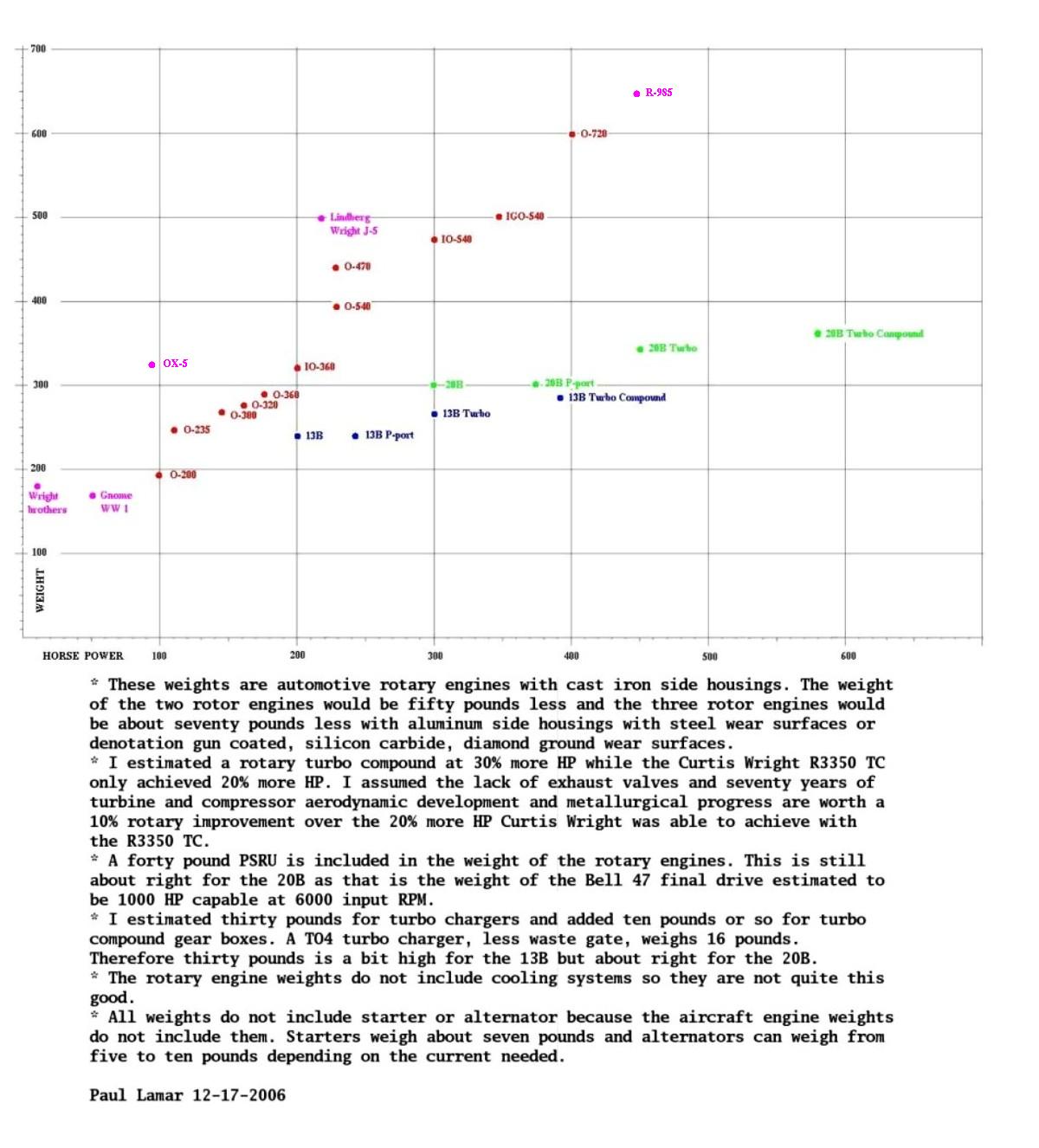
Here is a chart comparing rotary engines with aircraft engines with the
same projected life and duty cycle.
Paul Lamar
The Rotary Engine NewsLetter. Powered by Linux.
ACRE NL web site.
http://www.rotaryeng.net
Copyright 1998-2006 All world wide rights reserved.