OK, all you aerodynamicists; here?s the scoop ? what I did and what I
measured;
1 ? sealed the strake/wing in front of exit fairing - - No effect
2 ? Installed Gurney flap at back edge of exit fairing (see photo 1) ? Very
little effect.
3 ? Set up manometer to get some pressures. (photo 2)
4 ? Dynamic pressure in front of scoop, ½? from surface (photo 3) -- 9.5? at
160 mph. Nothing wrong with that. Free stream away from surface would be a
bit over 12?.
5 ? Static pressure ½? from face of core ? 3 ¼? (end of tube was pointing
slightly away from direction of flow at about 60 degrees to the flow; flow
velocity is pretty low)
6 ? Static pressure just behind the core --- 0?
7 ? Static pressure at behind exit fairing, ¾? from surface (photo 4) ? ¾?
So .. . plenty of dynamic pressure in front of scoop and only 3 ¼? pressure
in front of the cooler core. This would suggest that the scoop/duct isn?t
working.
Photo 5 is a reasonably accurate x-section of the scoop and duct. Shaping
was limited because duct entrance is right behind the spar, and by the
limited thickness of the wing root. I'm just guessing that the somewhat
abrupt curvature of the upper wall at the entrance is causing flow
separation, turbulence; and whatever.
You'll also note in photo 4 that I had cut the center section of the exit
fairing to allow exit further forward - that didn't help. I also did soap
drops on the surface which way air was going both in front of; on top of;
and behind the fairing. In all places the flow was relatively straight
back. I'm also guessing that there isn't much chance of developing a
greater negative pressure at the exit; but, hey, whatever works
All I need to know is a simple fix:-)
Al
Well two things Al. You are measuring dynamic pressure with the front
hose. It is basically a pito tube but it says nothing about what
is going into the duct. The back hose is not exit pressure.
It is being affected by air currents passing over the open end
of the tube. If you want to measure static pressure you need
to hot glue porous foam on the end of the tubes. Ordinary kitchen
foam works fine. Also drip irrigation tubing is smaller than what
you have there and would cause less disturbance.
Paul
------------------
Yes, I wanted to measure the dynamic pressure ahead of the scoop to see what
is available; and roughly what the BL effect is. It tells me that the BL is
not very thick, and that the 'average' velocity seen by the scoop entrance
is quite high. It also tells me that much of that air is spilling over the
scoop.
I realize that what I have is a not necessarily accurate, but a rough cut,
and gives me an idea what's going on. That is 1/4" drip irrigation tube;
BTW.
Al
-------------------------------------
I think your assessment of the duct shape is probably correct.
I can see no simple fix but good pressure data in four spots
on the front face of the core would help.
Paul
-----------------
The shape is an attempt at a K&W diffuser, but is truncated because of the
limited space available. That plus the turn makes it quite dissimilar to
what K&W did their measurements on.
Al
-------------------------
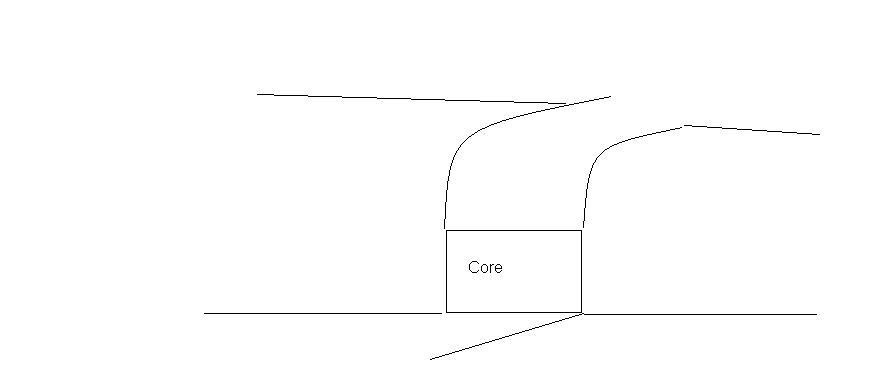
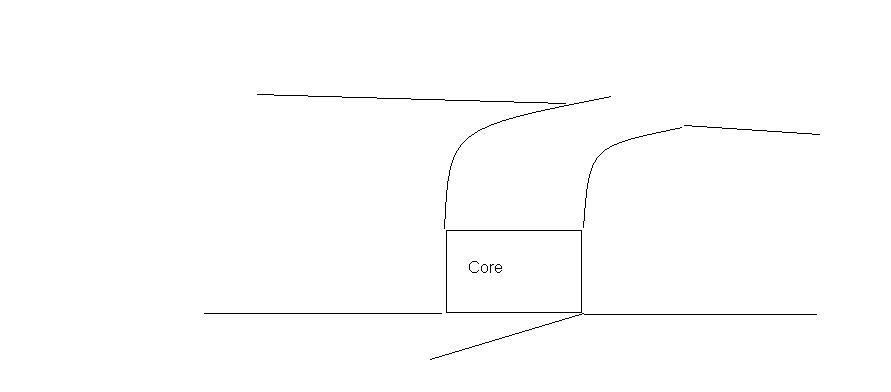
I think there's likely separation as illustrated in the first picture.
I think Paul is right about the wedge diffuser, but I don't think you have
to move the cooler to the cowl. Maybe have a look at the 2nd pic...
What do you think?
Matt-
Brilliant Matt. I like it. Perhaps with some boundary layer energizers ahead
of it. Why did I not think of that :)
Al
---------------------
I suppose that could work, but my initial reaction is somewhat along the
lines of Chris's.
Realize that this was set up by hollowing out the PVC foam in the wing core,
and putting a layer of glass over it; so making that change is pretty major.
It's worth making some further simpler attempts first; things I can do
without taking the wing off and removing the cooler. I don't need a huge
improvement - it works fine now on cool days. Another 30% in air flow would
get me there.
Before seeing Chris's posting, I had basically the same thought; along the
lines of the attached. What do you think?
Al
The Rotary Engine NewsLetter. Powered by Linux.
ACRE NL web site.
http://www.rotaryeng.net
Copyright 1998-2006 All world wide rights reserved.