Al, do you remember this message?
-------- Original Message --------
Subject: Thick heat exchangers/ oil coolers; re-do the math
Date: Fri, 23 Nov 2001 15:15:02 -0800
From: ACRE NL
<rotaryeng@earthlink.net>
Al Gietzen wrote:
>> Paul;
>> I think we need some clarification on this oil cooler info. Seems that
your
>> saying that a 3.5" thick oil cooler can't work because the air side
pressure
>> drop based on a specific case that is not applicable. The pressure drop
is
>> dependent on much more than thickness; at the very least we need to know
fin
>> and tube density, cross sectional area and whatever.
>>
>
>Some of that is unnecessary Al. This is the bottom line. Mass of air flow
through
>the core verses differential pressure drop. Note this is for a given
>core of a given area and thickness. It is designed as an aircraft oil
cooler
>so it is a specific case. It needs to be normalized for each square inch
>of core. The point is this core will not work well until the pressure
>differential gets to 12 inches of water or about 160 MPH in terms of
>dynamic pressure and mass airflow.
>
>Did you download the oil cooler .pdf file? It takes three curves
>to completely characterize an oil cooler. >
>They all have the same problem. They don't start to work well
>until they get to about 160 MPH.
Paul;
Yes; I downloaded all three charts and did the math. A typical design point
for that specific cooler is an oil flow of about 1.5 gpm and air flow of
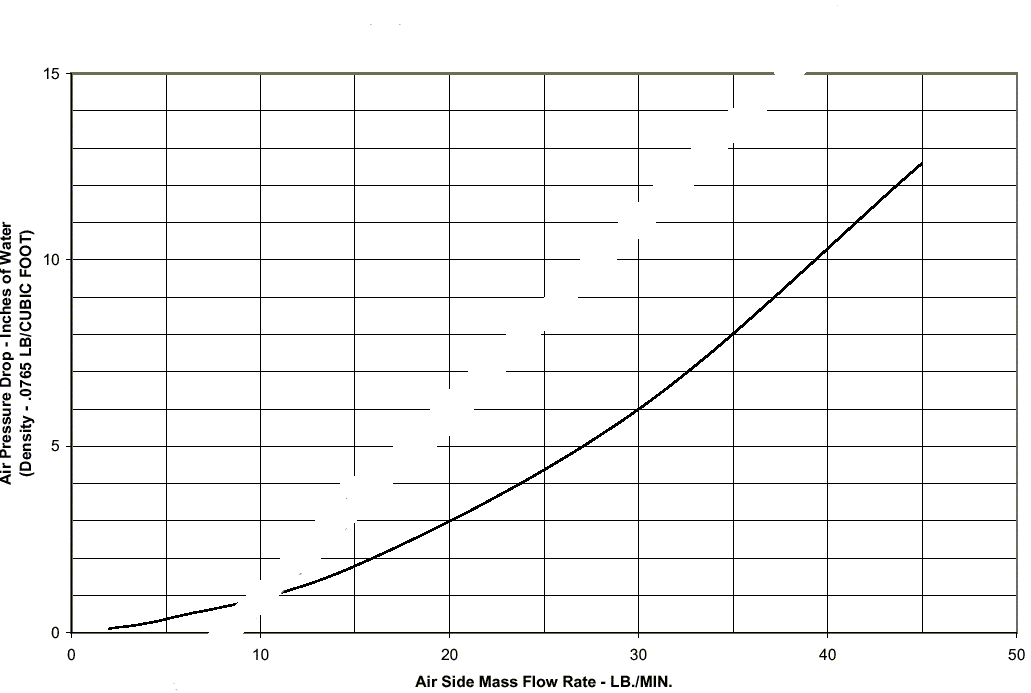
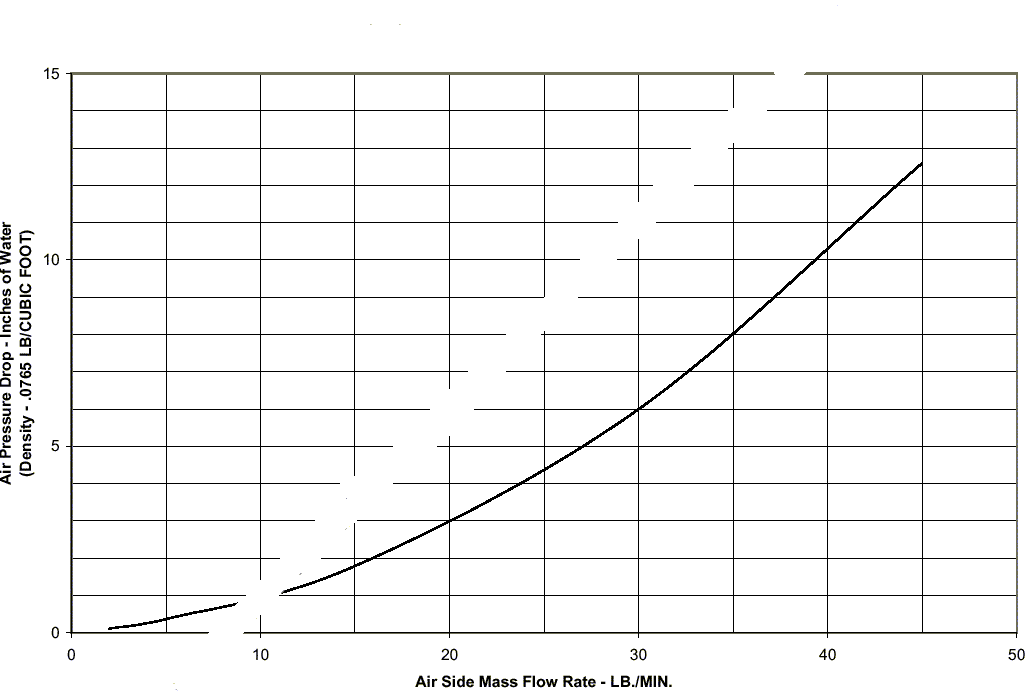
about 20 lbs/min. That airflow results in a air side pressure drop of about
4" water; and for that cross-sectional area, an air velocity of 22 mph.
Obviously we come to different conclusions for the same data; and it is
pointless to spend time disputing it.
I don't think it is pointless for our readers at all.
OK here are both the air flow and the heat rejected rate charts.
You choose 20 pounds per minute mass air flow rate.
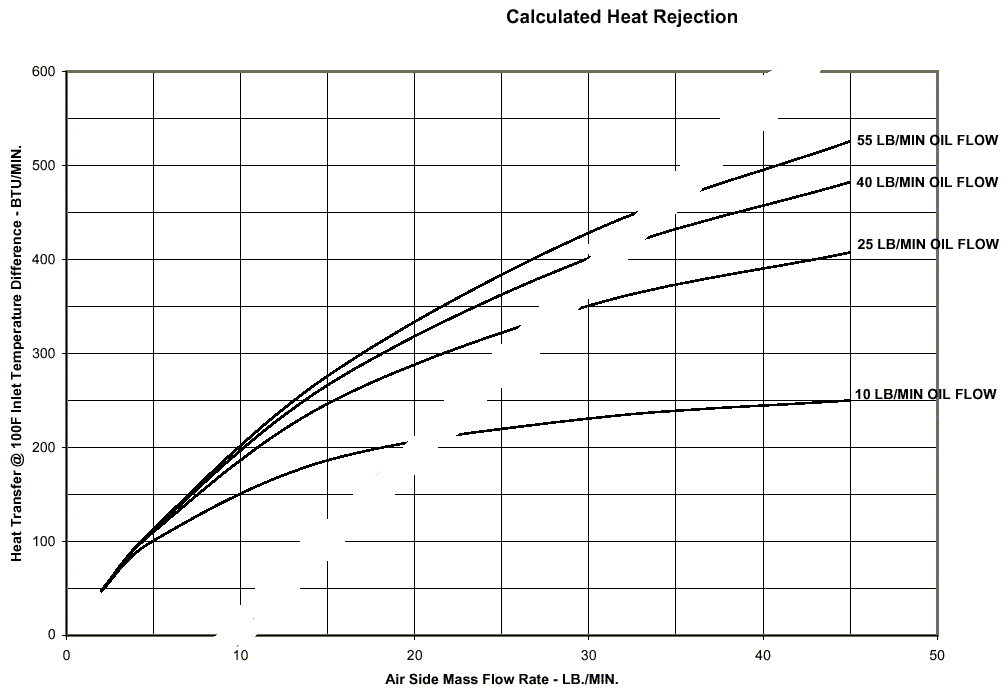
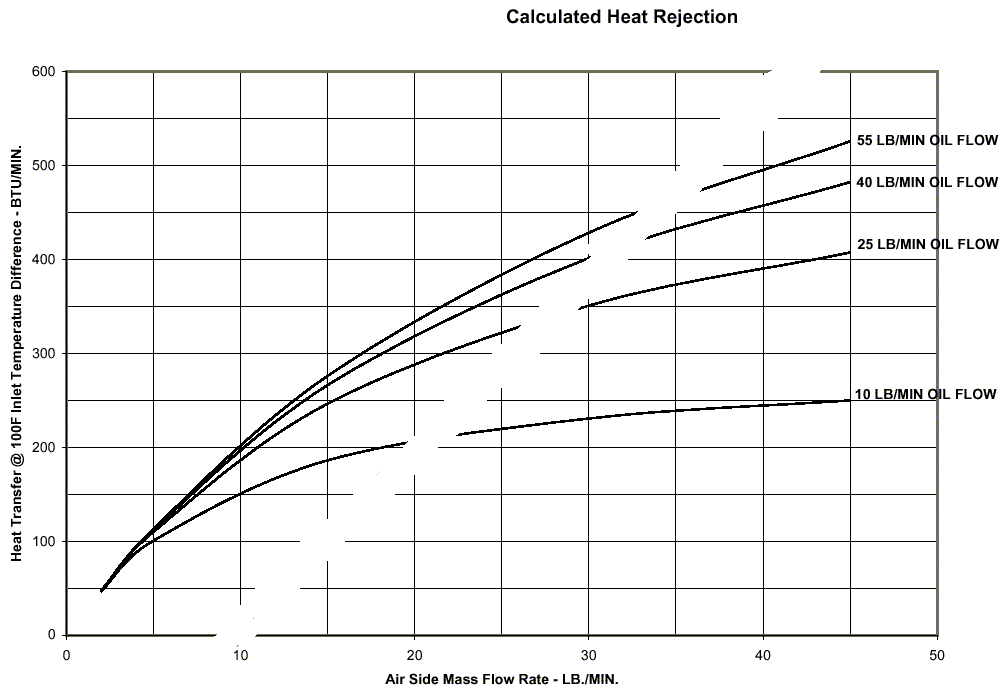
Entering the calculated heat rejected rate chart
below at about 20 pounds per minute mass airflow gives
only 260 BTU/per minute. Obviously nowhere near enough.
Paul,
1 Btu/min = 17.56 watts
(You put the 60 in the wrong place, so are off by a factor of 3600)
So, 74,600 watts = 4246.206 Btu/min
175 Btu/min = 3074.509watts = 4 HP
Bill Schertz
KIS Cruiser #4045
Now if that is the correct conversions factor
from BTU/min to watts 260 BTU/min is only 4565.6 watts!!
Since one HP is 746 watts that is 6 HP! No where near enough
to cool the waste oil heat from a 13B let alone a 20B.
Checking the pdf file for the size of the cooler that corresponds to these
two attached charts it is roughly 4 inch by 5 inches by 3.5 inches thick.
This is too small by a factor of ten at the dynamic pressure that
corresponds to 22 MPH. Obviously this cooler is not going to work.
But in any case, it is not correct
for you to delete ( withhold from the other readers) the more important part
of my last message; i.e.;
Sorry. I deleted it to simplify and make my point. My mistake.
I get caught [up] in my points from time to time. Forgot to include the rest
of your message. Sorry again.
"I am getting a custom oil cooler from Griffin for my 20B installation. It
has a core thickness of 3.35", commonly used by NASCAR. The MEASURED air
side pressure drop for the core for the mass flow per unit area that I need
is 1.48" of H2O. Perfectly acceptable."
And, that with a core size of 5" x 20.4" (x-sectional area of 102 sq in) get
the
needed heat rejection rate of about 2350 BTU/min for takeoff power on 100 F
day (total air flow 1600 cfm, oil flow 16 gpm, air velocity through the core
of 26 mph). This is a very compact, effective heat exchanger, and; yes - it
is nearly 3.5" thick.
Al Gietzen
Since one third of the heat rejection is by the oil and your engine is
roughly 300 HP you will need to reject roughly 100 HP or 74,600 watts
to the oil alone. Waste heat is roughly equal to net HP out.
Converting that to btu/min gives us 4200 BTU/min
The area of your chosen cooler is 100 square inches or five
times larger than this cooler represented by the attached charts.
Looking at a more realistic pressure drop of 6 inches of water or
about 100 MPH with a 80% efficient duct the mass airflow rate
would be 30 pounds per minute.
Entering the calculated heat rejected rate chart again
at about 30 pounds per minute mass airflow gives us 350 btu/min
at 25 pounds per minute oil flow.
The area of your chosen cooler is 100 square inches or five
times larger than this cooler and about the same thickness.
This gives us 1750 BTU/min.
This is is still too small by a factor of 2.4 at the six inches of
H2O dynamic pressure that corresponds to 100 MPH.
No way will it work at 1.48" of H2O.
If you have data for the custom oil cooler from Griffin
that differs greatly from the charts in the SW pdf file please by
all means share it with us.
Paul Lamar
The AirCraft Rotary Engine NewsLetter. Powered by Linux.
ACRE NL web site.
http://home.earthlink.net/~rotaryeng/ http://www.linux.org