Hey Al,
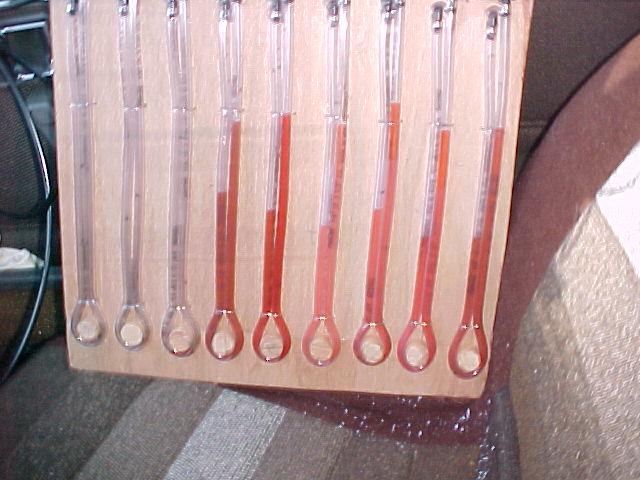
I think there's likely separation as illustrated in the first picture.
I think Paul is right about the wedge diffuser, but I don't think you
have
to move the cooler to the cowl. Maybe have a look at the 2nd pic...
What do you think?
Matt-
Matt wrote:
How can we apply instrumentation in the duct so that we can tell where the
flow is becoming turbulent? Or we can just continue to guess... Since this
duct is not exactly like any in the books, we can't directly copy any
solution that's out there.. I believe Al's data is valid (it is what it
is), but a few more key data points could help make the picture clearer.
Hopefully we can talk Al into continue playing along.
-------------
I'll look at getting a bit more info.
Meanwhile; I'm looking toward the idea of a vane as what might be a
relatively easy fix. I think that my scoop opening is large enough, and the
BL thin enough, that if I can get effective diffusion in the duct it should
work just fine.
-------------------
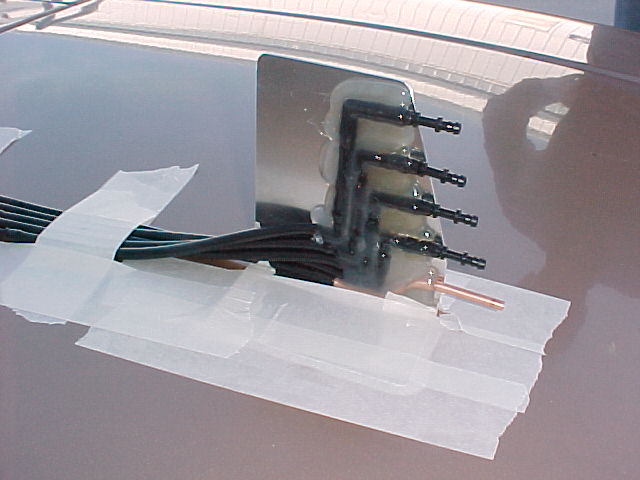
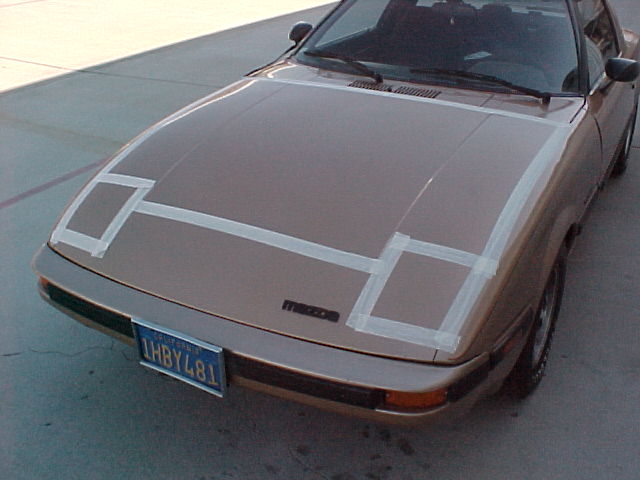
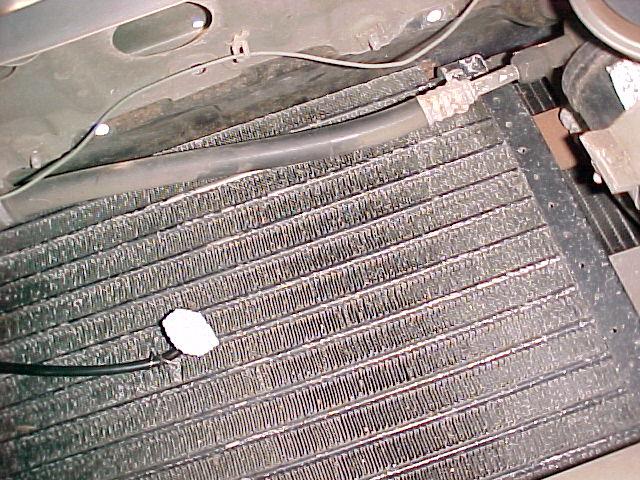
I got a couple more data points today (I am only able to route one tube
'before' the cooler and one tube 'after' ). I placed the 'before' tube up
close to the inner surface where the turbulence is expected. The pressure
was less than 0.25". I interpret this as confirming the turbulence.
The 'after' tube was placed on the upper surface of the exit fairing,
(static pressure, perpendicular to the flow. The reading there was -0.75" -
the same as measured behind the fairing exit. I'm not sure how to interpret
this, other than confirming that there is little negative pressure in that
area to help the airflow through the cooler. I'm thinking there is nothing
to be done at the exit.
Al
I am not surprised Al. What air speed was this taken?
Dynamic pressure at 100 MPH is 4.8 inches. At 150 MPH it is about 11 inches.
At 200 MPH it is 21 inches.
If the reading is accurate it is obvious the high velocity air
is being diverted around the opening. NOTHING is going to change
that substantially other than an effective boundary layer air bleed.
A good scoop and diffuser can recover 80% of dynamic pressure or
3.84 inches on the face of the heat exchanger at 100 MPH. A fair scoop and
diffuser can recover 50% or 2.4 inches.
Is that with or without the foam Al?
If you blow air across a coke bottle opening
at just the right angle you get a tone. This is because air is alternately
drawn in and out of the bottle. When air is drawn out of the bottle a vacuum
is formed so air is then drawn back in proving that air has elasticity, viscosity
and adhesion.
In our case the bottle is of infinite size (the atmosphere) so no tone is generated
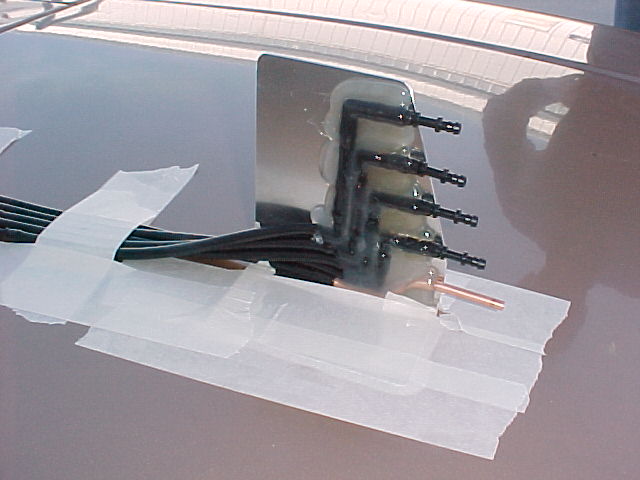
but the vacuum in the hose is nondeterminate. The porous-foam-on-the-end-of-the-hose
trick is widely used in the automotive industry to mitigate this phenomena.
I suggest that one do some testing on one's automobile to get a feel for this
technique and confirm that one's own test technique is repeatable.
If you send me your shipping address Al by private mail and the height of the exit
slot I'll send you a water manometer, a velocity rake, porous foam and a bunch of drip
irrigation tubing. All you need is a hot glue gun. In return I expect some
good readings.
IMHO this won't do you much good until you decide to make some major changes.
Paul Lamar ...No rotor no motor.
The Rotary Engine NewsLetter. Powered by Linux.
ACRE NL web site.
http://www.rotaryeng.net
Copyright 1998-2006 All world wide rights reserved.