Based on the temp drop of the oil, and the temp increase in the air; I am
currently getting 950 - 1000 CFM air flow through the core @ 160 mph. Even
assuming an emissivity of 0.8; my calcs show that radiation heat transfer at
200F to be negligible - even if it wasn't in an enclosure.
Al
Lots of room heaters work this way. No fan. Convection currents only.
1000 CFM at one square foot oil cooler frontal area is 1000 FPM or 16 FPS or
11 MPH
air speed through the core. Sounds like convection currents to me.
Paul Lamar ...No rotor no motor.
-------------------
The cooler core area is 0.67 ft sq., velocity through the core is about 16
mph. Natural convection is what I get on the ground - pretty close to zero.
Average velocity into the scoop entrance is about 55 - 60 mph
Al
I will certainly keep you informed. Your suggestion of changing the upper
contour of the duct certainly has merit, and I think it is something I can
implement in a temporary way to see its effects.
You asked about leaks at the top and bottom of the cooler. Yes there is a
small space (about 1/8" or less) between the sides of the cooler and the
enclosure. This is there deliberately to isolate the hot cooler from, and
provide cooling for, the fiberglass and foam. The gap extends the width of
the cooler, providing some pressure drop, but maybe less than through the
core, so I'm not much concerned about the amount of air that gets by. But
does that change the dynamics of the diffuser?
Al
Sure will try plugging it with red RTV good for 500 F.
If you don't want the gooey stuff you can gets sheets of
it from McMaster.
That could be a major change.
--
Paul Lamar ...No rotor no motor.
-----------
Well; I may end up with VGs and change in upper duct wall shape. My
intention yesterday was to install VGs as a first step, test fly, measure
pressure and temps; then proceed with installing sheet metal upper duct wall
change.
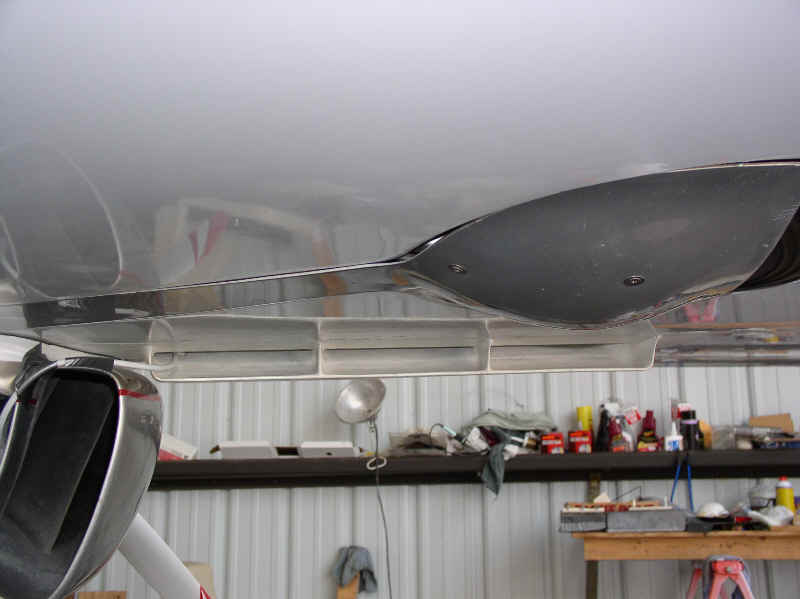
In deciding where to put the VGs, I looked at things with the gear up (Photo
1). The gear door has a bump, and there is some gap around the door. Don't
know what all this does to BL. Ended up putting VG toward the left side
about 26" in font of scoop, and toward the right side right on the gear door
bump.
I then spent a bunch of time trying to get the pressure measuring tube
situated. The only access is through the scoop opening, and I can't get my
hands in there; so it is very tough. Plus the tube going in there, or along
the surface in front will affect the flow behavior, so what affect are we
going to measure. Having multiple measurements would be great; but very
difficult to achieve.
While doing that, I spent some time looking in there with a small mirror.
What I noted was that initial gaps above and below the cooler (required to
slide the unit in and out) had changed a bit. The cooler is supported on
pads of 'Cool-Mat' insulation. Those have compressed just a little, so now
there is very little gap at the bottom, and 1/8"+ along the top. That is a
fairly substantial leak, and the loss of pressure at the top likely
exacerbates the flow separation. I decided it wasn't worth going to test
the VGs as long as that leakage gap was there.
Taking the wing off (mostly getting it back on because of next to impossible
access to nuts), and removing the cooler looks a bit much right now. I
realized then; that by putting in a sheet metal 'false' upper duct wall, I
could extend it up into the gap at the top (photo 2), thereby changing the
shape, and (mostly) closing the gap at the top.
The false wall has to be in three parts for the three openings, and there
will be gaps between because of the supporting dividers; but it could make a
substantial difference. I made the piece for the center, and considered
testing just that; but the upper gap concerns me enough that I think I'll
try to get all three fit in.
Then go take a flight test. Unfortunately this combines three changes, VGs,
closing gap, and changing duct wall. I had hoped to test these one at a
time. If there is a substantial change; it will be easy to remove the VGs
to see what that effect was.
Of course I'll let you know when I get some results.
Oh, the price of innovation:-).
Al
The Rotary Engine NewsLetter. Powered by Linux.
ACRE NL web site.
http://www.rotaryeng.net
Copyright 1998-2006 All world wide rights reserved.