Okay, at the risk of revealing my ignorance through dumb questions,
here
goes:
1) The Tillitson manual says the carb has its own integral fuel
pump. It
seems very unlikely that a pump this size that is driven through
"pulsations
of the engine" (i.e. not driven mechanically with a hard link) could
actually deliver sufficient fuel for WOT operation. What does this
pump do
(starting? acceleration pump?).
2) The manual says "Atmospheric pressure on the vented side pushes the
diaphragm toward the inlet control lever, opening the inlet needle
to allow
fuel to enter the metering chamber . . . " Will this function work when
ambient static air pressure is significantly reduced (at altitude)?
3) Dual carbs: Just so I understand, what are the
advantages/disadvantages of a dedicated carb per P-port vs both carbs
mounted on a common rail. The independent carb set up would have the
preferable failure mode (one carb failed would still allow one rotor
to run
well and get you safely down.) Are there ANY advantages to going
with a
common rail instead?
Again, sorry for the basic questions.
Mark Waldron
They are very good questions.
(1) Tillotson makes two types. I will copy the one without the built
in pump and use an external ordinary low pressure fuel pump.
A low pressure regulator can also be used to ease the load
on the Tillotson.
(2) It will if we manually reduce the spring pressure by moving the
spring
seat away from the diaphragm.
(3) Well you have a very good point there. Two carbs would allow the
engine
to run on one rotor. The rotary runs real rough on one rotor as most
people
report but it could extend your glide. However there are a zillion
aircraft
engines out there with only one carb. Carbs I think tend to be very
reliable.
Paul Lamar ...No rotor no motor.
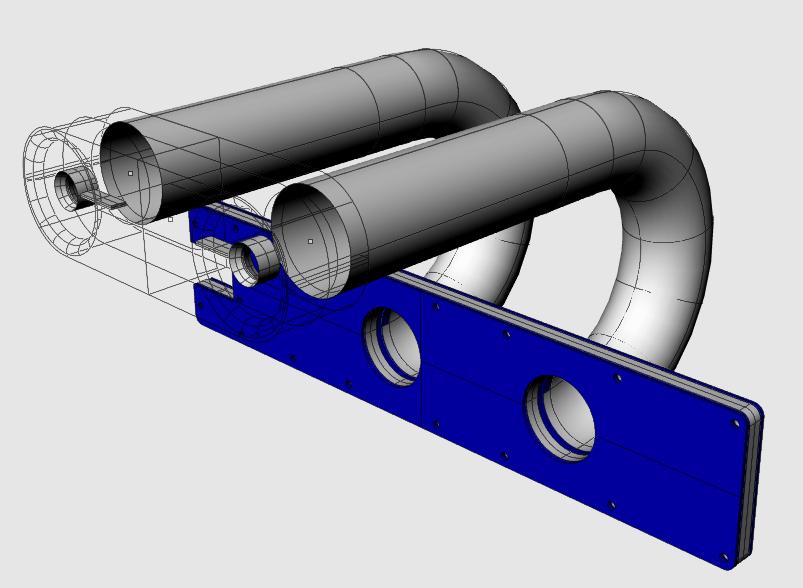
The dual Tillotson type could be mounted here.
Advantages are smoother air flow through the venturis at
low throttle opening and a slightly better BSFC due to better
mixing of fuel and air. Saves a bit of money because the required
bell mouths are incorporated into the carb body. The carb will
run cooler as it is further way from the exhaust. Tested on the dyno
with the Weber and Marks injectors are located in this area.
Also better tuning as the Weber style venturis would act as a discontinuity
if located down near the slide throttle.
--
Paul Lamar ...No rotor no motor.
The Rotary Engine NewsLetter. Powered by Linux.
ACRE NL web site.
http://www.rotaryeng.net
Copyright 1998-2006 All world wide rights reserved.