From the Dial A Jet web site.
http://www.thunderproducts.com/dial_a_jet_techpaper.htm
"Dial-A-Jet is an add fuel only device. You cannot add fuel to an engine that is running rich
or has an adequate fuel supply and hope to gain horsepower. You must create a lean condition
so that Dial-A-Jet has a window of opportunity to function. Dial-A-Jet will automatically fill
in the lean areas of the fuel curve giving you optimum performance. The fine emulsified fuel
charge can't displace the heavier poorly atomized fuel from the other circuits so it takes
the path of least resistance and fills in the lean mix areas eliminating fuel spiking and
giving you a consistent fuel flow pattern producing stable temperatures and horsepower. The
only way Dial-A-Jet can fail to perform is if you do not get the carburetor within range of
the Dial-A-Jet. This usually means that the main jet is too large. You must create a slightly
lean condition so the Dial-A-Jet has a working range. This is typically about three or four
jet sizes below a properly jetted machine. A single Dial-A-Jet will deliver 10% to 15% of your
overall fuel curve in an emulsified state."
In other words you MUST install VERY lean jets to begin with and then let this device
increase the fuel flow to the desired mixture. It is sort of leaning in reverse.
I suspect it won't work with a Weber as I understand it a Weber already has
an emulsifier tube. Larry Childs or Bill Jepson knows more about these things so perhaps
they can confirm this for me.
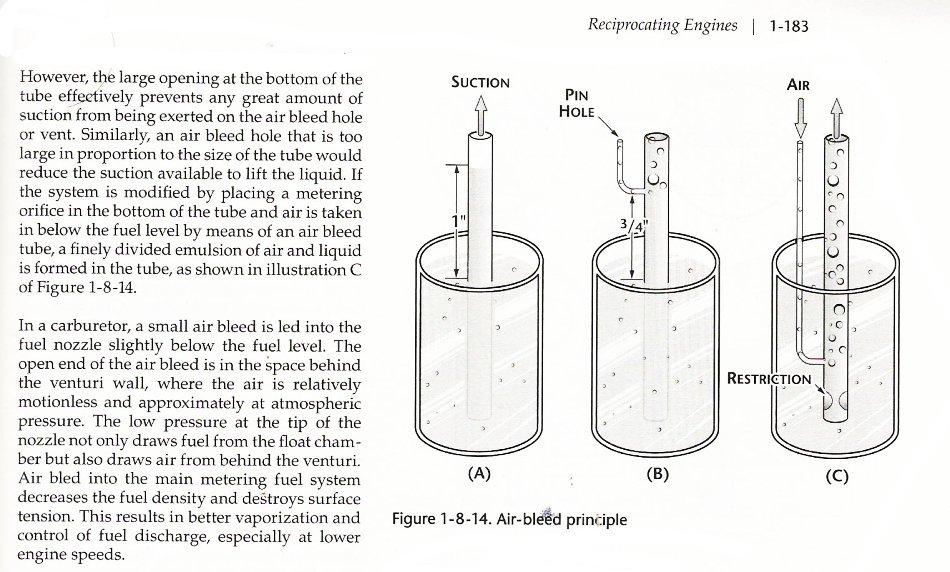
IMHO this device senses dynamic pressure ahead of the throttle and feeds a controlled amount of
the air into the bottom of the tube after the main jet allowing the venturi to suck more
fuel using the principle shown in the illustration. I am also not sure it will
work with a diaphragm type carb.
Paul Lamar ...No rotor no motor.
The Rotary Engine NewsLetter. Powered by Linux.
ACRE NL web site.
http://www.rotaryeng.net
Copyright 1998-2006 All world wide rights reserved.