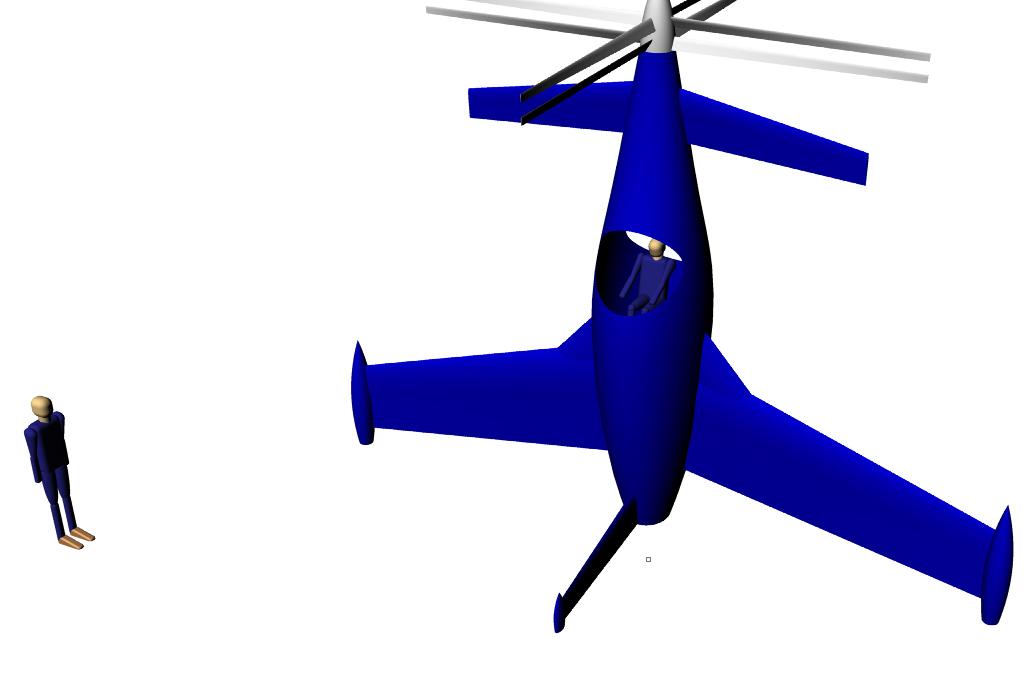
This would be a lot cheaper to build.
--
Paul Lamar ...No rotor no motor.
>> -- ----------------------------------------------
>>
>> This is even cheaper and easier.
>> Nothing new here. This was done back in the 60's.
>> The pilots had problems with landing because they
>> did not rotate the pilot and he was ahead of the wing
>> so visibility on landing was poor.
>> Modern fly by wire will make it easier to rotate
>> the pilot for helicopter mode.
>>
>> Tie down might be a problem but if all three
>> tie downs are used it would be OK in moderate winds.
>> Strong winds and it would have to go in a high hanger.
>> -- Paul Lamar ...No rotor no motor.
>
>
> And since the whole airframe is operating in disturbed air, you
> wouldn't have to spend so much time on laminar flow.
>
> Chris C.
>
> It would still be twice as fast as any gyro or helicopter and
> have three times the range. Much easier to build than any
> VTOL aircraft I have seen so far.
> -- Paul Lamar ...No rotor no motor.
>
Do you remember Wayne Handley's Raven? It would seem that this idea
is not that far away. Us a really big prop a 4 or 5:1 redrive, and
ailerons that go all the way to the root. Like you see in all the RC
competition models, where they hang the plane on the prop.
The beauty about being able to use turbulent sections for the wing,
is you can use 18% or better airfoils (airfoil thickness is 18% of
chord) This gives you the ability to make a really strong wing with
minimal structure, because of spar depth. Cirrus just cut 55 pounds
out of their wing.
Weight is the name of the game.
Chris C.
You need coaxial to nuetrilize the torque.
A canard version is more stable when parked.
--
Paul Lamar ...No rotor no motor.
Paul,
Regarding the above design, what I have read in researching my project
(AlienAir-1),
during rotation of the prop or props a counter rotation mechanism
is needed to stabilize the fuselage such as a fan on the tail.
The DOAK, VTOL from the 50's, had a jet exhaust nozzle in the tail that
controlled
pitch during hover but there was still a tendency of the fuselage to
tilt up during transition
from hover to forward flight.
Rodger
Yes I realized that but the next design overcomes that. Keep reading.
The third version will be a canard version
for more stability on the ground. I am still working on the 3D.
---------------------------------------
Here is the third version. The 3 rotor engine is behind the
pilot and passenger and drives the coaxial props with a carbon fiber drive
shaft out of an RX8. Gear box is in the nose.
Much more stable when tied down on the ground.
A canard configuration was something else they did not have in
the 60's.
Paul Lamar ...No rotor no motor.
The Rotary Engine NewsLetter. Powered by Linux.
ACRE NL web site.
http://www.rotaryeng.net
Copyright 1998-2006 All world wide rights reserved.