I liked this practical configuration so much I added it to my web site:
http://www.rotaryeng.net/STOL.html
Thanks to all the people that uploaded ideas and suggestions.
Especially Roger Parker for displaying his STOL airplane at the Camarillo
air show and inspiring me.
Honda is getting into personal jets. Mazda could build something
like this almost anybody could afford. People have dreamed
about an airplane that can take off in their back yard and fly
for a 1000 miles for the last 100 years. The Mazda rotary engine and
carbon fiber could make that dream come true.
Paul Lamar ...No rotor no motor.
Paul,
You need to talk to this guy:
http://www.amvaircraft.com/html/new_developments.html . Atilla (that's his
real name) was using a turbocharged 13B engine in his prototype and he was
hovering when he burned it up. He's now thinking about installing an
Allison 250 (Rolls Royce) turboshaft. I was looking at those aluminum
housings from Racing Beat today and I'm thinking a turbocharged 20B with the
aluminum details might be the ticket for this aircraft.
By the way, forget about that rotating cockpit. I work at the company that
built the more successful of those two "pogo" type prototypes. If you
really want to do that, make the airplane(?) a pusher, do vertical with the
pilot standing up (Hiller did this) and have the pilot prone horizontal
flight (this was successfully done by both Northrop and the Horton Brothers
as well as the Wright Brothers). You could also have the engine behind your
feet and use a shaft to drive rotors in the nose but you would have to be
careful about forward visibility. Someone is now building a UAV in the same
configuration as the Lockheed XFV-1 but they are using a computer for
landing that didn't exist in the 50's. Check this out:
http://www.unrealaircraft.com/gravity/xfv1.php . In any case, a design like
this isn't too unreasonable especially since ballistic parachutes like the
one in the Cirrus are readily available.
Steve Brazil
Thanks for the suggestion Steve. A prone pilot sounds like a great idea
if he could look straight down as well as up. TV view I am not so sure
about. How do you land if you have total electrical failure?
A pusher would require a duct I suspect which is very inefficient
in high speed forward flight. Also the canard is much more stable
on the ground than a conventional airplane like the XFV1 in windy
conditions.
Also I use helicopter like cyclical pitch controls to
get around the XFV1 hover control problems. A helicopter
will auto rotate to a safe landing in the event of an engine failure
or running out of fuel for that matter.
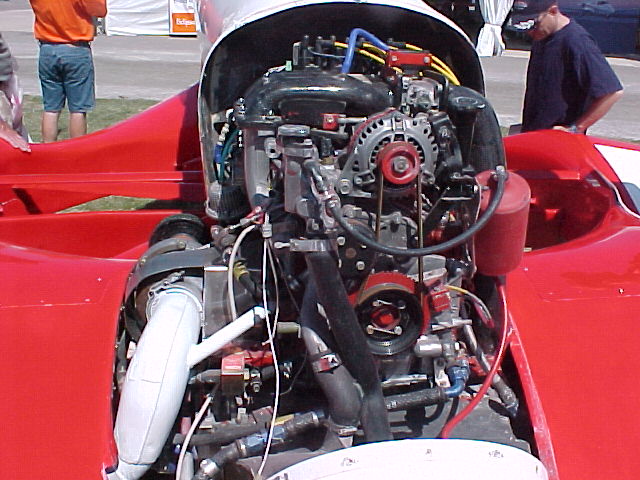
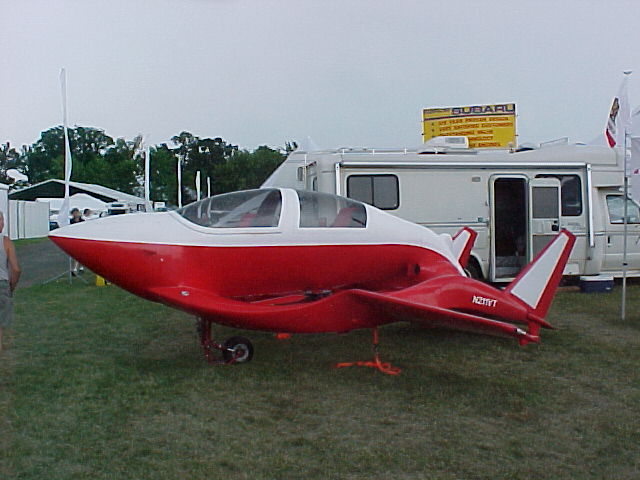
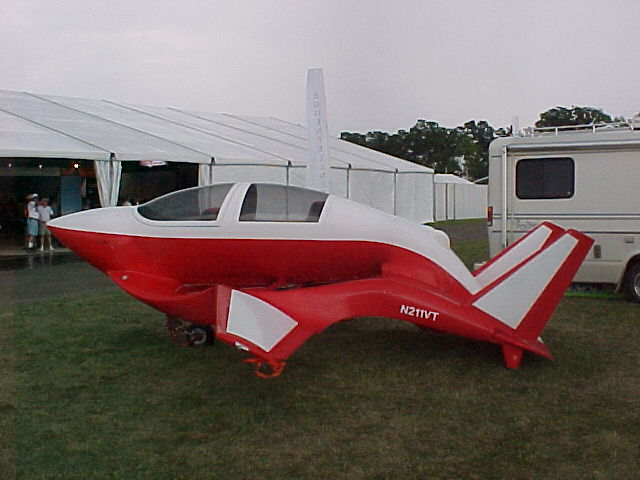
Here are some pictures I took of the Amvair aircraft at OSH
in 2003. It never flew as far as I know.
The request for investment always raises a red flag in my mind.
As far as I can tell from looking at it the hover controls
are inadequate. The engineer was also naive about tuning a
13B turbo rotary engine allowing it to detonate and destroy itself.
Not a confidence inspiring event. Small turbo prop engines are
too expensive and fuel hungry.
Paul Lamar
The Rotary Engine NewsLetter. Powered by Linux.
ACRE NL web site.
http://www.rotaryeng.net
Copyright 1998-2006 All world wide rights reserved.