>
>> Steve, Are you going to design and build
>> your own helicopter rotor head?
>>
>> What do you think of this one?
>>
>> Paul Lamar ...No rotor no motor.
>
> Gee I don't see why helicopter maintenance is so pricey :)
>
> John
>
> Here is almost a complete articulated counter rotating rotor head.
> I can see why counter rotating rotor head helicopters are so rare. I still
> haven't figured out how to move the forward swash plate yet. I am thinking
> Blue Tooth radio controlled :) Four high speed, computer radio controlled,
> angular electric servos, one on each blade, would do the trick.
> It would vastly simplify this and make fly by radio control a real
> reality.
> It could also be done with a infra red optical link.
>
> Another possibility is control the swash plates with three servos each.
> The servos would not have to be as fast.
>
> Perhaps the control rods can go into the inner shaft for the front
> rotor. About the only company in the world that could build this is Kamov.
>
> It is also still laking the lagging and flapping hinges.
>
> I am not dumb enough to try to build one of these :)
>
> Paul Lamar
Kamov has rooms full of guys that analyze and design all that stuff, I
don't. Co-axial designs may have advantages but they have control problems
in auto rotation and even if they are more efficient, it's easier for me,
time and money wise, to put in more power than deal with those other issues.
Steve
For our STOL canard we have little choice as aerodynamic surfaces
have proven to be inadequate for low speed control. Particular in cross
wind take offs and landings. I don't think it is all that practical
to add a tail rotor to our canard.
--
Paul Lamar ...No rotor no motor.
Paul,
All I can say is try it with a large, probably 1/4 scale, model first. I
didn't think of it before, but you might be able to get adequate low speed
control with the canard because it would be so close to the rotor. You
could use a mixer in the control to get roll and pitch which would become
translation and rotation around the z axis when in hover. A forward
vertical surface would allow sideways translation and provide some crash
protection in the event of a horizontal forced landing.
Steve Brazil
Yes that might work but the R&D might be considerable. I am inclined
to stick with stuff that is proven to work. A man needs to know his
limitation's :) I don't have a blimp hangar available for tethered testing.
I am not planning on building one. It is just a design exercise for me.
I might be able to afford a coaxial helicopter if I had help building
it and I could copy something that works. Hiller built a small single
place coaxial years ago.
Paul Lamar ...No rotor no motor.
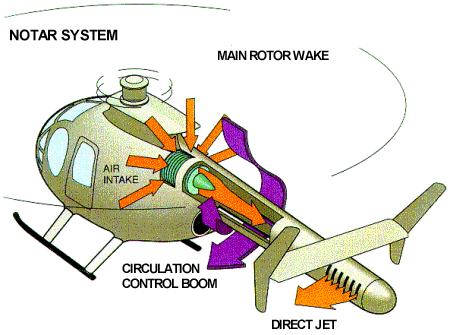
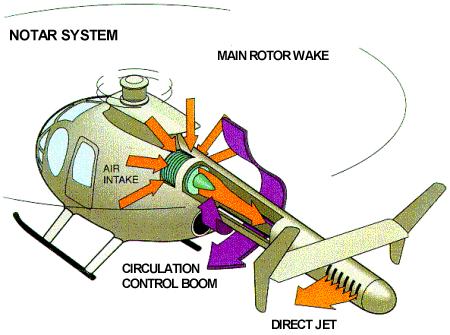
How about applying the technology of Boeing/MD Helicopter's NOTAR system?
I don't mean, hang a NOTAR, straight of an MD-520, onto your design.
I mean, NOTAR has a certain novel approach to controlling helicopter's
attitude countering torque. Would the NOTAR, for your application, be
mounted vertically, horizontally, at 45 degrees to the moon? :-) I
don't know. I am just saying, here is an innovative control technology,
a torque problem: you have control problem, a torque problem. Could an
innovative, "out-of-the-box" application of the NOTAR technology solve
your problem?
Here is a non-official, hopefully no-propaganda website:
Unofficial NOTAR web page
How NOTAR works
http://home.wanadoo.nl/helicopter/development.htm
And here is a cutaway of the conventional NOTAR application:
http://home.wanadoo.nl/helicopter/images/notafly.jpg
Something to think about,
Les
Well the NOTOR must be mounted perpendicular to the rotor shaft axis
to counter the rotor torque. One rotor torque cancels the other
countering rotating rotor torque in a coaxial helicopter.
That would make it a large diameter post sticking straight out the
top of the canard or the bottom of the canard fuselage. The drag in airplane
mode would be unacceptable. Also it takes HP to pump the air out the slot.
Paul Lamar ...No rotor no motor.
The Rotary Engine NewsLetter. Powered by Linux.
ACRE NL web site.
http://www.rotaryeng.net
Copyright 1998-2006 All world wide rights reserved.