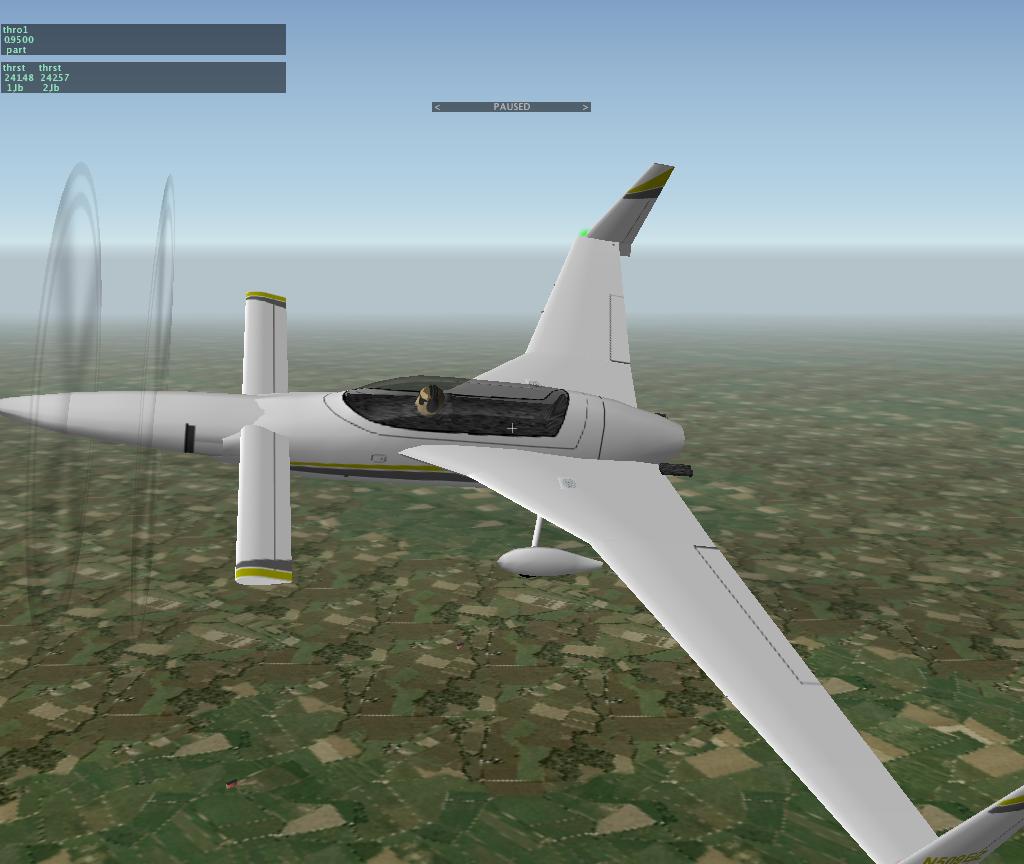
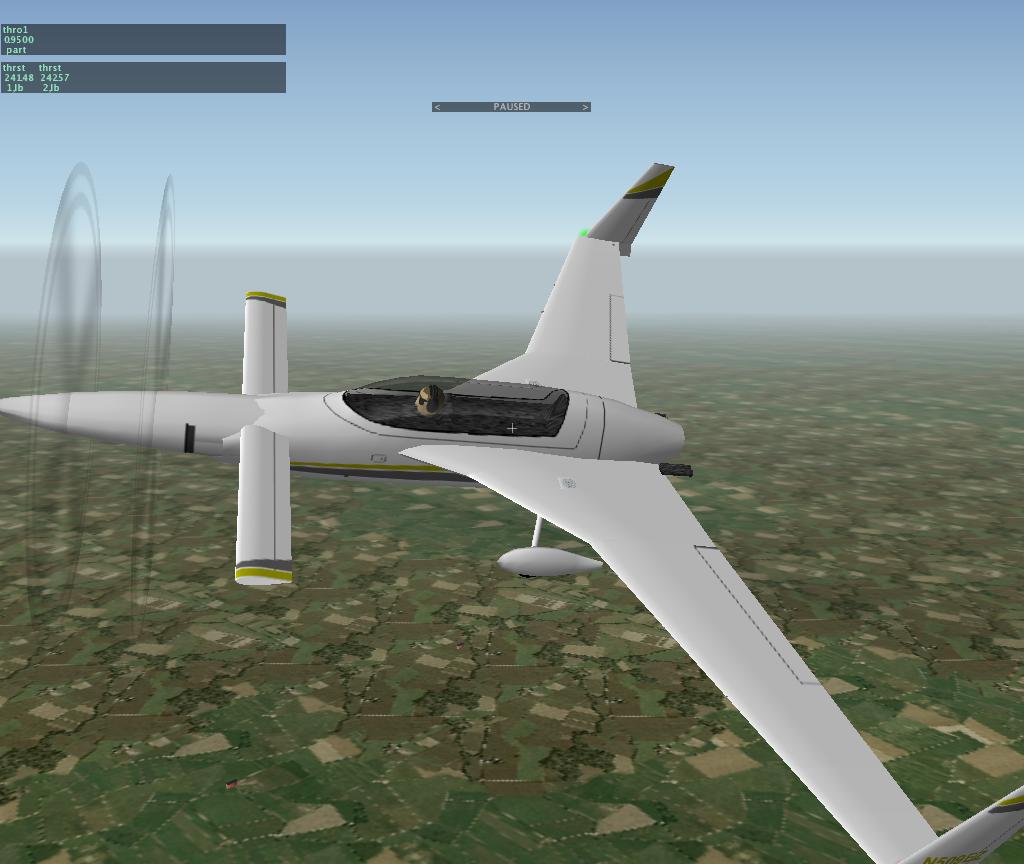
> You can only climb straight up for a few seconds so you better
> start pitching over right away or its going to hang on the
> prop. This program assumes you are going to pitch over right
> away. If you don't the velocity will drop to near zero and the
> the airplane will stop climbing vertically. It also assumes the prop
> pitch is adjusted for maximum thrust at all times.
>
> Top speed will be limited by the rotor tips going supersonic.
>
> Paul Lamar ...No rotor no motor.
>
>
> Paul,
> The way I read your data, at takeoff, your are making 6.66 lbs of
thrust
> per
> hp. At 11,000 ft you are making 9.18 lbs of thrust per hp. I
think that
> portion of your formula is inverted, as the other attached chart
shows the
> prop loosing thrust with airspeed (and air density), not gaining.
> The other thing is the velocity appears to be gaining at a steady
rate and
> it should be decaying in proportion to the vertical g force.
> As a reality check, look up the gross weight of a 300 hp
helicopter and
> what
> it's vertical performance is.
> Larry
>
> Thanks Larry. I'll check it over.
> --
> Paul Lamar ...No rotor no motor.
>
> Thanks Larry for your help in finding those errors and thinking
about it.
> I lost focus there for a minute. This is not altitude. It is
distance
> traveled
> through an arc over.
>
> I added altitude compensation to the HP by mistake. I removed it
in this
> version.
>
> I am assuming the aircraft is going to pitch over once it reaches
> flying speed around 70 MPH and at around 1000 feet so this is
mostly a
> crude
> approximation of the vertical and horizontal acceleration up to four
> seconds.
>
> No need for altitude effect on HP below 1000 feet.
>
> This model needs to be refined to add the effects of gravity and
perhaps
> induced
> drag due to lift. Gravity hardly affects the acceleration in
horizontal
> mode and induced drag due to lift hardly affects it in vertical mode.
> I will probably assume the flight path is an arc consisting of one
> quarter of a circle and calculate the various forces based on
> that assumption. This is new to me but I am sure it was new to the
> Osprey designers as well. I notice the Osprey starts moving forward
> almost immediately and within a few hundred feet of altitude.
>
> I'll refine the model more later.
>
> Here is a chart showing rotor diameter tip speeds using the
> 6.24 PSRU ratio. We are going to be limited to about a 12 to 14 foot
> rotor due to the forward velocity vector adding to these tip
> velocity numbers approaching Mach 1. That means the blade area
must be
> large
> enough to absorb the HP available and provide the thrust required.
> I am sure Perry is working on this as we speak.
>
> The Osprey is affected by this same phenomena but it has the
advantages
> of twice the disk area. The name of the game in vertical take off
> is a low rotor disk loading.
>
> The engine and rotor RPM will probably be forced to slow due to
tip mach
> effects
> at WOT as the airplane pitches over and builds forward speed with a
> consequent
> loss in available Horse Power. Fortunately we don't need all that
HP in
> forward
> flight anyway nor do we want to run the engine at 8500 RPM
continuously.
>
> We are very fortunate indeed to have a very low cost engine with such
> an exceptional power to weight ratio as the Mazda p-port Wankel
> for this application.
> Paul Lamar ...No rotor no motor.
Paul,
Suppose that you have been on site
http://www.vstol.org
Colin Smith
Yes but there are no free technical papers on there as far as I
could find.
This is a bit hard to access but there are free NASA and NACA technical
papers on here. Just be careful of how you cut and past this into
your browser.
http://naca.larc.nasa.gov/search.jsp?R=846225&id=9&qs=Ntt%3DVertical%252B
takeoff%26Ntk%3Dall%26Ntx%3Dmode%2520matchall%26N%3D0%26Ns%3DHarvestDate%257c1
------------------------------------------
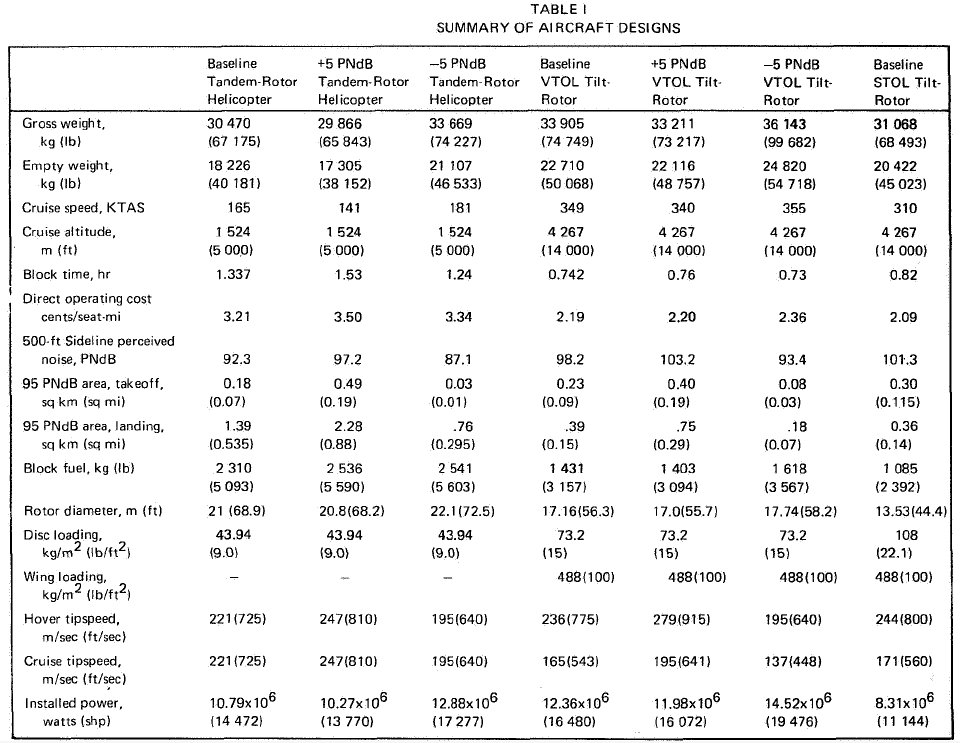
Here is an interesting table from that pdf paper.
Also a table on the tip speed of our configuration at
a forward speed of 200 MPH. It is labeled Vect MPH.
This is a severe compromise. If only we had telescopic
rotor blades :)
--
Paul Lamar ...No rotor no motor.
I don't think we'll have to worry about prop diameter or a hit in speed.
In the new Sept. 07 issue of Air and Space there is an article about the
Osprey.
It has 38' diameter blades and cruises 275 mph. The blades are
conventional variable pitch.
When I level this sim off with 300 HP, it easily hits redline, goes like
a rocket.
I have props set to constant speed 1200 RPM, and at 12' diameter I don't
think we are pushing the sonic limit.
Perry
That's cool Perry. I'll put them on my web site with a link to yours.
I am worried that 12 feet diameter is not going to give us enough
static thrust for a gross weight of 2000 pounds.
Here is my table again. At 200 MPH we have a problem IMHO.
The last column is 200 MPH. I'll add 250 MPH and see what it looks like.
What program are you using that predicts static trust
as a function of blade length, blade area, twist and plan form shape?
------------------------------------------------------------------
I added both 250 MPH forward speed and disk area and loading.
Here too is a chart from Boeing showing disk loadings from
other successful VTOL aircraft. I think we are going to need
a 14 foot diameter rotor to get the disk loading down
to 13 pounds per square foot with 2000 pound gross weight. Perhaps
we need a test rig to check our rotor design for static thrust.
--
Paul Lamar ...No rotor no motor.
The Rotary Engine NewsLetter. Powered by Linux.
ACRE NL web site.
http://www.rotaryeng.net
Copyright 1998-2006 All world wide rights reserved.