Hello All,
Here?s a question about the ROSS PSRU, I?ve gotten many good suggestions
on modifying and adding thrust bearings to prevent the input shaft from
rocking back and forth. There?s one thing that keeps nagging at my
mind; I remember reading somewhere a fellow had a ROSS PSRU (no mods) on
a gyro and he was able to put over a thousand hours on his unit without
any troubles. Now a gyro is a pusher, and my plane is a pusher (Osprey
2) ? would I have the same luck on my ROSS PSRU? Or should I bite the
bullet and do the modifications to my gear box?
Cheers,
Burck
Good question. I assume you have a 2.17:1. The planet carrier is fixed
to the housing so the prop shaft is pushing on the planet carrier and not
the sun gear. The sun gear tends to un screw it self and that is why
it puts a load on the e-shaft and then on the e-shaft thrust bearing at
the front of the engine. I have no idea how the guy lucked out
with a thousand hours. Perhaps he did not have as much HP as Tracy had.
IMHO you still need that thrust bearing.
--
Paul Lamar ...No rotor no motor.
Burck and Paul...
My "testosterone" gyroplane didn't have a thrust bearing in it's 2.85:1
Ross. My *significantly* bridgeported 12a was making 219 hp at 7800 rpm on
the dyno (as I remember). I routinely ran it at 7500 rpm for WOT, and
"throttled back" to 6000-6300 for my "regular" (read as: abusive) flight
activities. I had over 1100 hours, sold it (the PSRU) to another pilot, and
he put another 100'ish hours on his machine before selling it yet again...
don't know it's current history though. I obviously got lucky!!! On an
email to Tracy long ago... he indicated his experience was that the 2.85:1
had a different wear pattern than the 2.17:1 system.
Yet I'd agree that the thrust bearing is a safety necessity for any future
build I perform. Again... I obviously got lucky!!
Gary Buster
Tyler Texas
N263GB
You sure did. The stock Mazda thrust bearing is designed to take
the occasional force from the clutch throw out mechanism.
A far cry from 700 pounds. Perry Mick has some experience along these
lines as well. He flew a direct drive ducted fan for a few years
and then changed the front cover and thrust bearing when it showed
signs of failing for a larger 3rd gen version.
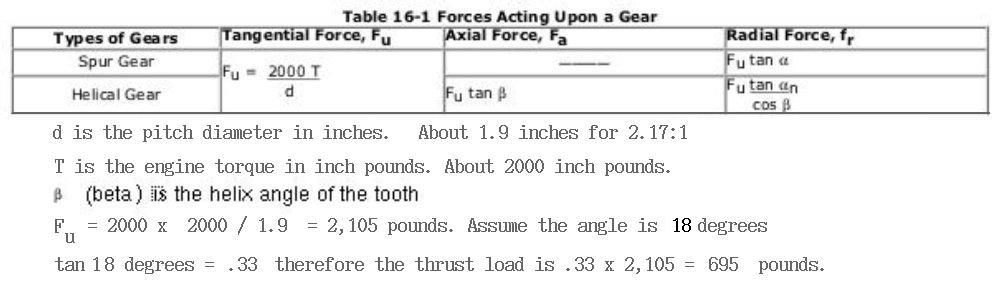
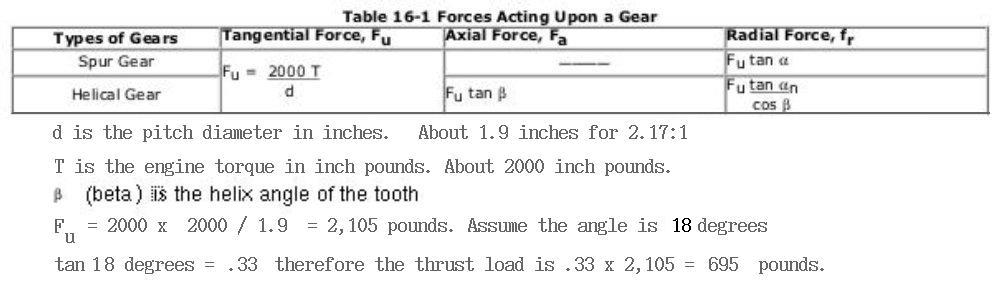
The 2.85 has a larger sun gear so that reduces the helical gear
thrust load according to the attached equation.
Paul Lamar ...No rotor no motor.
Paul,
Don't you have to add the thrust of the prop to the thrust bearing load as
well?
Doug Fir
Not in a Ross or Tracy PSRU. There are separate bearing that take
the prop load. Needle bearing six takes tractor thrust in the 2.17 in
the Ross and a bearing between the prop shaft and the planet carrier
takes prop thrust in a pusher configuration. Not shown. The planet
carrier is locked to the outer housings. This needle works because it is
going only prop RPM. Needles don't like high RPM. The engine thrust
bearing is subjected to engine RPM which is the killer. That is why three
of them back to back are used in Tracy's PSRU to take the helical
gear thrust only. Each needle is going one third engine RPM.
In the case of Tracy's PSRU all prop thrust both pusher and tractor
is taken by the large ball bearing just behind the prop flange
shown in these pictures.
------------------------------------------
BTW note that the tooth force calculated above is 2,100 pounds and assumes there
is only one mating gear. With a planetary you have six mating
gears so the tooth force is only 350 pounds per tooth.
The helical gear thrust force on the bearing is the same.
It would be interesting to lock the planet carrier and the ring
gear together and see how much static torque the Ford planet
set will really take. I have a four pinion set I will donate
to a person in a position to try this.
Paul Lamar ...No rotor no motor.
The Rotary Engine NewsLetter. Powered by Linux.
ACRE NL web site.
http://www.rotaryeng.net
Copyright 1998-2006 All world wide rights reserved.