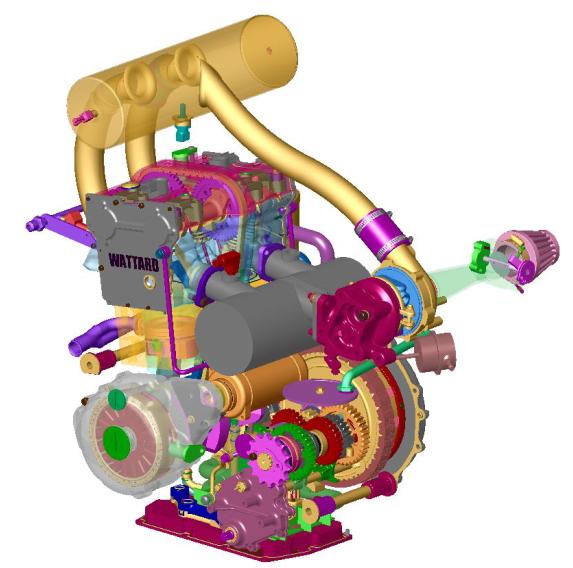
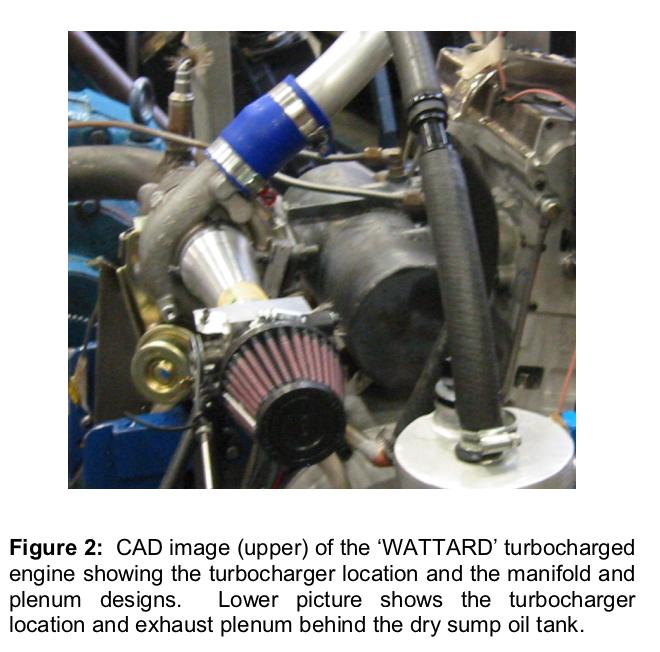
This type of exhaust and intake were used very successfully on a custom
built engine for a FSAE car. I haven't seen it on anything else till you
guys talked about it. I figured I show this to you in case there was
something to be gleaned from it.
*/Rotary Engine
<rotaryeng@earthlink.net>/* wrote:
>>>> Dear Mr Lamar,
>>>>
>>>> My name is Pierre Terblanche and I am a product / automotive
designer.
>>>> First can I say that the Chaparral cars were some of the
objects of
>>>> wonder of my youth.
>>>>
>>>> I am working on a Wankel engined project in my spare time (A
hobby...)
>>>> as I have always been a fan of the rotary engine. When I was
in college
>>>> in South Africa in the early 70s my
>>>> roommate raced a Mazda RX2 in production racing.These cars were
>>>> extremely fast and bulletproof.
>>>>
>>>> I had forgotten about the Wankel until I saw a small go-kart
engine at
>>>> the Birmingham race car show. After years of working with four
stroke
>>>> engined bikes the motor appealed to me as it is lightweight,
compact,
>>>> vibrationless. ( 52ps x 16kg.)
>>>>
>>>> It is clear to me that there are issues with the engine as far as
>>>> emissions and noise
>>>> is concerned but for a track day bike this will not be an issue.
>>>>
>>>> I found an article on the Internet about a conceptual exhaust
system
>>>> for
>>>> Wankel engines which you have designed.This was the one with the
>>>> cylindrical drum main body. Based on Russian research..?
>>>>
>>>> Would it be possible for you to let me have some more
information as to
>>>> the potential advantages of such a system. ( Compact light weight
>>>> etc....? )
>>>>
>>>> Yours Truly,
>>>>
>>>> Pierre Terblanche.
>>>>
>>>> I purchased your book "How to Cool Your Wankel" when I was in
the USA
>>>> recently.There are some very interesting practical ideas in
there.
>>>> Thank
>>>> you very much.
>>>>
>>>> ---------------------------------------------------------
>>>> Thanks you for your interest and complements.
>>>>
>>>> I think this is the muffler you are speaking of.
>>>>
>>>> Weight is going to depend on what you make it out of and how long
>>>> you want it to last and or the duty cycle.
>>>>
>>>> For a continuous duty aircraft engine some parts of it will
have to be
>>>> made
>>>> from
>>>> .035" thick Inconel to keep the weight down. The rotary
exhaust runs
>>>> up to 1800 F on all peripheral exhaust port engines. The RX8
engine
>>>> has side exhaust ports and they are about 200 F cooler.
>>>>
>>>> --
>>>> Paul Lamar ...No rotor no motor.
>>>>
>>>>
>>>>
>>>> Paul,
>>>>
>>>> Does that thing work? It would fit well on a helicopter,
especially on
>>>> a
>>>> vertical installation. Does it work better than a turbocharger?
>>>>
>>>> Steve Brazil
>>>>
>>>> In theory it does but so far as I know nobody has built one yet.
>>>> It is cheaper and easier in a plane to just use two pipes 32
inches
>>>> long and a collector. Probably would pay off in a pusher
configuration.
>>>> --
>>>> Paul Lamar ...No rotor no motor.
>>>
>>> How much to build one? Who is competant to build it? I have a
project
>>> coming up (pusher) with a single rotor that will need an effective
>>> compact
>>> exhaust system. If I don't have to sell a kid, I might be
willing to
>>> fund
>>> a
>>> prototype.
>>>
>>> best,
>>>
>>> George W.
>>
>> The muffler on my one rotor in the picture is very effective and
simple.
>> Header is 1.5" going tangentially into the 4" expander and the
aoutlet is
>> 1". I will probabely go to 5" with the expander in the flying
version, it
>> is
>> now 4" because it was available. The whole system is empty.
>> The two factors making this exhaust work are, the expansion with the
>> assosiated adiabatic cooling, and matching of the tail pipe size.
>> Standing next to the engine as in the picture, without any ear
mufflers
>> is
>> no problem, even for a prolonged period of time.
>> If anyone has a standardized measuring method, I would be
interested to
>> take
>> db measurements.
>>
>> Richard Sohn
>> N2071U
>
> Lets talk, Richard. What does your exhaust system weigh?
>
> George W
Sorry, George. I am not ready at this time to do any optimization on the
exhaust. The present system is made of mild steel from the auto muffler
shop.
For a rough weight estimate using 35thou SS, use 16"x 1 3/4, 20"x 5, and
12"x1 1/4 plus a couple of ounzes for welding and 8oz for the
flange. That
will get you close to what I am going to have on the flying version
of the
engine.
Richard Sohn
N2071U
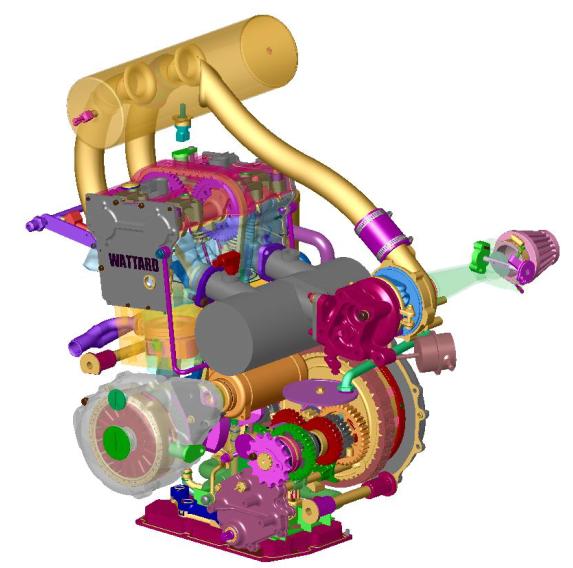
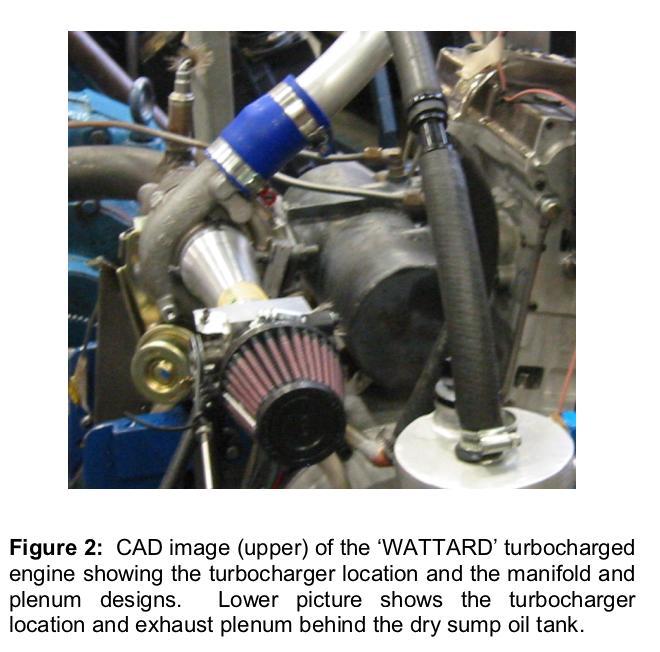
This type of exhaust and intake were used very sucessfully on a custom
built engine for a FSAE car. I havent seen it on anything else till you
guys talked about it. I figured I show this to you incase there was
something to be gleaned from it.
Rob Woods
The pdf are too big to publish Rob but here is a screen capture.
It appears to be a simple tangential muffler which dates back at least to
prewar II VW beetles. Not a tuned muffler.
Paul Lamar
The Rotary Engine NewsLetter. Powered by Linux.
ACRE NL web site.
http://www.rotaryeng.net
Copyright 1998-2006 All world wide rights reserved.