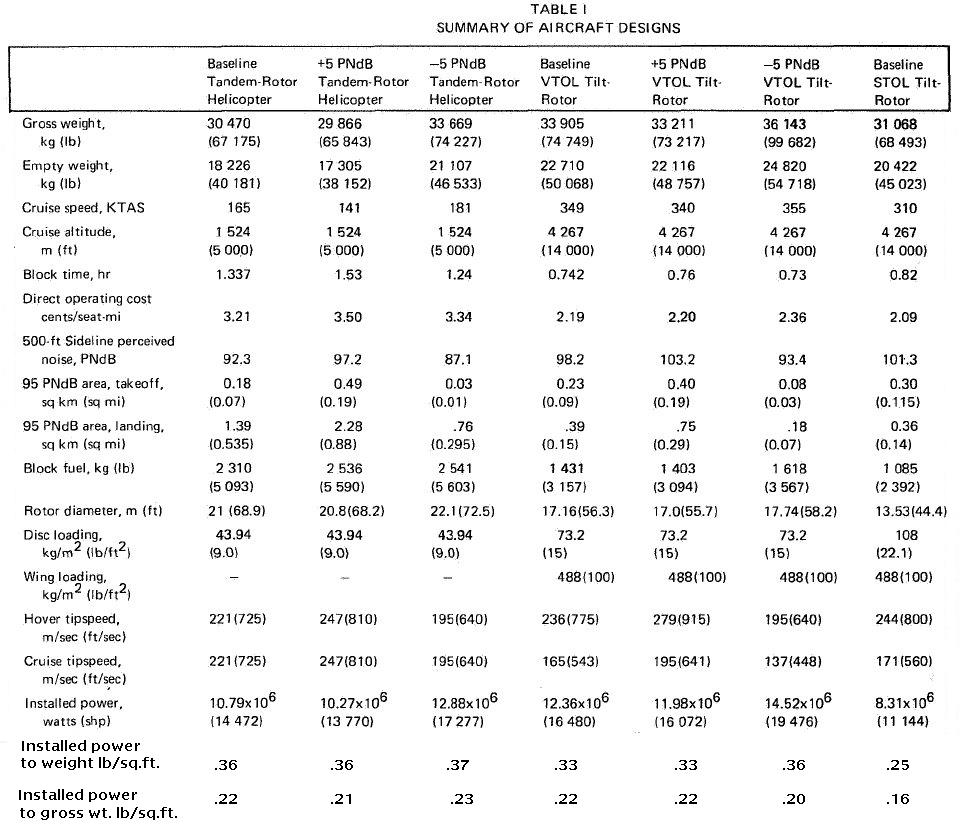
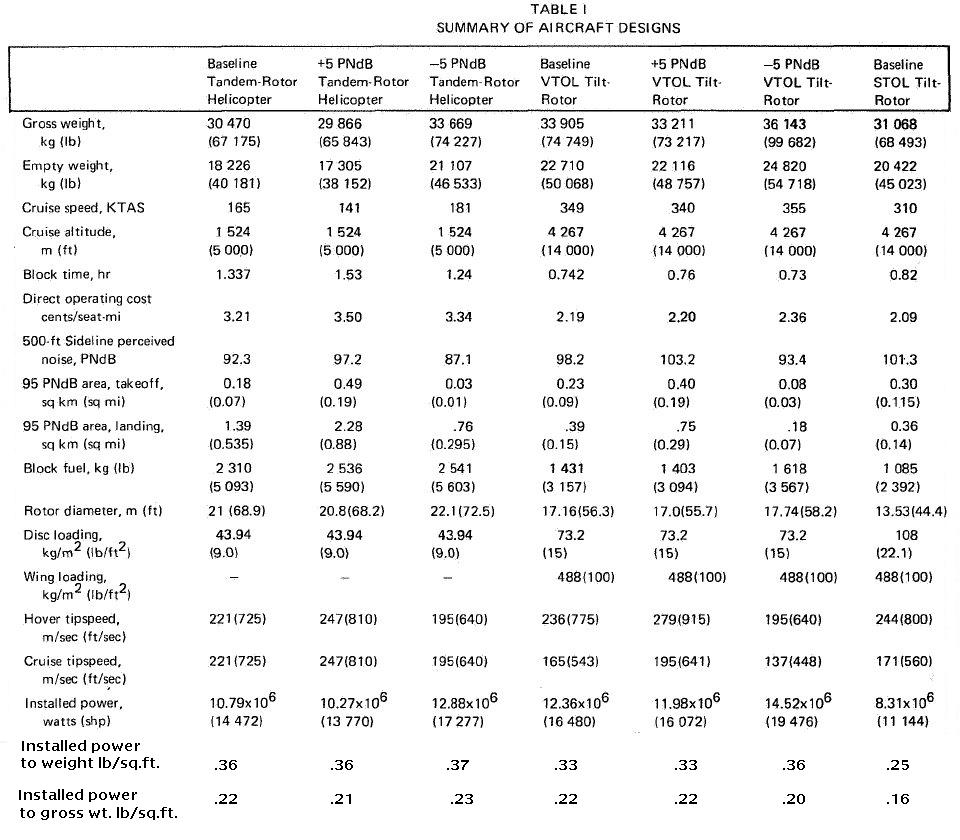
> > I have added a power to weight ratio rows on the bottom
> > of the Boeing VTOL table.
> >
> > Looks like we need to get the empty weight down to 666 pounds.
> > 13B p-port engine with aluminum end housings is 165 pounds.
> > Gear box and rotors are 100 pounds.
> > Drive shaft and accessories are 100 pounds.
> > That leaves only 300 pounds for carbon fiber structure.
> > We will probably need smaller wings with less wing area if not a delta
> > configuration. A delta configuration would ease the
> > CG, structural problems and high speed aerodynamic drag.
> > It would also shorten the drive shaft from engine to gear box.
> > A small canard for enhanced control purposes might be OK.
> >
> > No room for anything other than an optimized design in carbon fiber.
> >
> > Sorry Perry.
> >
> > The gross weight needs to be less than 1200 pounds.
> > Payload and fuel must then be 534 pounds.
> > Two 175 pound people are 350 pounds.
> > That leaves 184 pounds of fuel or 31 gallons.
> > At 10 gallons an hour 200 MPH cruise that gives us 3.1 hours
> > or 600 mile range. Beats a Robinson R22.
> >
> > Paul Lamar ...No rotor no motor.
> >
> > I haven't worked out the details yet. I started with a standard Long-EZ
> > model that has gross weight of something just less than 1500 lbs. and
> > the current simulation is running around 1200 lbs. gross I think. With
> > 300HP and 12' rotors it is underpowered. I currently have it set to
> > 400HP and it will definitely climb vertically with that power.
> >
> > I brought my son's joystick to work so today I'm going to play with
> > rhino rudder and elevator surfaces to see if I can control hover.
> >
> > Perry
> >
> > Here is the delta configuration. Motor cycle passenger
> > configuration.
> >
> > Only 10 foot span. Will fit in a one car garage.
> >
> > 50 square feet of wing area. Wing loading 24 pounds per square
> > foot. Way less than most tilt rotor VTOL aircraft which average
> > 100 pounds per square foot.
> >
> > Tilt rotor VTOL aircraft do not need a lot of wing area because
> > at 200 mph the dynamic pressure is 100 pounds per square foot so
> > that is 5000 pounds of lift at a C sub L
> > of one. 1200 pounds gross will give us a C sub L of only
> > .24 no problem.
> >
> > At 300 MPH the dynamic pressure is 234 pounds
> > per square foot 11,700 pounds of lift at C sub L of one.
> > The required C sub L would then be only .1.
> >
> > No problem getting the structural weight under 300 pounds
> > in a two piece blended wing body female mold. This will be real
> > easy and quick to build as well.
> >
> > Paul Lamar ...No rotor no motor.
>
>
>
> Do desperate times call for desperate measures? It has been written:
>
> "Looks like we need to get the empty weight down to 666 pounds."
>
> "13B p-port engine with aluminum end housings is 165 pounds."
>
> OK, guys, not that I WANT to spread heresy on this board, but, since
> weight is constrained so tightly, how about considering a gas turbine
> engine, like Honeywell's RE50, which weighs 1/2 of a 13B p-port engine?
>
> photo of the RE50:
>
>
http://www.aviationweek.com/shownews/03nbaa/images/awst09a.jpg
>
>
>
_Aviation Week and Space Technology_ said about the RE50:
>
http://www.aviationweek.com/shownews/03nbaa/awst09.htm
> The APU will weigh 50-60 lb. and *is being developed in conjunction with
> the firm's automotive products groups to keep acquisition costs low*.
> The installation envelope should be about 20 X 12 X 12 in., and the unit
> should be at least as quiet as the company's RE100 APU, used on the
> Citation Excel. Company officials predict the finished product, which
> should be able to
*remain "on-wing" for 3-5 years*, will have a *price
> "significantly below" the RE100*.
> Technology used in the unit will include a *gearless, oil-less system
> *that incorporates a generator mounted on the core shaft. The shaft will
> turn at 100,000 rpm., and the
*unit will provide 250 amps of energy*.
> The APU will feature *innovative air bearings *derived by Honeywell from
> air cycle systems used in aircraft environmental control systems. These
> bearings,
*which also serve as thrust bearings in the **APU* . . .
> (edited by Les Nordman for emphasis)
>
> So, light weight--check. Reliability--check. Low price--check.
> Bearings--check. Sounds like it meets your criteria.
>
> Either your Favorite Innovator or your favorite Pelagian,
>
> Les Nordman
>
>
> Low price is relative.
> Turbines are great. The cheap ones based on old APU's suck down fuel
> like there is no tomorrow. After all what is a couple of hundred gallons
> of fuel to a B747 or other jet aircraft? The relatively economical
turbo prop
> versions cost well over $100,000 used and maybe as much as $250,000.
The high fuel
> consumption cuts into the range because there is only so much volume in a
> small aircraft around the CG to store fuel. That is not a problem for the
> military as they usually have air to air refueling.
>
> This is one of the reasons people put rotaries in aircraft.
> Up to about 1000 HP the rotary is a better choice for aircraft use.
> Another reason is turbo prop performance drops off with altitude
> rather severely. It is possible to sequentially turbo charge a rotary to
> the point it will make 40,000 feet or more. My buddy Jeff Spitzer got
a piston
> engine aircraft up to 56,000 feet using sequential turbo chargers.
>
> 40,000 feet was common for WW II super and turbo charged piston engine
> fighter aircraft. Fundamentally there is no difference other than
> the fact the rotary may be more altitude capable due to the high energy
> content in the exhaust. The turbo compound rotary could be as much as 20%
> more economical than a piston engine and half the fuel burn of a
> comparably sized turbine with only a slight penalty in power to
weight ratio.
>
> Paul Lamar ...No rotor no motor.
"Up to about 1000 HP the rotary is a better choice for aircraft use.
"The turbo compound rotary could be as much as 20% more economical than
a piston engine and half the fuel burn of a comparably sized turbine
with only a slight penalty in power to weight ratio."
Fantastic! So, if a 13B p-port engine with aluminum end housings weighs
165 pounds, how much would the same engine with a turbo compounder
weigh? And, though it is heavier than just the 13b engine, would the
turbo compounded 13b yield enough extra energy to lift the VTOL design
into the air and push it through the sky at 300 mph?
Maybe your favorite Gnostic,
Les Nordman :-)
Yes if based on a P-port Mazda rotary engine.
A TO4 turbo charger weighs 16 pounds. A gear box and belt drive
for it weighs about 3 or four pounds. In fact the turbo compound engine
really pays off big time at high altitude. My guess is 350 MPH. Which
will beat any personal jet on MPG by a factor of five or more if not on speed.
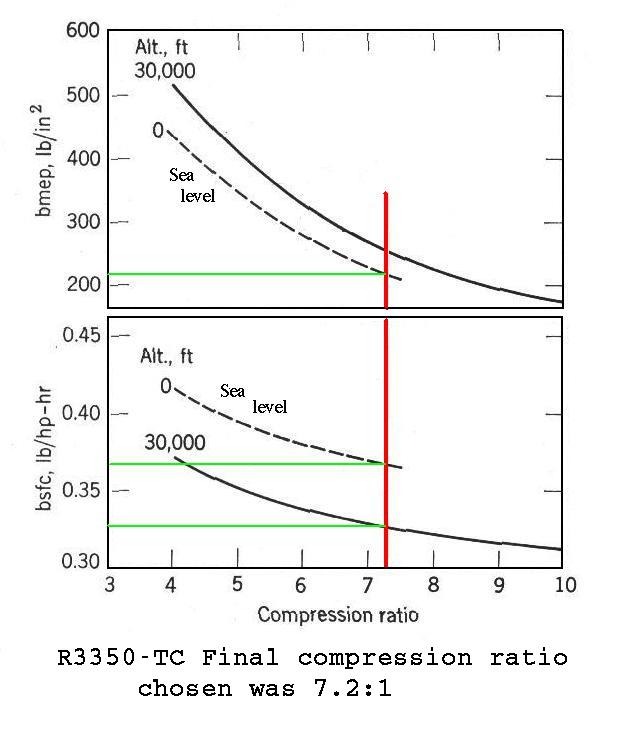
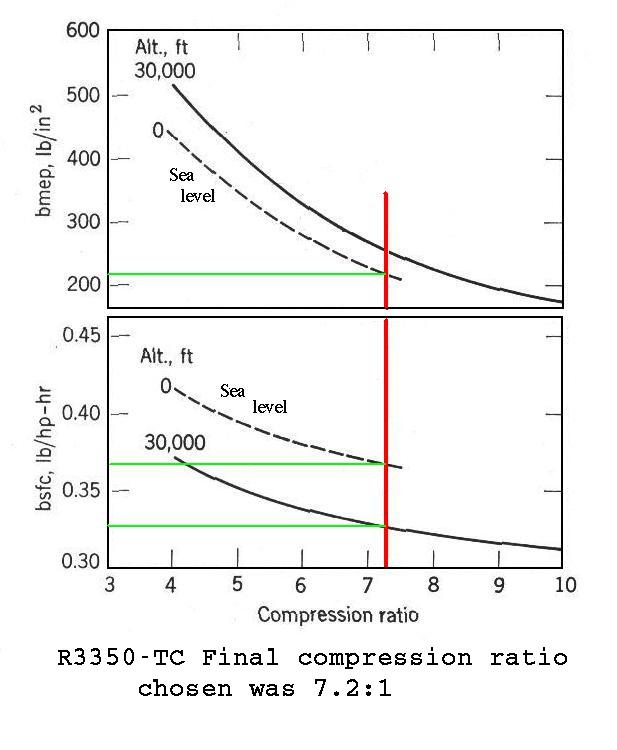
Here is a chart for a R3350 turbo compound engine fuel consumption as a function
of altitude. As you can see both the power is up and the fuel burn per HP
generated is down while so is the aerodynamic drag. This is due to
less back pressure on the turbo compound turbine.
I updated the web site so check out
http://www.rotaryeng.net/VTOL.html
Let me know if you find any errors.
BTW we could go even faster if we upped the wing loading to a typical
tilt rotor VTOL wing loading of 100 pounds per square foot. That would drop
the wing area to 12 square feet and the wing drag HP to about 25 at 300 MPH.
It would also reduce the wing weight and the interior volume for fuel and cooling
system. Perhaps to an impractical level.
Also BTW In this airplane with the engine running there is no such thing as a
stall. As the aircraft slows down the angle of attack automatically increases
up to 90 degrees.
Paul Lamar ...No rotor no motor.
The Rotary Engine NewsLetter. Powered by Linux.
ACRE NL web site.
http://www.rotaryeng.net
Copyright 1998-2006 All world wide rights reserved.