All,
That business with the ball instead of the swashplate has been done and it
works well on a rotor system with light control forces. The other problem
with this system is that it is mounted under the transmission where the
access may not be what you want.
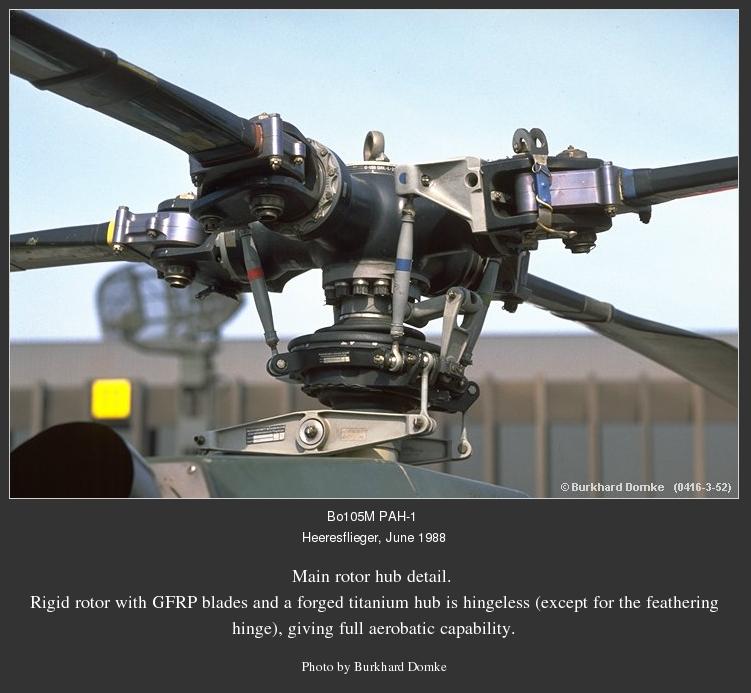
Bolkow-Messerschmidt, now owned by Eurocopter, builds a helicopter with a
four-blade rotor system that is hingeless and bearingless. It uses the
elasticity of the composite (S-glass, I think) beams that connect the blade
to the hub for lead, lag and pitch. This aircraft is seen at airshows doing
aerobatics like a fixed wing aircraft. You're right that articulated
systems do not impart a moment to the mainshaft (at least not until they hit
their stops) but rigid hub types can.
Steve Brazil
----- Original Message -----
From: "Rotary Engine"
<rotaryeng@earthlink.net>
To: "AARotary Engine"
<rotaryeng@earthlink.net>
Sent: Thursday, September 06, 2007 1:46 PM
Subject: VTOL rotor hub FEA
Well Sir, I finally got a few seconds to do these FEA's on
your hub.
I installed some 'ball bearings' of sorts and then a shaft/stub
where the
blades would sit. I loaded this stub two ways. The first was
radially out from the center w/ a 16,000 lb load. And then on
a flat face which
was 24" from center I put 325 lb's force perp to the plane of
rotation. I put symmetrical loads on either end of the hub and
then used Larry's
6061-T6 Alum material properties to test it.. 32seconds later it
gave me these
I think that the area where it neck's down is really the only
area which might need a little more material.. the rest looks
like it could
fly. If it was made from Alum.. that is..
Larry also gave me some material data on composites so I did
these w/ Eglass. Now the data did not provide a yield number
for the material
so it doesn't show whether it's exceeded it , but hopefully these
will be
useful to you as well..
Anyway if you want me to do any more just fire away.. it takes
longer to copy and
paste the screen shots than it does to do the FEA part of the
job..
Jarrett
Thanks Jarrett. You do great work.
Looks like it is over designed just about everywhere except
the necked
down area. Time to save some weight :) I'll go with the e-
glass results.
--
Paul Lamar ...No rotor no motor.
I think the yield strength for e-glass structures is rarely a
concern -
it's so flexible that by the time you reach yield, the structure has
flexed so much that other things start going wrong. Certainly e-glass
can be used in a particular structure where the yield strength
matters,but it may be more relevant to design for stiffness..
Regards,
Matt-
I would agree in most cases. Helicopter rotor heads are unique
situationswhere some flexibility is required to deal with the
gyroscopic forces.
You have this big gyro up there and every time you try to pitch
or yaw huge bending forces are introduced into the shaft. Also as the
blade moves forward on one side the lift is greatly increased while
the blade moving aft the lift is greatly decreased. This too causes
bending moments on the blade. Mitigating all this is the centripetal
forces on the blade due to their own weight which in effect tends
to keep them flat while still supporting the weight of the craft.
Without this effect they are no where near strong enough to support
the weight of the helicopter.
Consequently most helicopters have what amounts to a U-joint between
the blade and the shaft. This minimizes the bending loads on the
shaft.
The new thing is a semi rigid rotor head made from glass composite
that provides the flexibility required while simplifying the rotor
head.Glass fiber does not fatigue.
http://www.b-domke.de/AviationImages/Rotorhead.html
Paul Lamar ...No rotor no motor.
When I was a kid I always wanted a helicopter.. never had the gumption to go
and do something about it.. but I could day dream. Now, back then there
was no Internet to cloud my train of thought so I set down to figure out
how to make it fly.
I understood the concept of a swash plate and how that actuated the
blades but wanted to simplify it. My plan was to use a rather large
rotor mast [in the order of 6" dia. or so] and run a control rod up through
the center of the mast. It would have a spherical plane bearing
in the center and a ball bearing at the top. The rod [ an 3" tube more
likely]
would be moved in both the x and y directions at it's bottom end, it would
pivot on the spherical plane bearing in the middle of the mast and
thereby move the top end of the rod [w/ the bearing] in the same but
opposite motion as the bottom end. The bearing at the top was
connected to the blades via linkage arms and would actuate
the blades when the center rod was moved.
The top bearing was riding on a shaft which slid in the center control
rod and would be used to adjust collective.
I'm not sure if it was less complex than current swash plate and link's
used in heli's of today or not.. maybe someday when I have time I'll build
an R/C
model of it and test it.. I know the R/c heli's I used to fly were a beast
to configure
and get working/tracked properly.. and all that stuff bends and wreck's
easily in only
the slightest of hard landings..
Anyway, looking back I guess it wasn't such a bad day dream.. at least not
for a
14 yr old kid..
Not sure if the idea applies or not.. but just wanted to tell someone about
the idea..
maybe it will go somewhere.. or maybe it's already been done..
Best
Jarrett
I would love to see a 3D Jarrett. Sounds like it has real possibilities.
--
Paul Lamar ...No rotor no motor.
All,
That business with the ball instead of the swash plate has been done and it
works well on a rotor system with light control forces. The other problem
with this system is that it is mounted under the transmission where the
access may not be what you want.
Bolkow-Messerschmidt, now owned by Eurocopter, builds a helicopter with a
four-blade rotor system that is hingeless and bearingless. It uses the
elasticity of the composite (S-glass, I think) beams that connect the blade
to the hub for lead, lag and pitch. This aircraft is seen at airshows doing
aerobatics like a fixed wing aircraft. You're right that articulated
systems do not impart a moment to the mainshaft (at least not until they hit
their stops) but rigid hub types can.
Steve Brazil
I figure the moments will be brief :) Sorry Steve I could not resist
saying that. I know John Dinkel, whereever he is, will appreciate that.
In all seriousness I am going to try a glass fiber shaft to mitigate
the problem.
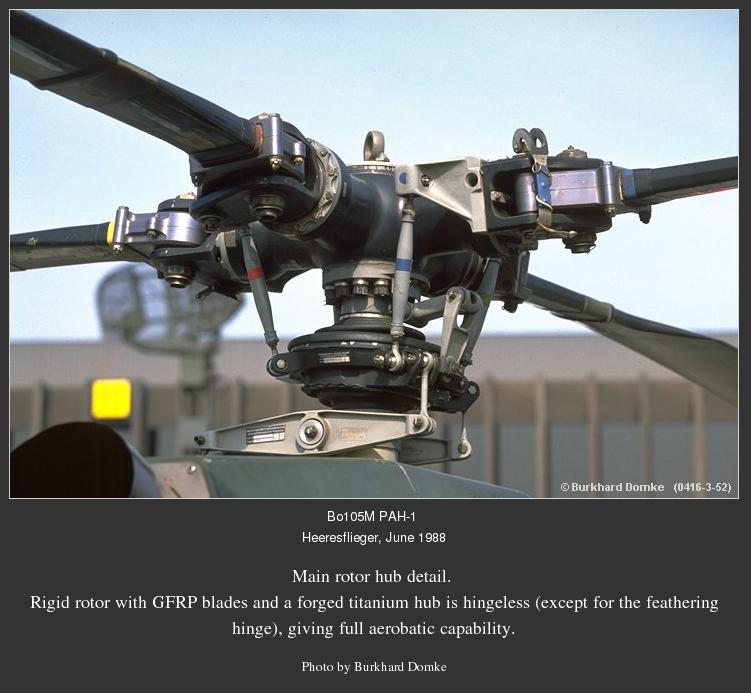
Here is a picture of the Bolkow-Messerschmidt rotor head.
I think I will copy this as closely as possible.
Paul Lamar
The Rotary Engine NewsLetter. Powered by Linux.
ACRE NL web site.
http://www.rotaryeng.net
Copyright 1998-2006 All world wide rights reserved.