> > Hey Paul,
> >
> > I have seen a number of Midget Mustangs (the single seater)
> powered by
> > O-320's. I just saw an MM powered by an O-360 with a C/S
> prop. I'd
> > have to think it would be fairly reasonable to stuff a
> 13B into
> an MM.
> > Maybe even mount the radiator under/behind the pilot, just
> like the
> > P-51. Could help the weight and balance. I've also seen a
> couple of
> > MM's with retractable landing gear. Such a combination
> should
> qualify
> > for Sport Class - enough have been built. I'd like to
> have a
> structural
> > analysis for flutter. It shouldn't be against class rules
> to put
> enough
> > more beef in the structure to make it go
> 400mph.. Hah. :) Or
> at least
> > fast enough to raise some eyebrows.
> >
> >
> > Regards
> >
> > Matt-
>
> If you want to run in the Sport Class with a Midget
> Mustang, I
> would
> use an
> aluminum 20B. A better place for the radiators is in the
> inboard
> leading
> edges. I think this is actually a lower drag installation and
> you won't
> have to sit on those coolant lines.
>
> Steve Brazil
>
> Rather than an Al 20b, I'd go with a turbocharged aluminum 13b. It
> would fit better, and probably fly better, and be plenty of
> horsepower.
> I see a development path on the airframe starting with an O-200
> (I have
> one), moving to an NA P-Port Iron 13b, and then to turbocharged
> Al (if
> I'm still having fun).. I realize there's no replacement for
> displacement however.
>
> Thanks,
>
> Matt-
>
> You know Matt there are plenty of cheap Formula 1 airplanes for
> sale.
> Here is the slickest one I have seen so far. Not necessarily
> for sale.
>
> Paul Lamar
>
>
> That's a Mike Arnold designed airplane Paul (the Endeavor -
AR-6). Mr
> Arnold came to fame as a film maker turned airplane designer
who built a
> 65hp Rotax powered airplane that ran ~215mph on a timed course -
> setting
> a world record, and earning the claim to being the only (or one
of few)
> man carrying powered airplanes with a flat plate drag
equivalent of less
> than 1 sq ft. Mr. Arnold studied and applied Hoerner's works
> extensively in the AR-5, and then again in Dave Hoover's
Endeavor. A
> talented guy.
>
> I suspect that the AR-6 is actually a nice flying airplane,
unlike most
> of the F1 birds. In a conversation I had with Gary Hubler a few
years
> ago, I got the impression that Mariah (a heavily modified Cassutt)
> actually didn't fly particularly well - on the first flight he
was doing
> aerobatics - a loop required forward stick pressure all the way
around.
> They put lead in the prop extension/spinner to try to get the
CG more
> reasonable. Most of the fast f1 airplanes have really thin airfoil
> sections and tiny control surfaces. Eeesh.
>
> The MM's are too big to be competitive in F1 racing (IMO), but
if you
> put more hp on them they could be pretty fast. They have
conventional
> Aluminum construction which should make structural analysis and
> improvement easier. The MM is already pretty strong - being
rated at
> something around 9g ultimate and having a 230mph published VNE.
> Obviously a study would be required to see what the limitation
on VNE is
> and how to increase it.
>
> I would prefer to keep the overall airframe weight close to the
stock MM
> max takeoff weight (at odds with the above goal).. At that
weight the
> MM has a reasonable stall speed (~60mph). The stall speed has the
> largest effect on bad-landing (off airport) survivability. It's
_much_
> easier to provide impact protection for 60mph than for 90mph. I
am not
> a daredevil nor a fighter pilot, and so I would like whatever I
come up
> with to remain a nice sport airplane.. My goal isn't to
actually win at
> Reno, but to have something that I could fly to the races,
raise a few
> eyebrows, and have well less than $50k in (total). It would be
fun to
> be able to spank a few F1 rockets and slower Lancairs too.
>
> Regards,
>
> Matt-
>
> I totally agree on the stall speed. The energy in a crash is
m*V^2.
> Fowler flaps can triple the landing lift coefficient required so
if
> you want
> to go fast and keep 60 MPH stall speed you need just enough wing
> area to have
> a stall speed of 60 MPH with the flaps out. The other mandatory
> requirement for
> going fast at Reno is a high aspect ratio wing. AKA low span
loading
> as you are
> in a continuous turn almost. Induced drag is Cl^2/(pi*A). 2G turn
> twice the Cl.
> Three G turn 3 times the Cl. Four times as much induced drag at
only
> a 2 G turn.
> All of this assumes you keep the weight as low as possible.
>
> I don't think a single place qualifies for Sport Aircraft at Reno.
> That I think is why they put the pax sort of next to the pilot
> in the Nemesis Nxt.
>
> --
> Paul Lamar ...No rotor no motor.
>
> The Sport Class rules:
>
> A. Aircraft eligible for competition within the Sport Class shall
fall
> into either of two catagories: Sport or Super Sport. Sport aircraft
> shall be limited to production model kit-built aircraft, to
include
> Long and Vari Eze models, of which 5 or more kits have been
produced
> and delivered to customers by the manufacturer, powered by a
> reciprocating engine of 650 cu in. or less, and capable of a
200 MPH
> qualification lap speed. Super Sport aircraft shall be limited to
> production model kit-built aircraft, of which 5 or more kits have
been
> produced and delivered to customers by the manufacturer,
powered by
a
> reciprocating engine of 1000 cu in. or less, and capable of a 300
MPH
> qualification lap speed. A kit is herein defined as consisting of
> wings, empenage, fuselage and all related control surfaces. Also
> included must be landing gear, canopy, motor mount and sufficient
> build instructions. The prototype may be included as one of the 5
> required kits. The specifications listed herein will be the only
> specifications of the Sport Class. Aircraft not in compliance
will be
> disqualified from the competition. The Sport Class Board of
Directors
> will implement disqualification upon due consideration along with
> recommendation of the Technical Committee and/or the Contest
> Committee. Any significant airframe modifications to eligible kit
> built aircraft must be approved by the Pilot Standards/Committee
prior
> to entry.
>
> My interpretation of this would allow running a single seat MM in
Sport
> Class... There was a single seat Harmon Rocket and I think a single
> seat Edge 540T a few years ago (the Rocket was surprisingly slow,
and
> the Edge was surprisingly fast).
>
> I think they made the NXT a 1.5 seater for marketing
considerations, and
> possibly for aerodynamics (area rule). I understand that some
future
> NXT's might be narrowed to a true single seater.
>
> Regards,
>
> Matt-
>
> OK I stand corrected. Looks like an RV3 also qualifies.
> Of course the wing is too short to be competive. That is why the
Rockets
> are so slow and why the Edge is so fast. What is the wing span on
the MM?
>
> Paul Lamar ...No rotor no motor.
>
> Paul,
> Of course one of the other considerations is how much motor you
can
> stuff in there. Looking at the NXT with the cowl off ther isn't a
lot of
> room to make the engine compartment narrower. With the turbos,
and the
> intercoolers there is just very little room in there. A 20B would
fit in
> a single though! The lyc wouldn't allow a much smaller package!
> Bill Jepson
I don't know that a Midget Mustang would be legal--not because it is
single
place but because I don't think it was ever offered in a kit as
complete as
the rules, that someone posted, defined. I wouldn't write off the
aluminum
20B; an O-360 with an aluminum constant speed prop weighs around
350lb and I
think the aluminum 20B with a turbocharger and a composite prop
would beat
that.
It is also true that the Midget Mustang is a tough little
airplane. What
you have to worry about, taking it a lot faster than it was intended,
is
flutter and the increased dynamic pressure. I think you will need
additional spanwise stiffeners on the forward wings and tail
surfaces, maybe
a thicker windscreen, stronger landing gear fairings and a stronger
cowl.
There are people who can help analyze and prevent flutter. You may
also
need taller gear for the larger prop.
This could be interesting. The reason that that Zivko Edge went so
fast is
that it had a GEARED O-540. They're going fast enough now that
propellers
are getting critical and 2.85 to 1 reduction is available for
rotaries.
Steve Brazil
Steve,
I agree with all of your analysis except for whether I want the weight
of an O-360 and a CS prop on the front of a MM. I kind of think I don't
want that. I'd like to shoot for O-320 weight or less in order to
retain bad-landing survivability, and to have good span loading and low
trim drag. Obviously if your sense of the numbers is better than mine,
a 20b as you described would be the way to go.
Regards,
Matt-
There isn't much difference in weight between the O-320 and O-360.
It can
be as little as ten pounds depending on variant. The big problem
with that
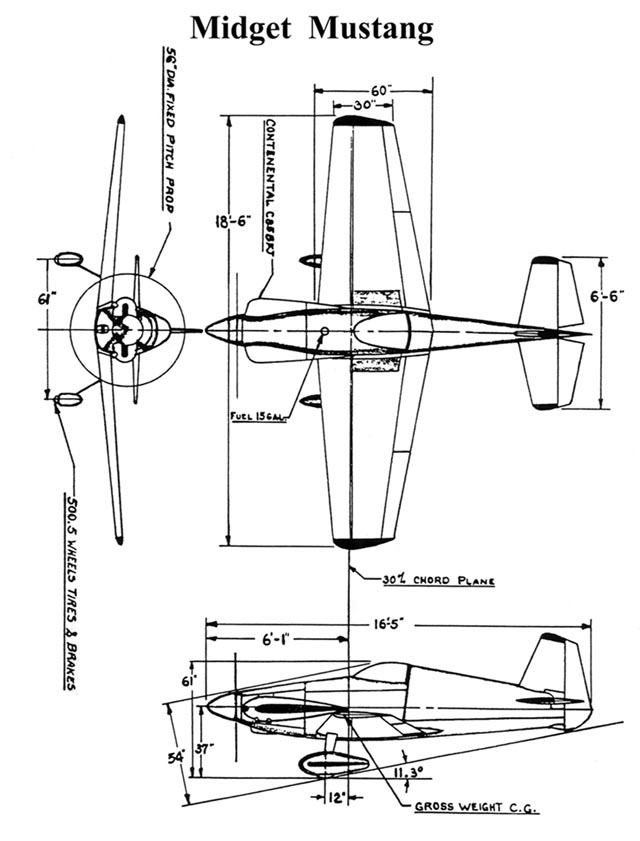
airplane is the propeller. The drawing calls out a 56 inch diameter
prop.
http://www.mustangaero.com/images/Midget%20Mustang/Midget%203%20View.JPG
<http://www.mustangaero.com/images/Midget%20Mustang/Midget%203%20View.JPG>
I think you will need a four-blade prop about 72 inches in diameter
which
will mean the gear will need to be another probably six inches
taller. MT
is probably the only supplier around for a composite prop like that,
the
weight of a metal one, if there was one available, would be prohibitive.
Another six inches in the aft fuselage would help along with a little
taller
vertical and it would still only be about 17 feet long. I think this
would
work but you will have to be very careful getting used to flying it.
I was
talking to my buddy today who I had helped race his RV at Reno a few
years
ago and he thinks this has possibilities too. Talking about RV's it
isn't
the aspect ratio of the Rockets as much as it is the NACA 23014 airfoil.
The Midget Mustang has a much faster, thinner laminar airfoil.
I still think the airplane to look at is the short wing Glasair II
RG. It's
a nose dragger, which I don't care for, but it's easier to deal with
on the
ground. It has enough room in the cowl for a turbocharged, aluminum
20B and
it was designed from scratch to use an engine of this weight. It has
room
for a 72 inch propeller and you should have no problem with the rules.
There are also abandoned kits around that can be had for reasonable
money.
One of these things with 500hp and a prop running at 2500rpm would
be in
the
running. A FIXED GEAR Glasair II TD ran at better than 265 at Reno last
year with probably 240hp from his four-cylinder Lycoming (I don't know
if it
had 390 or 400 cubic inches).
Steve Brazil
Steve,
That airplane is supported by the factory. It started life as a 390,
don't know the current displacement! I can say that it has a hell of a
lot more than 240 HP! 300+ as a mimimum.
FWIW.
Bill Jepson
I appreciate the thoughts.. My idea was to pick the smallest proven
airframe that could accommodate a 13b and still be a nice flying
airplane. The 13b is great because it's possible to keep costs down by
using off the shelf parts, and because it's just simpler - fewer total
parts. Like I said in previous messages, I am interested in have a nice
sport plane, not some flying "manhole cover," so I think a 20b is a
non-starter. I am not trying to discourage others from pursuing their
own dreams, however.
I had also concluded that a Midget Mustang with a 13b would need longer
gear for prop clearance. Before I gave up on the idea of running at
Reno, my buddy and I were speculating on the Sport Class rules and
whether the description of the kit to include landing gear meant that
the airplane actually had to use the landing gear from the kit, or
whether substitutions could be made. If it were required to use the
original gear, certainly extensions could be devised. My other idea was
to use (pieces of) the existing gear as a portion of the lower section
of a retractable system akin to the Grumman Bearcat - the upper portion
of which swings out, the lower portion swings in, kind of folding on
itself.
http://www.warmkessel.com/jr/flying/td/jd/images/pp39_main_gear.jpg
How to put retractable gear on a little airplane with a big engine...
Regards,
Matt-
The Rotary Engine NewsLetter. Powered by Linux.
ACRE NL web site.
http://www.rotaryeng.net
Copyright 1998-2006 All world wide rights reserved.