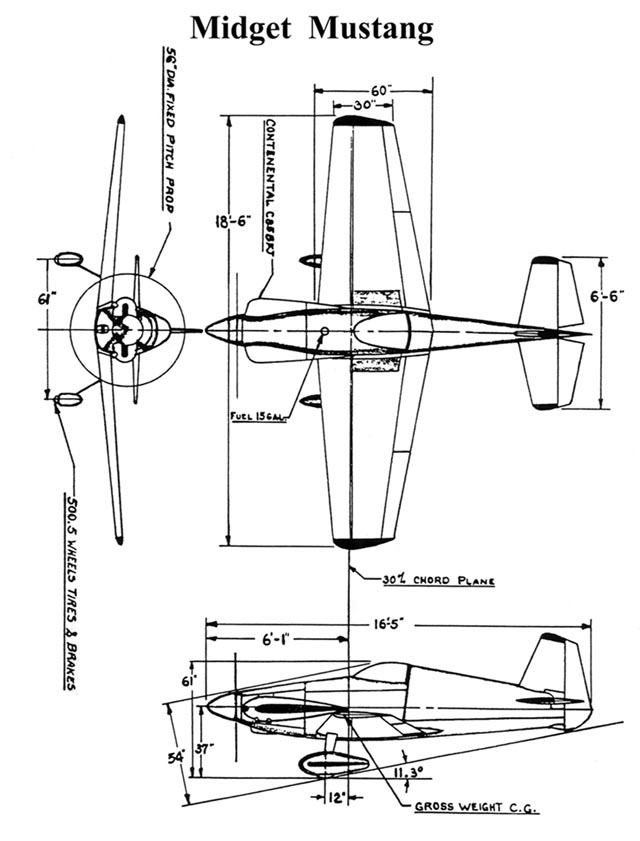
I don't know that a Midget Mustang would be legal--not because it is
single
place but because I don't think it was ever offered in a kit as
complete as
the rules, that someone posted, defined. I wouldn't write off the
aluminum
20B; an O-360 with an aluminum constant speed prop weighs around
350lb and I
think the aluminum 20B with a turbocharger and a composite prop
would beat
that.
It is also true that the Midget Mustang is a tough little
airplane. What
you have to worry about, taking it a lot faster than it was intended,
is
flutter and the increased dynamic pressure. I think you will need
additional spanwise stiffeners on the forward wings and tail
surfaces, maybe
a thicker windscreen, stronger landing gear fairings and a stronger
cowl.
There are people who can help analyze and prevent flutter. You may
also
need taller gear for the larger prop.
This could be interesting. The reason that that Zivko Edge went so
fast is
that it had a GEARED O-540. They're going fast enough now that
propellers
are getting critical and 2.85 to 1 reduction is available for
rotaries.
Steve Brazil
Steve,
I agree with all of your analysis except for whether I want the weight
of an O-360 and a CS prop on the front of a MM. I kind of think I don't
want that. I'd like to shoot for O-320 weight or less in order to
retain bad-landing survivability, and to have good span loading and low
trim drag. Obviously if your sense of the numbers is better than mine,
a 20b as you described would be the way to go.
Regards,
Matt-
There isn't much difference in weight between the O-320 and O-360.
It can
be as little as ten pounds depending on variant. The big problem
with that
airplane is the propeller. The drawing calls out a 56 inch diameter
prop.
http://www.mustangaero.com/images/Midget%20Mustang/Midget%203%20View.JPG
<http://www.mustangaero.com/images/Midget%20Mustang/Midget%203%20View.JPG>
I think you will need a four-blade prop about 72 inches in diameter
which
will mean the gear will need to be another probably six inches
taller. MT
is probably the only supplier around for a composite prop like that,
the
weight of a metal one, if there was one available, would be prohibitive.
Another six inches in the aft fuselage would help along with a little
taller
vertical and it would still only be about 17 feet long. I think this
would
work but you will have to be very careful getting used to flying it.
I was
talking to my buddy today who I had helped race his RV at Reno a few
years
ago and he thinks this has possibilities too. Talking about RV's it
isn't
the aspect ratio of the Rockets as much as it is the NACA 23014 airfoil.
The Midget Mustang has a much faster, thinner laminar airfoil.
I still think the airplane to look at is the short wing Glasair II
RG. It's
a nose dragger, which I don't care for, but it's easier to deal with
on the
ground. It has enough room in the cowl for a turbocharged, aluminum
20B and
it was designed from scratch to use an engine of this weight. It has
room
for a 72 inch propeller and you should have no problem with the rules.
There are also abandoned kits around that can be had for reasonable
money.
One of these things with 500hp and a prop running at 2500rpm would
be in
the
running. A FIXED GEAR Glasair II TD ran at better than 265 at Reno last
year with probably 240hp from his four-cylinder Lycoming (I don't know
if it
had 390 or 400 cubic inches).
Steve Brazil
Steve,
That airplane is supported by the factory. It started life as a 390,
don't know the current displacement! I can say that it has a hell of a
lot more than 240 HP! 300+ as a mimimum.
FWIW.
Bill Jepson
I appreciate the thoughts.. My idea was to pick the smallest proven
airframe that could accommodate a 13b and still be a nice flying
airplane. The 13b is great because it's possible to keep costs down by
using off the shelf parts, and because it's just simpler - fewer total
parts. Like I said in previous messages, I am interested in have a nice
sport plane, not some flying "manhole cover," so I think a 20b is a
non-starter. I am not trying to discourage others from pursuing their
own dreams, however.
I had also concluded that a Midget Mustang with a 13b would need longer
gear for prop clearance. Before I gave up on the idea of running at
Reno, my buddy and I were speculating on the Sport Class rules and
whether the description of the kit to include landing gear meant that
the airplane actually had to use the landing gear from the kit, or
whether substitutions could be made. If it were required to use the
original gear, certainly extensions could be devised. My other idea was
to use (pieces of) the existing gear as a portion of the lower section
of a retractable system akin to the Grumman Bearcat - the upper portion
of which swings out, the lower portion swings in, kind of folding on
itself.
http://www.warmkessel.com/jr/flying/td/jd/images/pp39_main_gear.jpg
How to put retractable gear on a little airplane with a big engine...
Regards,
Matt-
Matt,
The rules are pretty liberal on modifications. Daryl Greenameyer's plane
had large portions of the fuselage reshaped. Also the wing was completly
re-done. This may be one of these "old boy" deals. Before trying it
yourself you would be best off to check with the officials and get it in
writing that a mod was OK!
Bill Jepson
If you want to see what a Midget Mustang would look like cleaned up, look at
this:
http://www.polenspecial.com/polen_special.htm
This thing actually started out as a Midget Mustang. I don't know how much
of it is still but it shows how clean this thing can be made. It also uses
an O-360 with a constant speed prop.
Steve Brazil
I see where they claim it has excellent auto rotation qualities.
Paul Lamar
The Rotary Engine NewsLetter. Powered by Linux.
ACRE NL web site.
http://www.rotaryeng.net
Copyright 1998-2006 All world wide rights reserved.