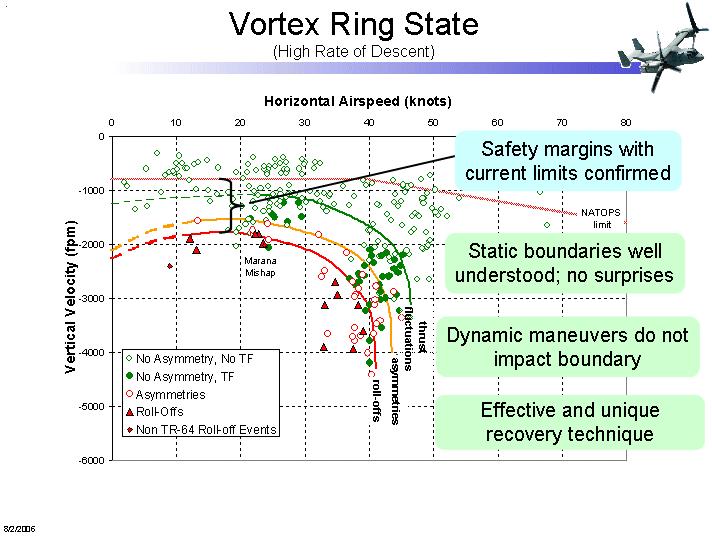
A big deal has been made about the V22 Osprey 47 degree blade twist
and how it affects the Vortex Ring State. Unlike a helicopter
high blade twist is necessary in a tilt rotor to get good
propeller efficiency at high speed. What the V22 critics don't
realize is an off the shelf variable twist propeller blade is already
on the market and has been proven to work. Namely the IVO. We are not
affected
to the same extent as the V22 is to VRS as we have only one rotor axis.
However blade
twist negatively affects the efficiency of the rotor in the vertical
take off mode.
I am going to check with IVO and see if they can build us a 6.5 foot
long variable twist blade. http://www.ivoprop.com/
Paul Lamar ...No rotor no motor.
Paul,
I don't think the blade twist has anything to do with vortex ring state on
the V-22. I think the reason it gets into that is that it has a very high
disk loading and a lot of vortex energy to get it going. Another term to
describe this phenomena is "settling with power". Almost any helicopter
can
get into this situation but it is aggravated by disk loading. That IVO
prop idea is interesting. Are you going to put some cone angle in the
hub?
Steve
There is a whole group of people that disagree.
There is no doubt a twisted blade with 47 degrees of twist, same as the
V22
Osprey has, is less efficient in the helicopter mode. Check out:
http://www.rotaryeng.net/VTOL.html as I updated it today.
Paul Lamar ...No rotor no motor.
Paul,
That's an interesting article, I'll go through the whole thing at work
tomorrow when I need something mentally stimulating. In the introduction,
the author pretty much agrees with what I said. That picture does a good
job of describing what happens. It looks like a toroidal tornado with the
center near the rotor tips. The aircraft is most susceptible at low speed
when the vortices can build on each other and in or near ground effect
height.
I didn't comment about the V-22's efficiency in hover, but as a rule, the
higher the disc loading, the worse it gets. Looking at the V-22 in hover,
I
would think that the inboard third or so of the blade is stalled so it's
taking extra horsepower to turn it. On a helicopter, the inboard third of
the blade really doesn't do that much, but it's nice to have it faired to
reduce horsepower required and preserve energy in autorotation. That's
what
would be interesting about your IVO prop idea--you could take some of the
twist out in hover.
Steve
Are you saying the blade twist is the reason the V22 won't auto rotate?
> Paul Lamar ...No rotor no motor.
Paul,
To auto rotate the lift vector of the driving section of the rotor must be
at a leading angle to the axis of rotation , to pull it around. As the air
flow is from below, and as the stall angle is less than 20 deg. , the actual
geometric angle of the blade to the axis must be quite small.
Colin Smith
Sounds like an untwisted blade would help. Do you agree?
Paul Lamar ...No rotor no motor.
The Rotary Engine NewsLetter. Powered by Linux.
ACRE NL web site.
http://www.rotaryeng.net
Copyright 1998-2006 All world wide rights reserved.