Paul
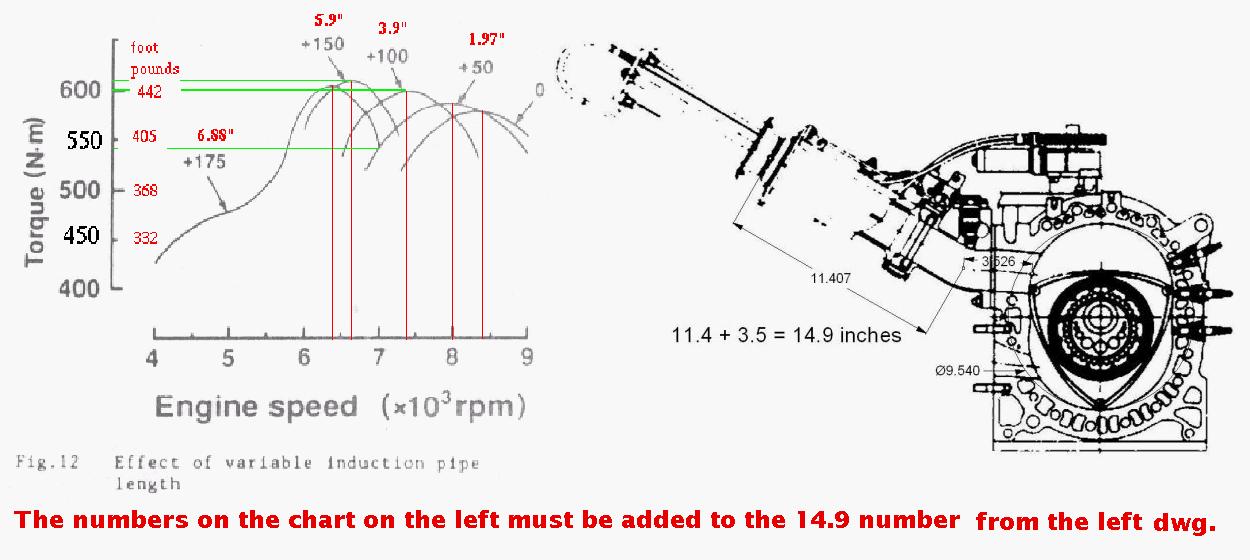
I noticed many intake designs have constant diameter intake pipes while
Guru Racing and a few others taper theirs down to the intake port.
I will make my intake manifold out of carbon or some other heat resistant
glass epoxy GRP so I am free at the moment as to the course and profile they
will be.
I thought to go from 60mm id at the intake plenum with the adjustable length
portion being able to extend another 120mm within the intake intake plenum.
From the plenum to the slide throttle, a distance of about 320mm I would
like to taper the tubes down to 50mm gradually over their length.
Injectors are right after the slide throttle so fuel mist separation is not
an issue. Other than being a pain in the butt to construct the tapered pipe
are their any disadvantages or advantages to such a design?
Thanks
Doug
It is mentioned in:
Scientific Design of Exhaust and Intake Systems. Philip H. Smith
and John C. Morrison Published by Robert Bentley. ISBN 0-8376-0309-9
http://www.rb.com
--
Paul Lamar ...No rotor no motor.
Paul
I sense this has been an well debated subject on your newsletter:) I did
find a forum that gave me a clue to stay with constant diameter pipes and
verify length on the dyno. My concern has always been what happens when the
supercharger or turbocharger fails. Assuming I have a bypass valve I am
suddenly operating in a N/A mode so that would need the testing.
........................................
http://www.physicsforums.com/showthread.php?t=80364
"You will need access to an engine dyno to determine the optimal runner
length/shape and optimal plenum shape. Intakes and exhaust systems are
voodoo black magic throw the chicken bones pieces of an engine and need to
be designed as such. You could do Helmholtz
http://www.phys.unsw.edu.au/~jw/Helmholtz.html calculations to match the
runner length to your desired operating band but in the end without a dyno
to test various runner lengths you're just shooting in the dark at a target
even the automakers can't theoretically hit. Yes, even the automakers use
dyno's to determine the optimal designs for their intakes.
Now you can get close (Ricardo
http://www.mscsoftware.com.au/produc...sy5_engine.htm ) to help you predict
a good design but require reams of data to be even 20% close to an optimal
design.
For a force-fed application, runner design is less of a factor than for a
N/A design. Plenum volume is the key---the rule of thumb is plenum volume >=
engine volume when force-fed. A large plenum has a few draw backs though so
it is not the magic bullet either. A large plenum breathing through a single
butterfly will have a lag between throttle opening and engine response.
Basically, there is no easy recipe for intake design. There are some rules
of thumb---long thin runners=low end torque, short fat runners=high RPM
power plenum volume=engine volume for supercharged applications but there is
no perfect solution nor is there an easy formula (Helmholtz calculations can
get pretty scary when one takes valve timing exhaust pulse velocities,
intake pulse velocities exhaust length and desired operating conditions into
consideration---even then there are 12937492137 not even accounted [factors]
so you are nowhere near optimal)."
No chicken bones bones at our house I wonder if mouse bones will work?
Doug Fir
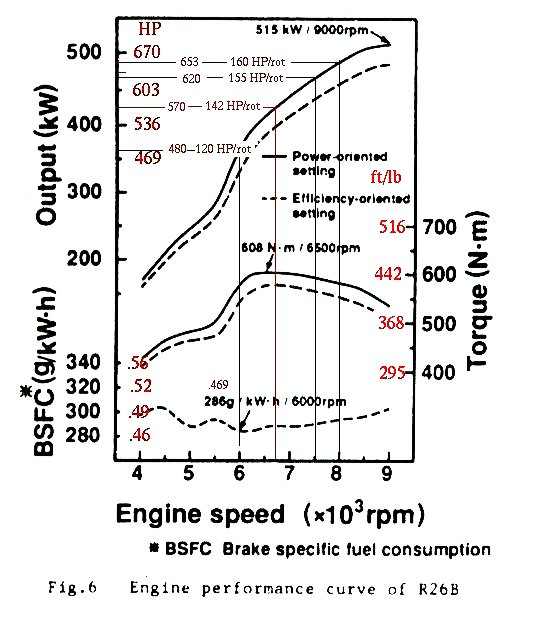
I agree. You have done your homework. We know what works. Mazda has shown
us their dyno data. Just copy what they did or expect to spend a lot of time
on the dyno trying to exceed what they did. Good luck.
--
Paul Lamar ...No rotor no motor.
The Rotary Engine NewsLetter. Powered by Linux.
ACRE NL web site.
http://www.rotaryeng.net
Copyright 1998-2006 All world wide rights reserved.