Yes the show runs for several weeks. I will definitely be there with
pen,
paper and camera in hand. I'll go twice if need be to speak with the
'right'
guys.
Everyone please get your list of questions ready.
Hmmmmm ... just yesterday I decided that with a one half Lemans style
engine, injecting fuel after the P port closed would be counter
productive
as the compression ratio would decrease encountering the cavity the
injectors reside in.
Perhaps I should have waited a day huh?:) It just goes to show that
the
more I study about the rotary engine the less I seem to know:(
I have heard from sources over here that the engine will run on
gasoline or
hydrogen. I suspect but haven't confirmed, the engine is set up to
run on
E-85 as well. I would make sense. The engine in the picture appears
peppered with injectors. My guess is as follows. It looks like a
(green)
fuel injector on the left shooting into the side port, an oil injector
above that, two hydrogen injectors at 11:00 o'clock and the high
pressure
direct injector at 12:00 o'clock.
With a small turbo this baby could clear 300Hp easily. Manifold may
not
clear the cowling though.
Doug in Japan
Doug you forgot one thing about direct injection. The hole can be very
small. The material truly injected after the port closing will make up
for any loss caused by the hole! A little interesting aside, when I
was
checking on the Orbital air assisted (semi) direct injection. They
mentioned that several sanctioning bodies wouldn't allow the Orbital
injection because they considered it a minor form of supercharging!
Bill Jepson
Bill,
That is interesting. I wonder why with the Leman why they didn't
angle the
injectors straight into housings. They could have moved the slide
throttle
much closer to the housing then.
I could agree with you if we use the standard Mazda type of injector
because they can be mounted very close to the inner wall and for all
intensive purposes be flush and shoot through a sealed 2mm dia hole..
In the last few days I have come across the ethanol compatible Multec
3.5
injectors from Delphi. If you download the PDF you can see what
concerns me.
http://tinyurl.com/yr7j2p
There seems to be a depression about 4mm deep and 12mm in diameter. Even
placing a donut spacer in the bottom of the hole would result in a
5mm by
4mm deep volume. Would two of them make a difference in lowering the
compression?
http://tinyurl.com/yr7j2p
Doug in Japan
That URL did not work Doug.
Paul Lamar
take out the %20 and it will work
-- Blake C. Lewis
https://delphi.com/shared/pdf/ppd/pwrtrn/gas_multec_mpfi.pdf
Ok Doug, oh and thanks Blake,
Those are NOT intended for direct injection. They are MULTI-PORT injectors.
So your worries are a bit moot. Siemens is making a direct injector.
(Common-rail)
I'm sure Delphi has working examples if theirs isn't in cars already. Most
examples use a piezo injector. The set up is that the piezo actuator is so
fast that they use multiple cycles (between 3 and 5) per intake cycle.
For alcohol you might just be able to use an extra cycle.
Bill Jepson
You are missing something Bill. The 16B is not high pressure direct injection.
It is low pressure direct injection if you will.
The pressure in the compression chamber at that point is way less than what it
is in the combustion chamber.
Paul Lamar
Bill
The terminology has me confused.
I am thinking common rail for both but have a choice of injecting into the
port tube behind the slide throttle (like the R26B engine) or boring into
the housing and injecting 0.5" or so before the oil injection hole.
It sounds like with these Delphi injectors the R25B manner would be the
better choice I'll try and find out some info on the Siemens design though.
I understood on the piezo electric actuator point. Thanks.
Paul
It is rather interesting to see Mazda's research path over the years
concerning injector placement. Speculation: Perhaps a portion of the mist
doesn't stay in suspension but hits the walls of the chamber. Injecting
further along would result in better results with direct high pressure
injection and its inherent challenges being optimum. This would make sense
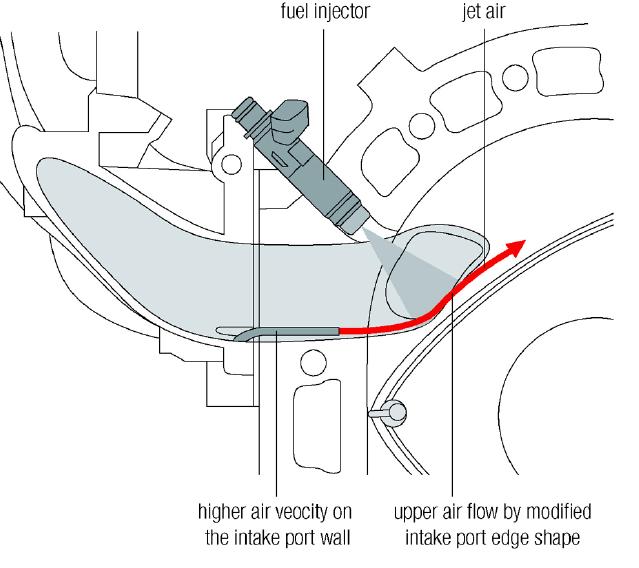
when we see the following in the Renesis 2003 press information release,
page 8 under Jet Air Fuel Mixing System. "The system utilizes port air bleed
in the intake port to effectively speed the flow of air over the intake port
walls and boost atomization of fuel particles adhering to them"
Now which location is the primary?
Doug in Japan
Here is a pictures of that.
--
Paul Lamar ...No rotor no motor.
The Rotary Engine NewsLetter. Powered by Linux.
ACRE NL web site.
http://www.rotaryeng.net
Copyright 1998-2007 All world wide rights reserved.