Paul,
I've been thinking about the turbo compound idea a bit since we
talked about
it last Sunday. I'm thinking that the exhaust turbines used for a
turbocharger aren't really that well suited for putting horsepower
into the
crankshaft. They are designed to spool up quickly and optimized
for driving
a centrifugal compressor.
I was looking at the turbocharger used on the P-38 and the B-17 and
it's
fairly large in diameter with the exhaust exit well away from the
shaft so
the force on the blades work a longer moment arm. I think it also
turns much slower. I'm thinking a configuration like this would be
much more efficient for our purposes and would allow normal gears to
feed the power to the crank.
Steve Brazil
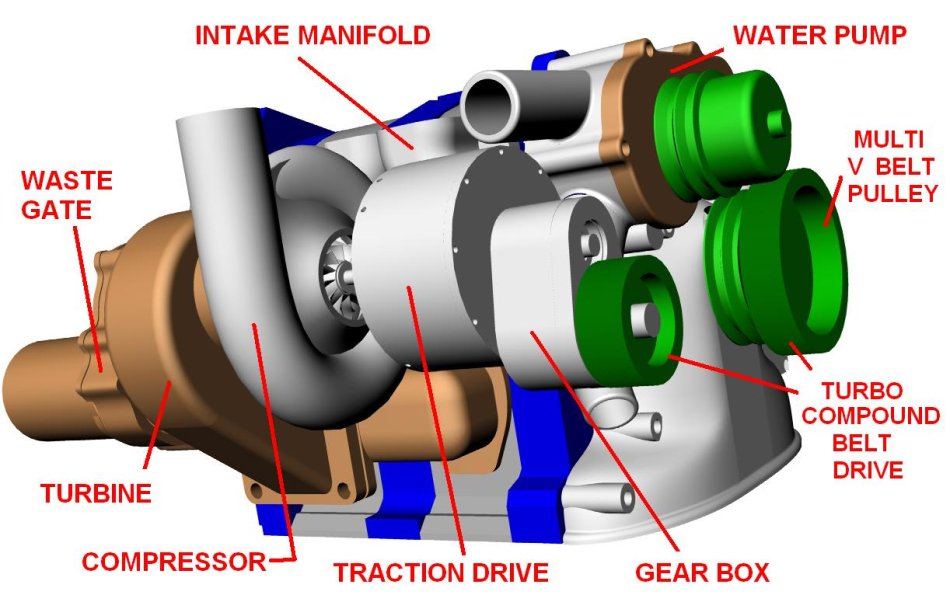
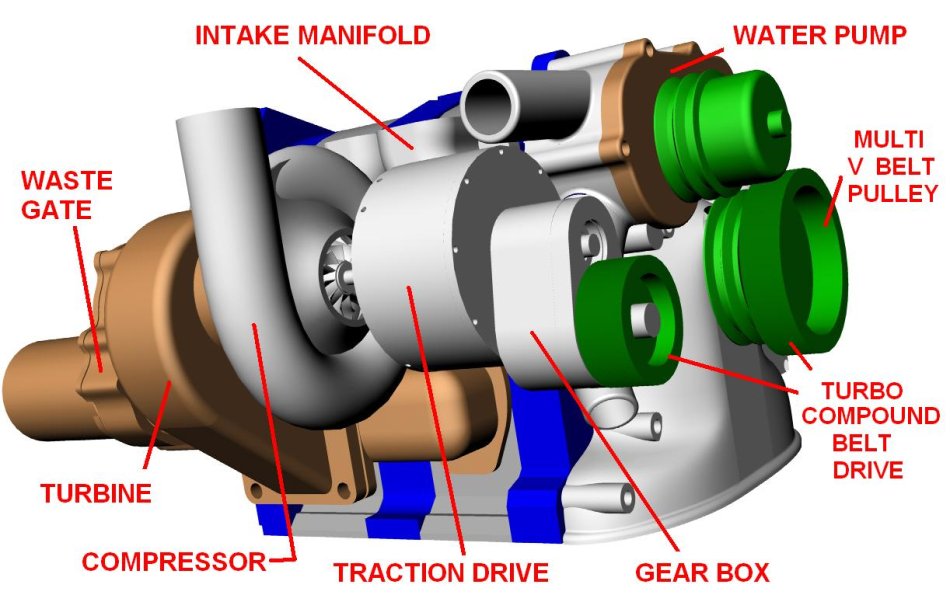
Perhaps something like this? Cheaper and more durable than building
a two liter four cylinder turbo charged 500 HP piston engine. It
should burn at least 5% less
fuel per HP generated than the very best piston engines, given
there is at least
as much wasted energy in the exhaust as comes out of the engine
shaft.
Paul Lamar
Yes! I've always thought this was the best idea proposed. It's
concentric with the motor and could use a planetary, if needed, to
transfer power to the e-shaft. The new larger rotary would allow a
larger diameter turbine still and slow the revs.
Chris Cosman
Due to the large diameter of the turbine and the high RPM of the
rotary I don't think the turbine needs gearing.
--
Paul Lamar ...No rotor no motor.
Okay, so what would it take to implement this approach? Custom casting?
Is it necessary for the blades to be tapered or could they be made from a
high quality stainless extrusion, just cut them to length and devise a
'keeper' to hold them in the ring?
The beauty of the hollow blades is they pump a bit of cool air down the
inside (like a furnace fan) and keep themselves cool.
To me this seems like the kind of 'bolt on' edge the rotary needs to wipe
out the competition.
Chris Cosman
Just get a turbine out of a R3350 TC for a start. Not optimum but it would
prove the concept. The blades are hollow for air cooling.
--
Paul Lamar ...No rotor no motor.
Paul:
Clearly a concentric turbine is not as simple as any of the previous ED
models of it imply.
You have a whole host of problems to solve, beginning with the fundamental
design of a suitable turbine. Running one at 6,000 to 9,000 rpm is not
particularly efficient, considering the exhaust gas mach number. I haven't
checked, but I doubt that the 3350 turbine runs that slow. And then, of
course, you are faced with significant mounting and bearing cooling issues
when you make it concentric with the engine's output shaft.
If you solve the mounting issues, you still have to deal with an
over-running situation when either the engine and/or the turbine suddenly
change speed due to throttle changes. If you look at the Pratt & Whitney
PT-6 twin engine recombining gearbox (I have a copy of the patent drawings
if you're interested) you'll see just one implementation of a solution to
this problem. It's fairly complex, involving numerous gears and flex
mounts.
Still, a self contained turbine with some form of recombining gearbox
arrangement appears much more feasible than any concentrically mounted
turbine.
Regardless of which method is chosen, I doubt that it would be economical
when compared to the cost of the core engine!
George Lazik
Depends on the price of gas. Turbo chargers are cheap.
I am definitely interested in those dwgs George. Are they scanned?
Can you scan them in quarters?
--
Paul Lamar ...No rotor no motor.
The Rotary Engine NewsLetter. Powered by Linux.
ACRE NL web site.
http://www.rotaryeng.net
Copyright 1998-2007 All world wide rights reserved.