Would appreciate all info I can get on single rotor balancing!
Exhaust port small tube with roll pin, is 13b the same?
How has this been closed?
Rolland (Philippines)
Kitfoxes RP-S135/S2804
Rolland,
I'm just looking at my notes for the carb, Mikuni recommends a 48mm ( 42mm
Venturi) for anything over 120hp. If you have a 42mm Mikuni it may be only
a
36mm Venturi, which may be restrictive. I don't think the Posa has a
Venturi.
I don't know what HP your looking for, but with a 44mm PP inlet you should
get at least 115 hp - all things being equal.
Your max flow rate will be 173.6 cfm at 7,500rpm at 6,000 rpm it will be
138.8 cfm, those flow rates suggest a 44mm inlet ( 42mm would be OK) with
inlet velocity of 121.5mph ( for the 44mm) and 133.32mph (for the 42mm).
Please advise of your inlet size and size of the Posa!
What Hp is your goal ?
George (down under)
You cannot makes statements like this unless you present a lot more
information.
The amount of air an engine pumps at any given RPM is going to be a
function of the
length and configuration of the intake runners.
Do you have any dyno curves on these numbers?
Also pictures or drawings of the manifold and carburetors used?
Paul Lamar ...No rotor no motor.
Paul,
I believe Rolland is trying to get an idea of what to expect from his single
rotary engine and to get that some maths must be applied to get a general
rule of thumb outcome, which I have done for my own development.
Although I agree with you that the intake runners have an effect on
maximizing VE, for a general rule of thumb the engine can't pump more than
it's capacity allows which is 40 cu" per rotor face.
With Air Density Unknown.
Air Flow at 10% VE = 40 cu" x 3x [ 7,500/ 3 ( Ratio of 3:1)]/1728=173.6 cfm.
Diameter of Inlet at 7,500 rpm
173.6 ( cfm) /60( sec/min) = 2,8933 cuft/sec/176.85 ft/sec= .01636sqft x 144
(sq"/sqft)= 2.3558sq"/pi (find sq root of ans)= .866 radius= 22mmradius=
44mm diameter.
Flow Rate = Velocity x Area.
Or Flow Rate/ Area= Velocity
22mm Radius ( .8661") [ 173cfm/.01636sqft=10611.2469ft/min/87.33=121.5mph.
( 87.33 = 5240 ft in a mile/60 sec in a min)
Although the net outcome may be more or less than the maths imply, due to
many factors, I found it better to have a ball park figure from which to
start for my own benefit.
If this can help others to roughly predict outcomes I'm more than happy to
provide information which has been quite generously supplied to me, from
others, who are much more qualified than me.
George (down under)
-------------------------------------------------------------
Who are these other people? Those numbers are totally wrong.
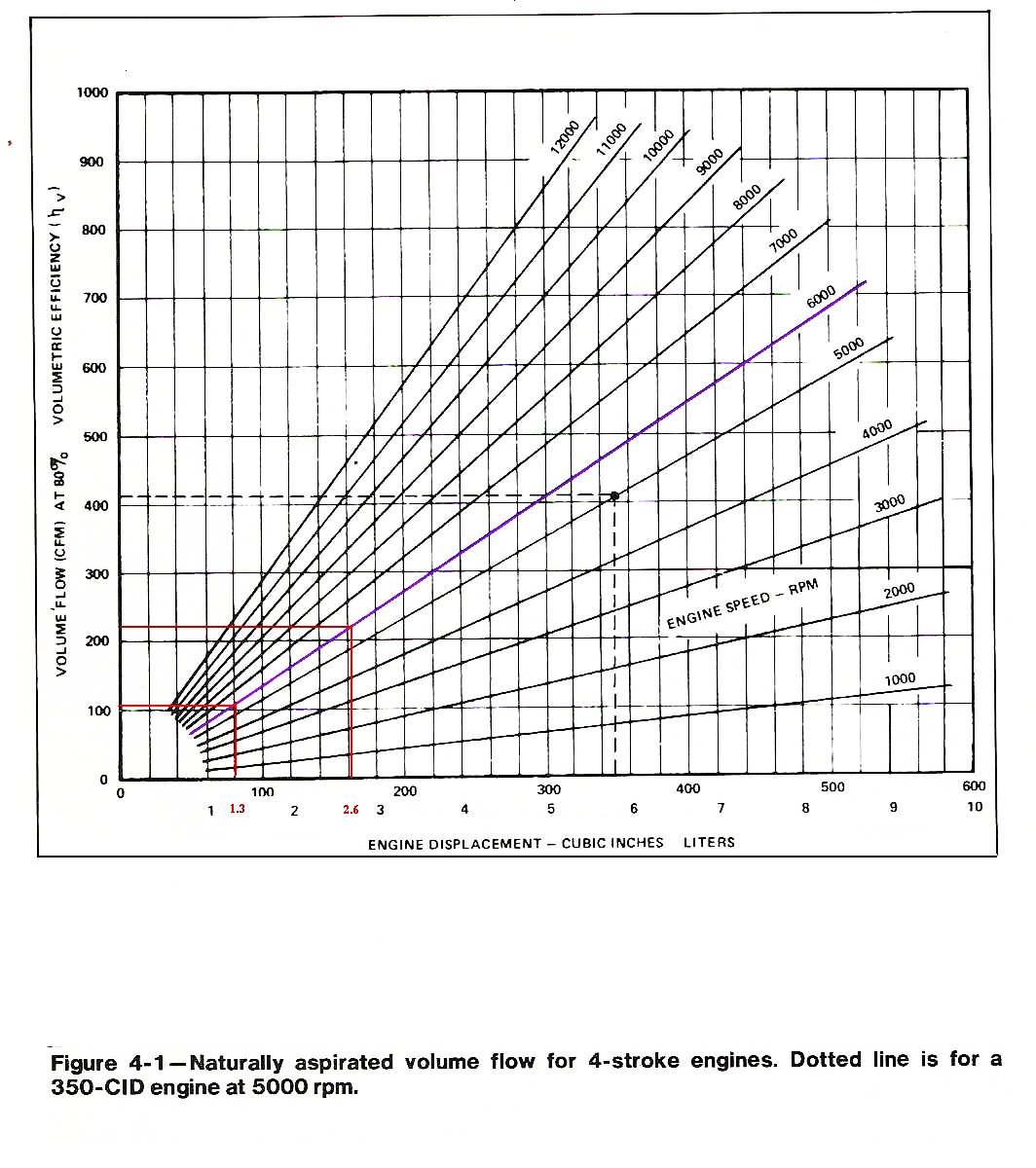
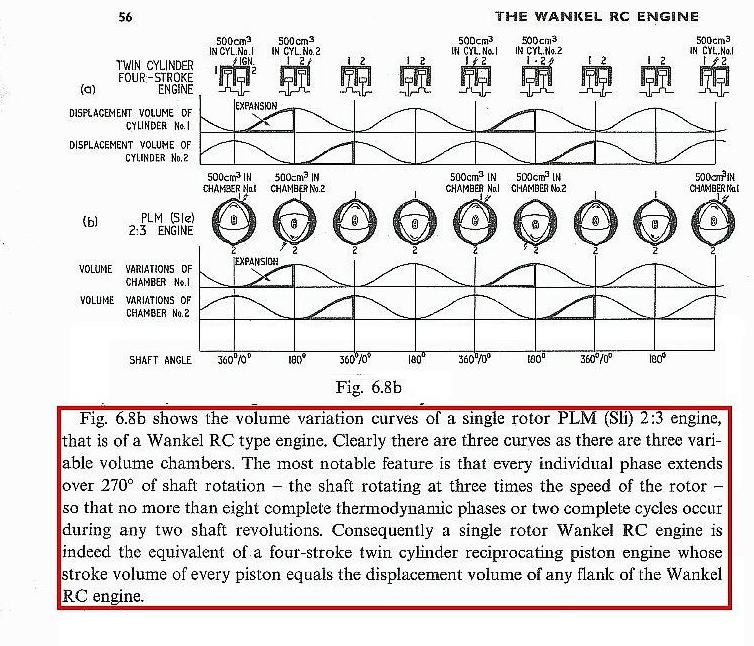
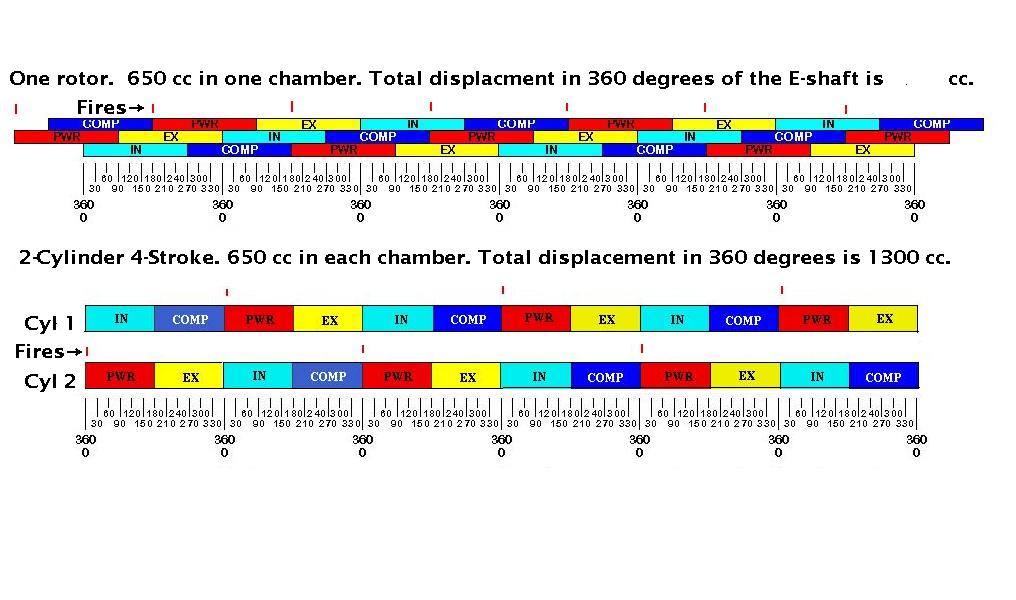
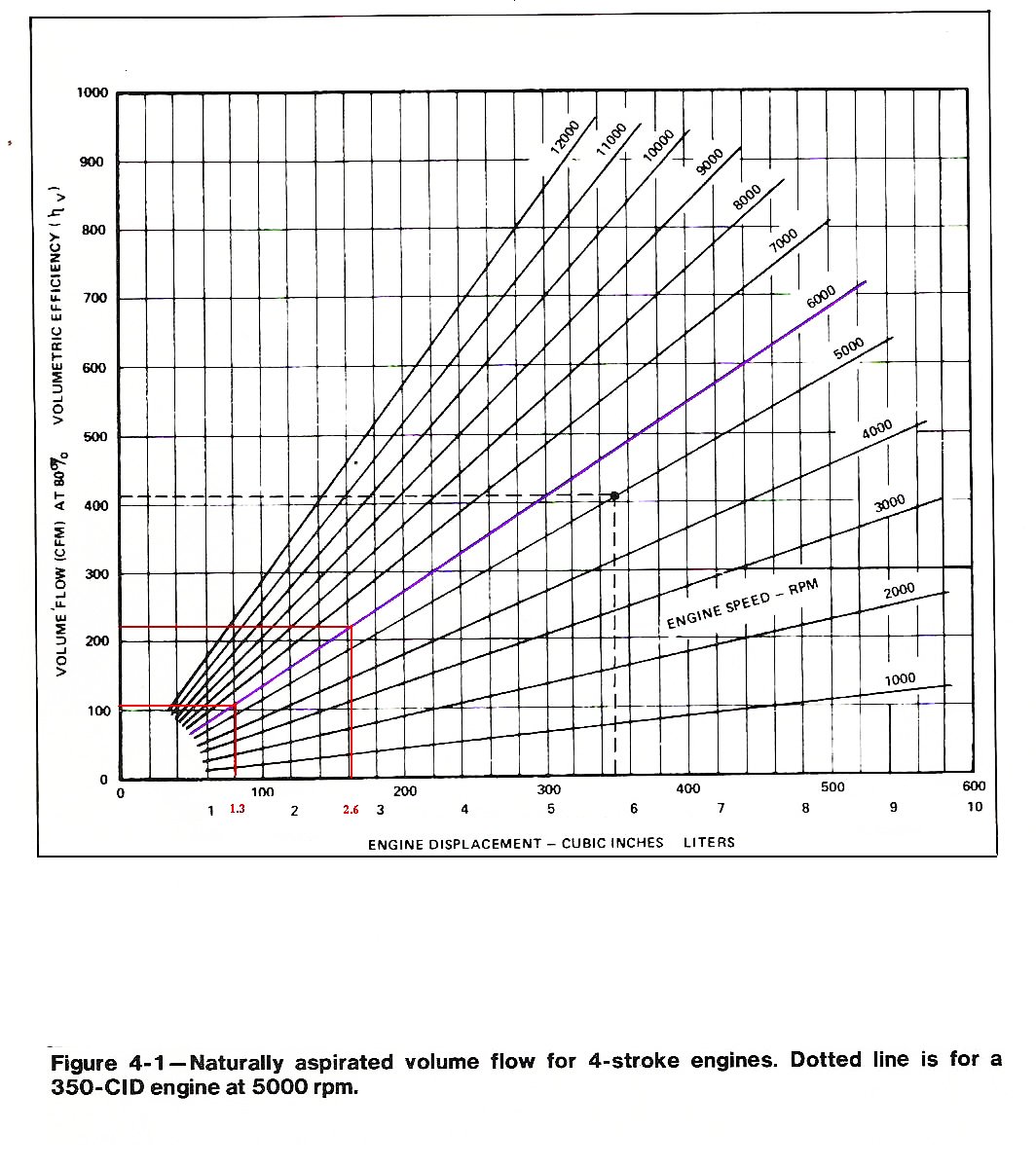
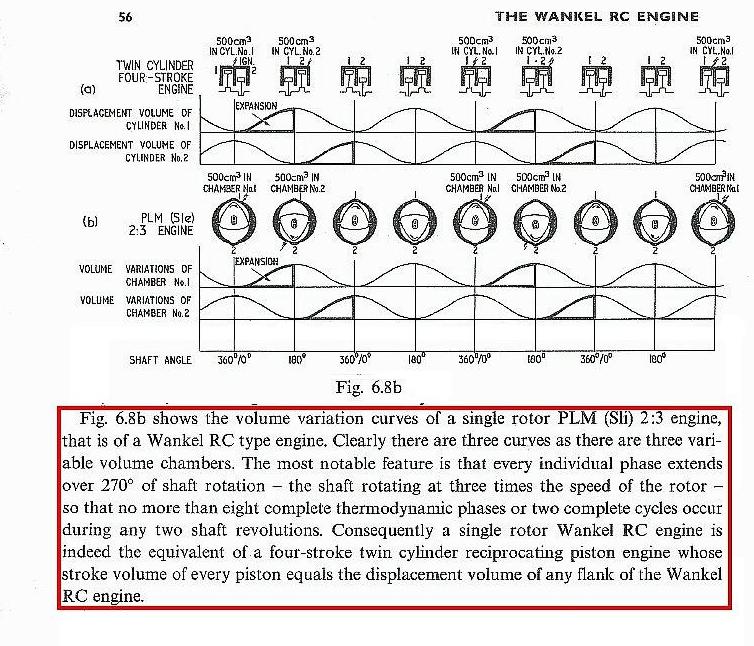
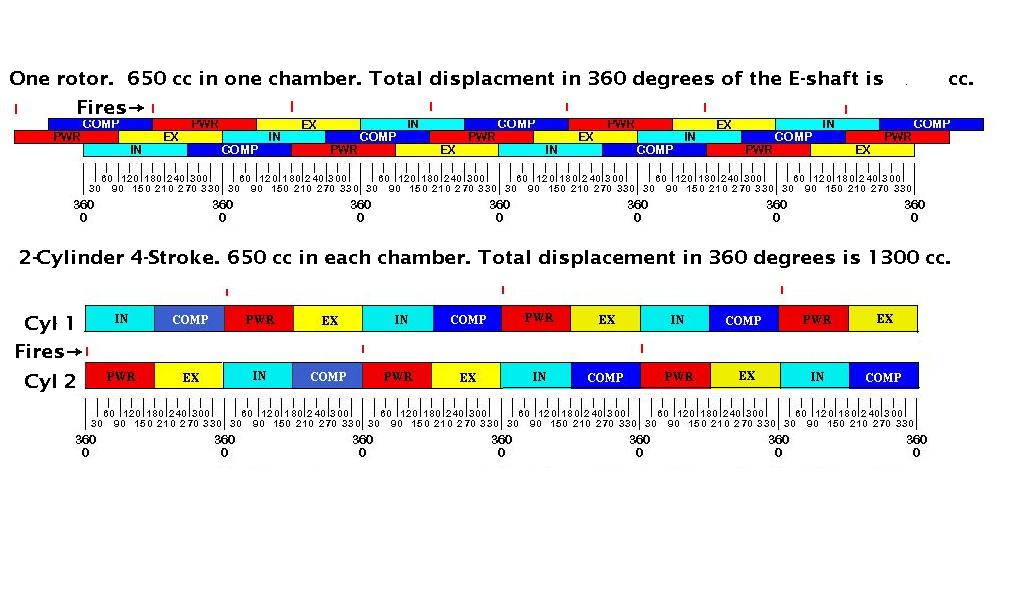
The pumping capacity of a one rotor is the same as an 80 cubic inch
(1.3L) piston engine. A two rotor is the same 160 cubic inch (2.56L)
piston engine.
The VE can also vary over a range of plus or minus 20% at any given RPM.
In other words the power can vary over plus or minus 20% or more at any
given RPM.
The 13B engine started life in RX4 form at 120 HP. In RX8 form it makes 240 HP.
Here is a chart showing the true pumping capacity of the 13B at 80% VE.
13B rotaries are raced in the 2.6 liter class world wide
for a very good reason. The only reason they generate more power
than most 2.6 liter 2 valve piston engines is they turn faster
and breath better. Better VE.
Lately that is less true as the piston engine RPM has been raised
by very short strokes and detail development and the use of high
strength to weight ratio materials like titanium for moving parts.
Four valves per cylinder has improved the piston engine breathing to a VE of
one or better than one. It is very rare for any 2 valve piston engine
to have a VE over .8.
The RX8 engine is just over one and P-ports typically have a VE of 1.2.
2.5 Liter V8 formula One engines are now revving to 19,000 RPM.
Lets compare that to a street 2.6 liter, 240 HP, VE = 1, RX8 engine at 8500 RPM.
HP is directly proportional to RPM all other things being equal.
19,000/8500 = 2.23 ..... 2.23 times 240 HP equals 535 HP. About what
a four valve V8 Formula one engine is making. Right in the same VE = 1 ball park.
It does not help others to quote wrong numbers from some anonymous,
obviously ignorant, person.
Paul Lamar ...No rotor no motor.
The Rotary Engine NewsLetter. Powered by Linux.
ACRE NL web site.
http://www.rotaryeng.net
Copyright 1998-2007 All world wide rights reserved.