With regards to a dyno for testing engines from ~ 40 hp to perhaps as
much as 150 hp, would anybody have some experience and/or advise which
make and type of dyno is advisable. Pros and cons of various systems?
Also, does someone have pre-owned equipment that is for sale?
Any help, hints or advise is much appreciated.
Regards
Rolf
Water pump dyno's are most popular but they require a lot of cold
water. Mazdatrix has an 800 gallon tank as I recall. When the water
gets hot you must let it cool off.
The cheapest is a prop load dyno.
--
Paul Lamar ...No rotor no motor.
Rolf,
Those water dyno's are good, but not terribly cheap, as Paul says they
heat
up. From what I've seen they require some significant cooling for
sustained
use. A lot of water and a cooling tower.
If you find anything ( that's both cheap and easy to build) please
advise
the group. I am looking for something myself and so far it's Paul's
trailer
Dyno that meets that criteria.
George ( down under)
Not mine. I just copied Everett Hatch.
Paul Lamar ...No rotor no motor.
Paul,
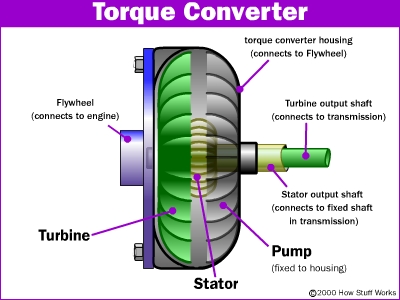
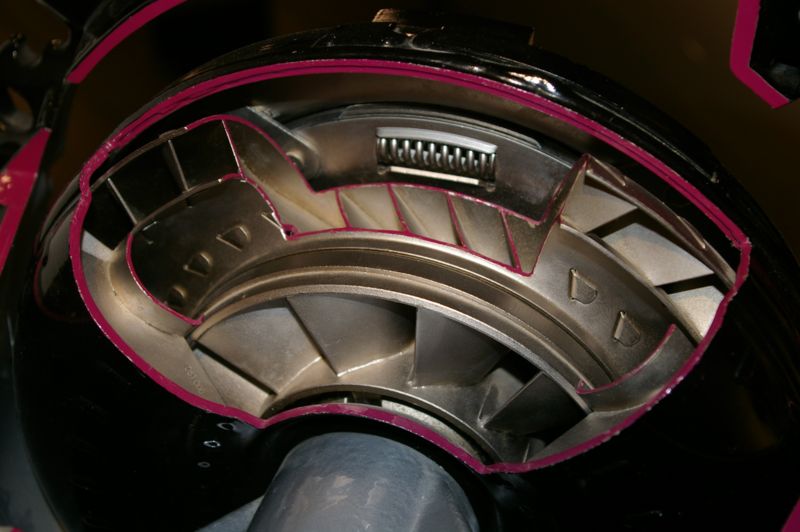
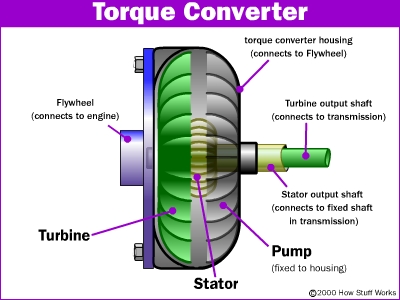
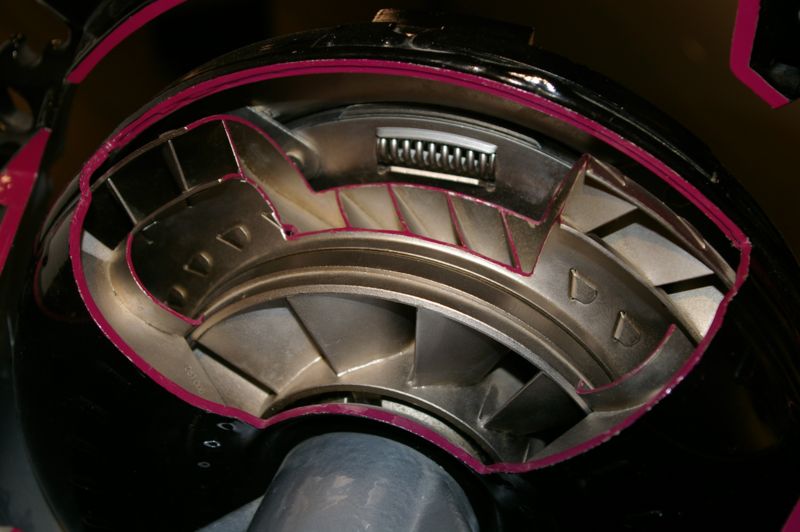
I have been toying with the idea of using the RX-4 torque converter as a
load for dynoing the engine. The movable impeller would be connected
to the
engine side and the toroid housing with the torque arm attached
mounted so
it could rotate slightly. Introducing liquid into the housing faster
then it
could drain out would increase the load. Don't know how linear the unit
would be though. Having it go from slipping to complete lock-up
instantly
would be no good obviously. Perhaps I could use a less viscous liquid
through it.
Doug in Japan
250 HP is a lot of heat to put into that torque converter Doug.
The red line on that old engine was probably 6500 RPM as well.
I am not saying it won't work.
Paul Lamar
Doug,
The centrifical force in a torque converter forces it to fill to
capacity
before it starts to drain back. That converter has a stall of around
3000
rpm, after that you break parts.... even high rpm drag race
converters are
stalled around 6500 rpm and they are generating huge amounts of heat.
At least if you try it in Japan, the scattered parts won't reach here!
Larry
Larry,
Thanks for those figures. I think it is safe to say I should keep these
parts on the shelf.
Doug
Doug,
As long as the toroid remains stationary, you will not have the
centrifugal force holding fluid in the toroid. Also, the fluid will be
constantly circulated out of the toroid and replaced by cool fluid from
the reservoir. So, dissipating 250 hp is quite feasible. The
commercial water brake dynamometers work just as you suggested. The
level of water in the brake is raised or lowered to adjust the load as
the water is continuously pumped from a holding tank or heat exchanger.
About a year or so ago this topic was discussed briefly. I went to a
local transmission shop, owned by a friend, and looked at torque
converters in his scrap pile. Some issues I could identify are:
1) The toroid would be difficult to take apart and re-assemble without
specialized equipment.
2) In addition to the pump and turbine, there is a third component in
the toroid, the stator. It free-wheels in the direction of the turbine
rotation.
3) It is not clear what role the stator would play if the converter
were used as a dynamometer.
4) The turbine and stator are internally splined and seem to be
supported by the transmission main shaft(s). There is a concentric
shaft for the stator.
5) One would need to have a transmission shaft to match whatever torque
converter was chosen.
6) Water alone would probably not give enough lubrication for the
internal needle bearings.
Overall, I think this is a good idea, although not as simple as I had at
first thought it would be. The torque converter components would need
to be strong enough to withstand the maximum torque output of the engine
under test. I'm not sure the RX-4 converter is beefy enough. A
converter from a medium sized truck would probably work. Water based
machine tool cutting fluid would probably work for the fluid. It
usually has strong anti-foaming additives and would lubricate the
bearings and also have a high specific heat capacity. The largest
unknown to me is the role of the stator. It may spin furiously and
waste energy which would be good as long as it doesn't spin too fast and
break. Under normal operation, with the toroid spinning at engine
speed, the fluid pressure in the toroid can get as high as 700 psi to
800 psi. So, I think it will be relatively safe to have the toroid
stationary and spin the other components to engine speed.
Aubrey Thompson
The Rotary Engine NewsLetter. Powered by Linux.
ACRE NL web site.
http://www.rotaryeng.net
Copyright 1998-2007 All world wide rights reserved.