>> Paul,
>> Very good point!
>> A is more compact than a round opening sliding over a round
opening.
>>
>> Although B is shorter than A is doesn't give sufficient room for
the
>> bearings spread that I wanted - but more importantly the opening
is far
>> less
>> linier, in that it opens to the widest part (centre) in a linier
fashion
>> (
>> incrementally), but then the 'additional- after centre' area
starts to
>> decrease ( incrementally) until it reaches the back of the opening.
>>
>> This is more difficult to match fuel flow to, and is what I
refer to as
>> less
>> linier opening.
>>
>> The half round slide over a round opening gives the shortest
slide with
>> the
>> most linier opening. The only thing better than this is a
square slide
>> over
>> a square opening. Next best is a round hole over a round opening
( given
>> it
>> will take up more room), because the round hole in the slide
actually
>> reduces any surrounding space to zero as the opening is fully
open (WOT).
>>
>> That's the best I can explain it Paul.
>> George ( down under)
>>
>>
>> The last thing is what you want. A round hole in the slide with
a round
>> opening. An aircraft engine spends over 90% to 95% of the time
at WOT
>> and that gives the smoothest runner walls when WOT.
>>
>> Paul Lamar ...No rotor no motor.
>
> Paul,
> I accept your argument, you may well be right, especially
considering the
> thicker slide that I'm using - who knows what turbulence is
involved. The
> problem is that I wouldn't be able to use either the round needle
or the
> flat ground needle as the needle needs to recess into a jet at
the bottom
> of
> the round opening - can't do it with that configuration you suggest.
>
> As usual the design is a trade-off considering what is available
to us and
> what the individual considers most important. As this design is
in current
> use with the Aero carb, I feel confident it will work well enough.
>
> There is also an additional configuration that is available to us and
> that's
> the opposite to A., which is even better than B - it has very little
> surrounding area and you can still use a needle, but it would
have to be
> elongated at the top to accommodate bearings. The incremental opening
> would
> also be greater at the critical low RPM levels ( i.e less control
at idle
> levels).
> Sorry to be so boring!
> George (down under)
>
>
> Yes that is true about the needle and all the Mikuni and other
similar
> carbs have
> the same problem. I have a new appreciation of the problems carb
have on
> tuned
> manifolds after our recent bad experience with the Weber. I
suspect most
> carb are
> not used on tuned manifolds so you could be in for a surprise or
two. You
> won't
> know until you try it.
>
> As far as linearity is concerned I doubt seriously you will
notice the
> difference
> among the various designs as the load on an aircraft engine with
a fixed
> pitch
> prop is highly non-linear.
>
> If I were doing a single throat carb I would do it this way.
> It is perfectly smooth inside when WOT. The most important
configuration.
>
> BTW why did you not use solid Teflon for the slide? It eliminates
the
> needs
> for bearings.
>
> Paul Lamar ...No rotor no motor.
Paul,
Again, another good point ! I did think of this just as I sent the last
e-mail i.e. hold the needle and move the slide.
This leads to other configurations, like having the needle behind
the slide
(say in another block of material). This could be used if you wished to
introduce a venturi just before to the needle. This could (like a
particular
brand of slide carb) allow for a very thin slide - bearings could
run on the
block attached /behind the slide.
There are some interesting designs out there.
I notice however there is a tendency for slides to jam from fod or
misalignment or galling of 'like materials' like Aluminum, most likely
because of the tight tolerances - hence my use of bearings. My
concern on
synthetic material (since you asked) was my concern of the tendency for
synthetics to expand at a higher rate than Al when heated- further
exacerbating the tendency ( in my mind) for jamming.
I envisage that one set of linear bearings on the slide side running
in a V
channel in the body of the carb Or Vice Versa, would be an optimum
design
IMHO. This would set the tolerances in all directions, however
difficult for
me to produce in the home workshop.
I hope Doug is getting all this cross discussion on carbs.
George (down under)
FOD is NOT necessary for slide throttles to jam. When you allow the
engine
to over run, a vacuum is created on the engine side of the slide.
The engine becomes a large and powerful vacuum pump.
The vacuum can be as much as 15 psi BELOW atmospheric pressure.
On a two inch hole that pressure difference will generate a force of
6.28 X 15 PSI or
94 pounds!!!!!!!! If the friction coef. between the materials is one
the slide will lock up and that 94 pounds is the force required to
move it.
The coef. of Teflon is not one. It is .06 so the force to move the
slide under these conditions becomes 5.6 pounds. I guess you missed
this message a year or so ago when we were discussing this.
The temperature of the slide is always very low as the process of
the fuel mixture
evaporating actually chills the intake manifold. Therefor temperature
expansion of the slide is not a problem. Also Teflon is soft enough
to accept small FOD such as sand.
Paul Lamar ...No rotor no motor.
How hot will it get when heat soaked - say ten minutes after shutdown?
Matt-
Might get as high as 150 F. I am guessing.
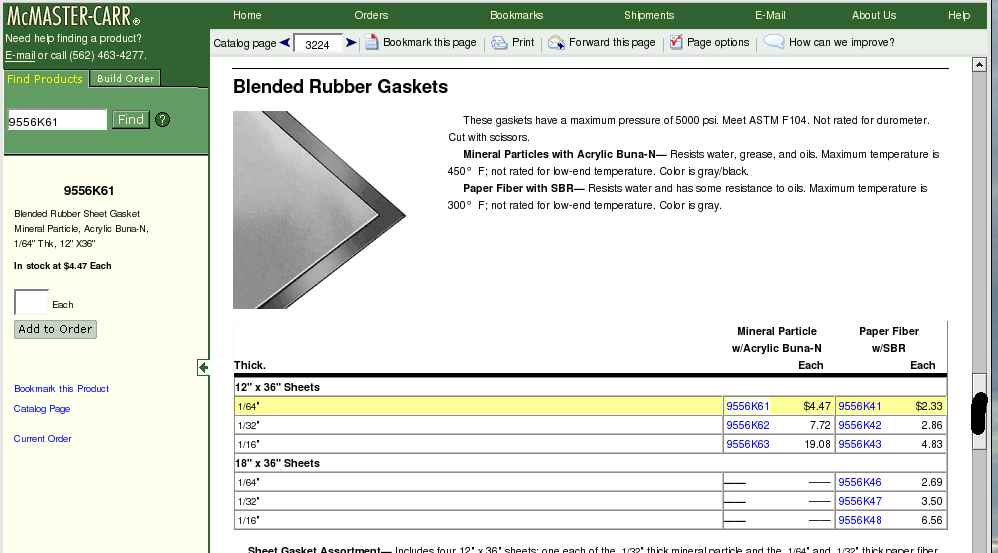
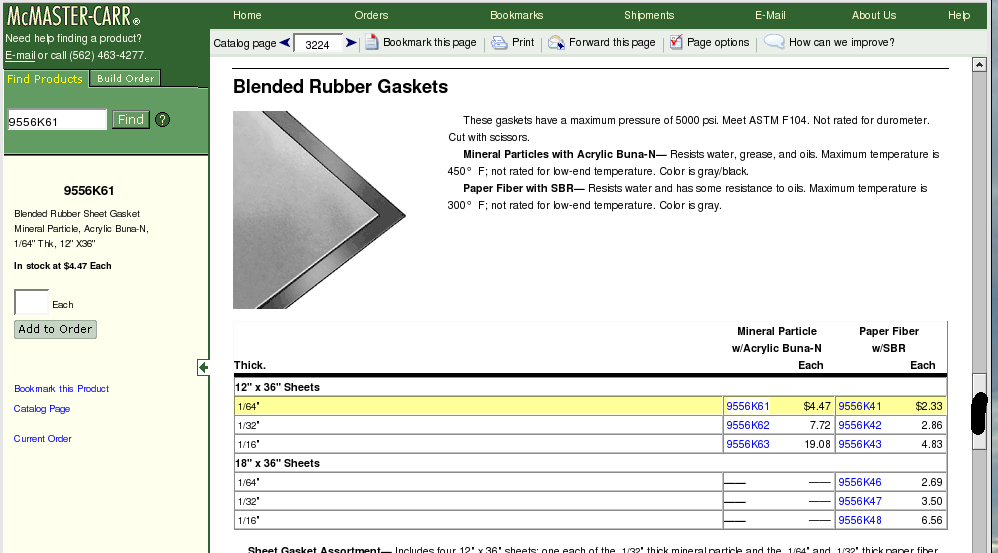
BTW in case you are calculating I recommended a 1/64 thick gasket or about
.016 inches thick on either side of the spacer that goes between the front
and back plates. We see no problems with this so far.
--
Paul Lamar ...No rotor no motor.
The Rotary Engine NewsLetter. Powered by Linux.
ACRE NL web site.
http://www.rotaryeng.net
Copyright 1998-2007 All world wide rights reserved.