> > Perhaps what is also happening is silicon nitride ceramic roller
> > rotor bearings and
> > silicon nitride ceramic apex seals are being used so it is less
> > important to cool
> > the rotors. Ceramic roller bearings are less affected by high heat
> > than steel
> > bearings. Same goes for apex seals. Some of the reasons for oil
> > cooling the rotors
> > in the Mazda is to cool the rotor bearings and help cool the apex
> > seals. Most of
> > the apex seal cooling is now done by the injected apex seal oil in
> > the Mazda engine.
> >
> > With less rotor cooling there is less waste cooling heat.
> >
> > Paul Lamar ...No rotor no motor.
> >
> > Paul,
> > Since the Mazda uses plain bearings anyway it would seem oil cooling
> > would be more of a natural solution. The first company that ever
did the
> > pass-thru charge cooling, (to my knowledge anyway), was BSA. They had a
> > full road going prototype motorcycle shortly before going bankrupt.
Some
> > people say that was the basis for the Norton rotary, others tell me
that
> > it was an independent effort. Mazda was impressed enough with the BSA
> > effort to buy several of the new patents they filed. I often
wondered if
> > a blended variant might work well. The idea would be to use air cooling
> > for the rotor, with the standard water for the housings. The rotors
> > could be considerably lighter that way. Just thinking out loud.
> > Bill Jepson
> >
> > The Norton and Midwest, now Diamond, engines use air cooling.
> > It is not free however as it take HP to drive the required
> > air pump.
> >
> > Paul Lamar ...No rotor no motor.
I agree with you, Paul, that air-cooling is not "free" as it does take
horsepower to drive the required air pump. Nevertheless, what if we
took another look at cooling the Wankel engine with air directly?
Porsche has had some experience with air-cooled engines in automobiles.
In fact, the 5-liter 917 flat-12 engine was air-cooled (a photograph of
which can be found here:
http://www.pelicanparts.com/vasekauction/917-3/med/DSC02088.JPG).
Paul Frere, in his article on the Porsche 917 in "Cars in Profile,
Collection 1" (Profile Publications Limited, 1973, Doubleday & Company,
1974), noted:
"Another shaft drives . . . the cooling blower running at 0.895 engine
speed . . . (p. 98)
(A photo of the blower can be found here:
http://www.pelicanparts.com/vasekauction/917-2/med/DSC01966.JPG)
"(in 1969) . . . the engine had been developed to give some 580 hp, and
those who think an air-cooled racing engine loses too much power in
driving its cooling blower will be interested to know that this absorbed
only 17 bhp at peak revs (/and at 236 mph - LN/). . . . This is, of
course, much less than the power required to drive a large water radiator
through the atmospere at over 200 mph. (p. 104)"
On the basis of Porsche's automotive experience, could not an
aircraft-based Wankel engine be cooled more efficently with air than
with a water-to-air radiator? Especially if the air cooling system uses
heat pipes?
Les Nordman :-)
Page 104 of which book?
Porsche built a fan cooled aircraft engine for the Mooney and it burned more fuel
than a Lycoming. You still have to get the cooling air into the cowling and out so the
drag due to that is not zero.
http://www.mooneyland.com/Mooney%20Models.htm
Robinson derates the Lycomings because of the cooling fans.
It is near impossible to air cool a two rotor without separating the
rotor housings with more distance. That adds to the stress on the e-shaft
and to the weight of the engine.
I am not saying it is impossible. Just not practical.
Paul Lamar ...No rotor no motor.
Dear Paul:
The quotes, both the one from p. 98 andthe one on p. 104, are from the Paul Frere
article on the Porsche 917 in "Cars in Profile, Collection 1".
So, to effectively air-cool a [TWO]rotary engine is not [im]possible, just not
practical? Great to know: thanks! Don't have to worry about that any more.
Rotaries are so different than the boingity-boingity engines. :-)
Les Nordman :-)
You are misquoting me.
"It is near impossible to air cool a two rotor without separating the
rotor housings with more distance. That adds to the stress on the e-shaft
and to the weight of the engine."
"I am not saying it is impossible. Just not practical."
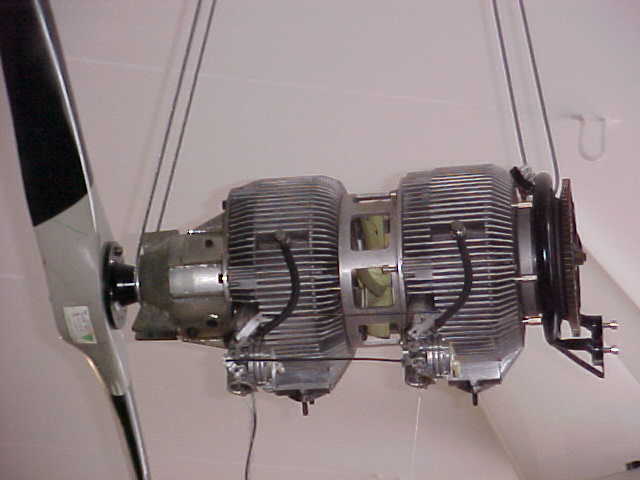
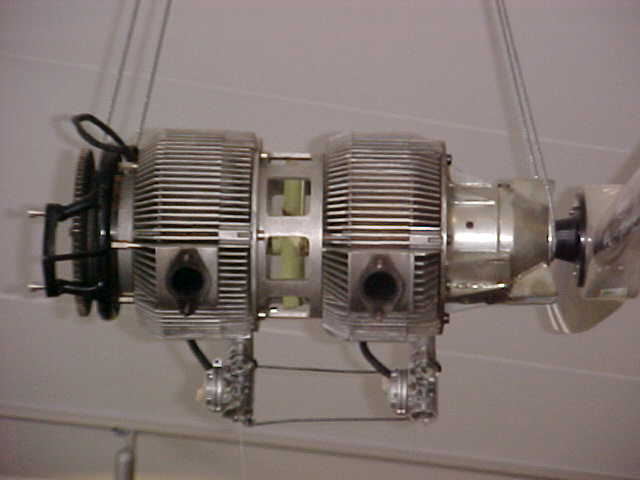
In fact here is such an air cooled two rotor engine. If we did this with a Mazda
size two rotor I would call it unwieldy
Paul Lamar ...No rotor no motor.
The Rotary Engine NewsLetter. Powered by Linux.
ACRE NL web site.
http://www.rotaryeng.net
Copyright 1998-2007 All world wide rights reserved.