Easy. The engine will gulp fuel at full or over rich.
Here is a chart showing GPH on the dyno with a Weber carb that is not
necessarily tuned properly for a tuned manifold.
Paul Lamar
Paul,
That chart seems to be all over the shop, the only thing that has an
incremental climb is the EGT. Why the big BSFC jump at 6,000 rpm, then slump
at 6600 and 6700 rpm etc.
George (down under)
That is to be expected with any type of venturi fuel feed and a resonant
intake system. A p-port rotary engine with a 20 inch long two
inch diameter tuned pipe is a very very powerful resonant
system. Think how load a pipe organ is. Now think how load
that pipe organ would be with a 200 HP pump driving the pipes.
There are no intake valves to get in the way. It is basically a long cylinder with
a piston moving back and fourth in one end at up to 7500 times a minute.
It is not for nothing a p-port rotary can fill it's displacement chamber
with 120% of atmospheric air pressure.
A variable amount of air and pressure is flowing back and fourth
at the speed of sounds over that venturi sucking fuel out at different
rates depending on the RPM and the exact point in the resonant spectrum
the engine happens to be in at the time.
The mixture becomes all over the map. It must be adjusted by a computer or
manually in our case by the pilot. Fortunately for aircraft use the engine
runs at one RPM and we can adjust the mixture to suite. In the air at
cruising speed one has to deal with the dynamic pressure coming into
the air box so that becomes another variable depending on the speed
of the airplane. Again the mixture must be adjusted accordingly.
BTW all you people doing FADECS. Mistral and Rotamax. This is
something you are going to need to deal with as you install your
engines in different types of aircraft. If you use a mass airflow
sensor and a computer you will have to damp the mass airflow signal to average
the airflow out as it too will respond much like a venturi to this
back and fourth airflow. Same thing goes for a MAP sensor.
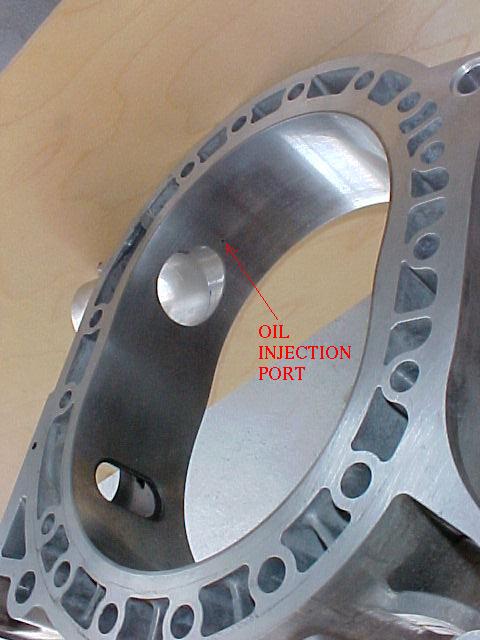
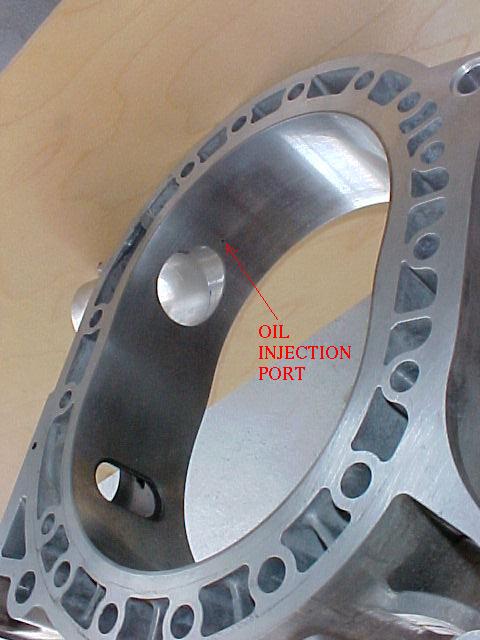
A better idea is to measure the actual pressure in the intake chamber
area right after the port closes with a high speed pressure sensor and
forget about the mass airflow sensor. That is the bottom line. I have
mentioned this before. Tracy should and could do it using the Mazda
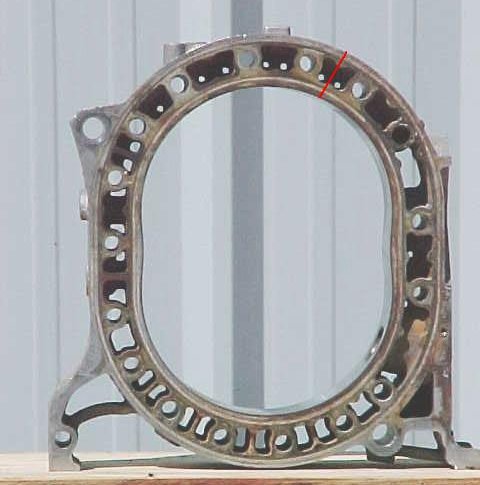
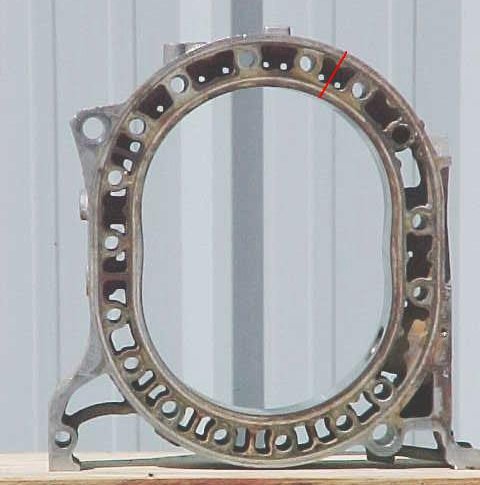
apex seal oil injection port. See the attached picture. Perhaps a better
place to do it is at the very top of the engine which will require
drilling through a rib in the Mazda cooling system. See the second picture
with the red line.
The dyno runs over a wide RPM range at full load quickly so it is not
possible to manually adjust the mixture. Next time we do a dyno run I will
try running it at a constant 5000 RPM with a constant load and see if I can
adjust the mixture to the best fuel burn. We will probably have to sneak
up on it. 3500, 4000, 4500 and finally 5000 RPM.
Paul Lamar ...No rotor no motor.
The Rotary Engine NewsLetter. Powered by Linux.
ACRE NL web site.
http://www.rotaryeng.net
Copyright 1998-2007 All world wide rights reserved.