>
> Hi Paul and others,
>
> I was quite puzzled on that "fuel cloud" phenomenon, have never
> seen/heard it before. I'm not sure if it was fully covered before, so...
>
> I found this discussion thread when looking for info about nox boosting.
> It's quite good on explaining the thing.
>
> "Fuel stand-off - intake reversion - what are the causes?"
>
http://www.eng-tips.com/viewthread.cfm?qid=190526&page=1
>
> Originally i got the name for phenomenon from this article:
>
http://www.carcraft.com/techarticles/116_0406_nitrous_350_chevy/index1.html
>
> There was some papers listed later on thread:
>
> "Intake bell-mouth effects"
>
http://www.profblairandassociates.com/pdfs/RET_Bellmouth_Sept.pdf
>
> NACA paper on induction manifold dimensioning
>
http://ntrs.nasa.gov/archive/nasa/casi.ntrs.nasa.gov/19930090861_1993090861.pdf
>
> NACA paper on induction manifold dimensioning - pipe length
>
http://ntrs.nasa.gov/archive/nasa/casi.ntrs.nasa.gov/19930084998_1993084998.pdf
>
> And later, article about exhaust manifolds
>
http://www.ssheaders.com/header.htm
>
> Cheers,
>
> Petri
>
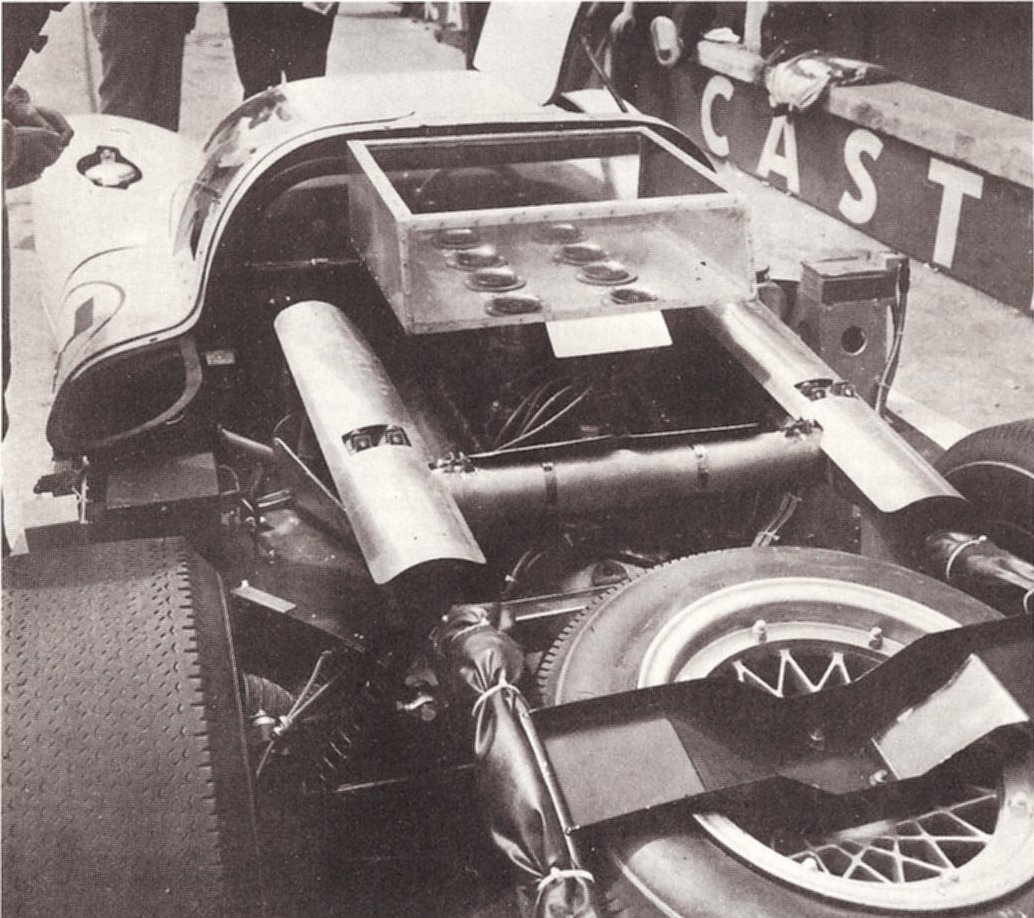
> I first noticed this around 1965 on 800 HP small block V8 Chevy
> Chaparral racing engines. The fuel mist was being blown away by the
> speed of the car. This is what I did about it. I designed this
> air box and had it installed on the Chaparral 2D and the problem
> went away. Perhaps just out of sight and out of mind. The car went on to
> win the Nurburgring road race in Germany so it obviously worked.
> As far as I can tell this was the first ram air box on a race car.
> Now common practice on almost all race cars today. Of course the P38
> and the Me109 used similar ram air boxes years before.
>
> Last year's 245 HP 2nd gen 13B p-port had it. This year's 264 HP RX8
p-port
> engine had it in spades. You can find a video of it on the web site.
>
http://www.rotaryeng.net/intake.html
>
> This years engine generated 20 more HP. Both in the same
> 7300 RPM range. Strangely this year's engine had 3 inch shorter runners.
> Both had downdraft Weber carbs as did the Chap. 1965 V8 Chev.
>
> Although we did not run it above 4000 RPM I did not notice it on Mark
> Suspinski's 13B p-port engine when running with EFI and 25 inch runners.
> That is not to say it won't do it at higher RPMs. Mark should have
> constructed an air box by now.
>
> I suspect it has to due with the carb venturi. Air must be shooting
> out of the intake runner sucking more fuel out of the float bowl and
> then back into the engine. I think the engine is flooding
> with excess fuel. In other words the mixture is probably down
> around 8:1 or worse. IMHO the engine is drowning with fuel.
> The BSFC is real bad when this happens and the engine stumbles.
> So too is the gallons per hour read out from the dyno flow meter.
>
> Perhaps one way of dealing with it is to restrict the size of the
> fuel hose to just enough to get peak power at 12.5:1 I am going to try
> that on the low pressure fuel injection I am now building.
>
> Paul Lamar ...No rotor no motor.
>
> ----------------------------------------------------------------------
> Petri,
>
>
> This report "Intake bellmouth effects" is great.
>
>
> Paul,
>
> Thank you for the photos of the Chaparral. At the time of that
> Chaparral Nürburgring victory (living not far from there) I was just a
> little boy, but knew the car from my racing car pack of cards (?) very
> well. Reading my first motorsport magazines some years later I learned,
> that the win of this single American car with its automatic transmission
> versus all the Ferraris and Porsches was really a sensation on that old
> hilly racetrack. For me this is one of the nicest race cars up to now.
>
> Reiner
>
> Thanks Reiner. Other than the ram air intake box I had little to do with
> that design. I had a lot more to do with the 2F design and that is
why it is
> so different than the 2D. The 2D body was done by stylist mostly while
> I tried to bring low drag aerodynamic principles to the 2F design shown
> here.
> It was so different in fact that I had to fight for it within the
> organization.
> Some people thought it ugly. Consequently it still looks modern to
this date
> 40 years later.
>
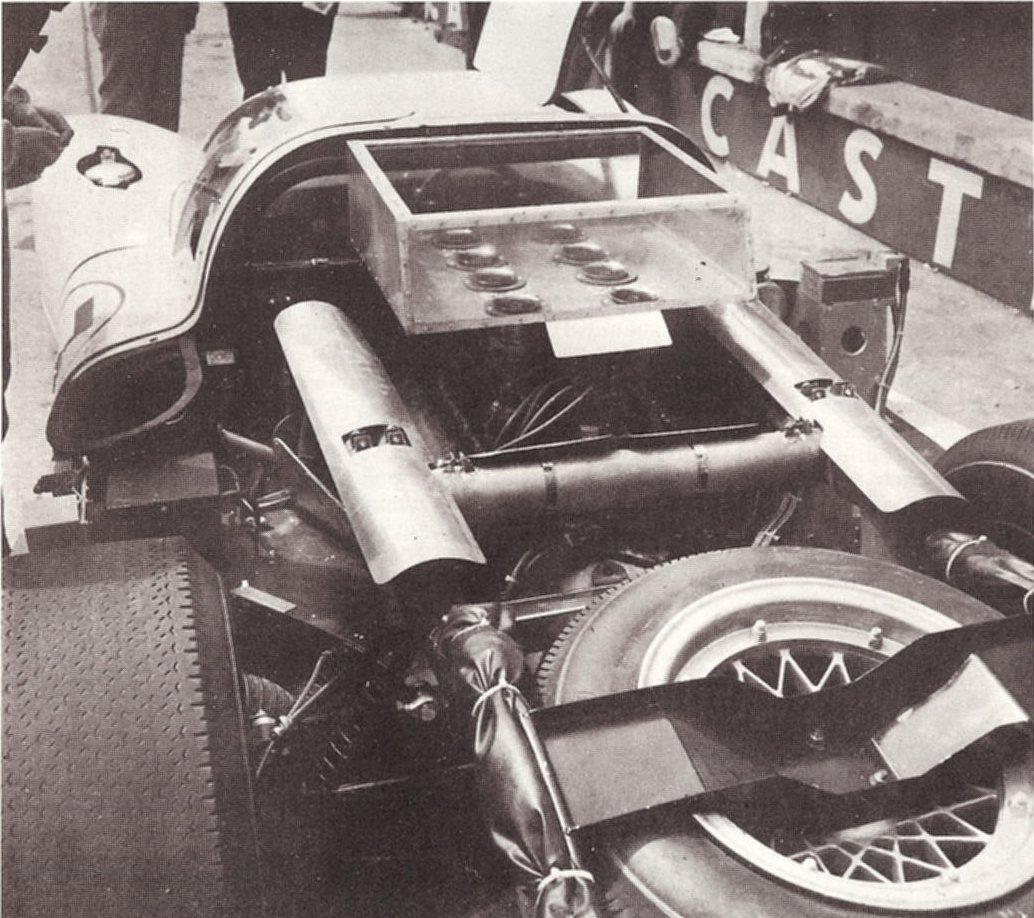
> The ram air box was built in to the rear of the body. The front and
> rear panels were Plexiglas so the driver could see through it.
> The carb air intakes were just above the rad air intakes on either
> side of the car. The car was required to carry a spare tire by
> the rules. One could see the reversion by looking in the inside
> rear view mirror. Also note the oblique mounted radiators. Another
> feature years ahead of it's time.
>
> The 2F set lap records at race tracks all over Europe that stood for
> a couple of years but the transmission was under-developed and broke
down in
> every race except the last one. The BOAC 500 at Brands Hatch England
> where the 2F won.
>
> Consequently the 2F is my favorite Chaparral.
>
> Paul Lamar ...No rotor no motor.
>
>
> Paul
>
> I just found my book "Chaparral" by Richard Falconer/Doug Nye. This 2 F
> had really some amazing new details (especially that big rear wing) ,
> which became common to most racing cars of the next generations. So
> congratulations for that, even if 40 years to late. Are there more books
> (technical side) of that Chaparrals in the US?
>
> Reiner
>
> The first edition of that book was not very accurate. Both Jim Hall
> and I called him on it and he modified the book in a later edition
> adding an appendix in the back with information from me. Pete Lyons
> wrote a small 96 page book or pamphlet called CARS IN PROFILE NO4.
> The Chaparral 2, 2D and 2F. Profile Publications Limited, Coburg
> House, Sheet Street, Windsor Berkshire, England. Whew!
>
> Apparently it is very rare as google
> knows nothing about it. Pete lived at my house in California when
> he wrote much of it in 1972. As far as I know Pete is still alive and
> living in Big Bear California. I have not been in touch with him
> since 2002. Pete is also a pilot. Here is his last known to me
> email address.
>
> Pete Lyons
<bigbearlyons@earthlink.net>
>
> I have one or two other books on the Chaparral at the hangar.
> They contain mostly photographs.
> --
> Paul Lamar ...No rotor no motor.
Paul:
I have the "Cars in Profile" Vol. 4 that has the Chaparral article in it.
Would you like the rest of the photos scanned in, and the article text?
I have an old computer, but I can try. :-)
Les Nordman
Thats OK Les. Thanks. I have the book. Perhaps somebody else
on here would like it. Can you make a pdf of it?
Paul Lamar ...No rotor no motor.
Paul
I Think I have a later edition with that "The story according to Paul
Lamar" at the end. Mentioning that to a friend he came to me with
another book "Chaparral" by Ludvigsen Library Service. There are only
photos, but a lot of them showing the car with open hood or even
dismantled gearbox in the paddocks or in the workshop. Very interesting
for me.
Reiner Nikulski
That is interesting Reiner. Can you scan some of those pictures with
the "secret" gear box apart. There are a lot of people out there that would
be interested in those pictures. I was never allowed to take pictures
of the "secret" GM gear box when I was there.
Here is another shot of the ram airbox on the 2D.
--
Paul Lamar ...No rotor no motor.
The Rotary Engine NewsLetter. Powered by Linux.
ACRE NL web site.
http://www.rotaryeng.net
Copyright 1998-2007 All world wide rights reserved.