Steve, read Paul's comments regarding turbo vs p port at the bottom
of this string. Most of us think p port is the way to go. Plenty
of power, simplicity, no danger of detonating. You can p port the
Renesis for far less money than buying a Mistral turbo. Next message I
will post at the bottom of the string so that we are all doing it the
same.
Begin forwarded message:
Hi Jerry,
No I'm not getting these from Paul. I have to say I like the way
this is shaping up. I have not had very much luck with Mistral. I
tried and tried to get them to sell me a back plate so I could use
my dyna focal mount. When I finally got ahold of them they said
they had changed the design and couldn't help me. I know they are
very busy with their certifications. I wonder if their turbo would
work anyway because their rotary is based on a 13B which I believe
is ported differently. If you think we can make it work, I'll ask
about it. I have heard they are mighty pricey though.
Nevertheless, I have to say that this seems a very elegant way to
get me a turbo and not string intake across the top where I clearly
have no extra room. Carlos Gonzalez will help me with the intake
and exhaust and he is also a turbo dealer. I'll send these to him
to see what he thinks. Where do you suppose the exhaust will go from
where it ends now? Down the side of the cowl and then down? I still
need a radiator and oil cooler too. Do I need a turbo intercooler
or am I looking at it?
We are looking good though, press on!
Thanks,
Steve
Steve, I don't know if you are receiving this stuff from Paul or
not. If you are let me know an I stop forwarding it to you. The
Mistral turbo is perfect. You can see your engine mount taking
shape in the 3Ds. Jerry
Begin forwarded message:
*From: *Rotary Engine <rotaryeng@earthlink.net
<mailto:rotaryeng@earthlink.net> <mailto:rotaryeng@earthlink.net>>
*Date: *December 17, 2007 2:07:10 PM GMT-05:00
*Subject: **Preliminary Lancair 360 turbo plumbing 3D*
This is the stock 2nd gen turbo and exhaust manifold.
Beg, borrow, steal or mortgage the family home
and get a Mistral turbo designed specifically for
the rotary. Doug Fir noticed it was turned around
the right way for tractor aircraft use. The turbine is at
the back and the compressor is at the front where it needs
to be. No crossing over the exhaust and intake plumbing
as shown here in the 3D's. Thank you Francois.
Here is a picture. Also a picture of Dave Leonards stock
2nd gen turbo install which I stole.
--
Paul Lamar ...No rotor no motor.
Steve, are you a member of Paul's rotary news letter? If not, join up.
Lots of excellent info. So far the conversation has just been between
Paul and me. I think by tomorrow or Wednesday he will have a drawing
that includes the rads. Once the drawings are completed he will publish
them in the newsletter.
In the drawing you are looking at the inter cooler in front of the turbo.
You must have the inter cooler I am sure. I am not an expert in turbos
or intakes, but I think you could buy just the Mistral turbo and build
an exhaust flange to fit it to your engine. Generally speaking, the
turbo does not need a muffler as it quiets the exhaust sufficiently by
itself. You can snake an exhaust pipe out the bottom. I would get it
out of the cowl as quickly as possible.
Jerry.
I might add the exhaust flange is part of the Mistral turbine housing.
Brilliant. I have not heard from Francois lately as he has been very
busy supplying helicopter engines to the Russians. I do hope he
will sell this turbo separately without support of any kind. He is not
set up to sell parts as it is not cost effective for him. Too much
support has been required in the past. People have abused Mistral's tech
support in the past. That has ruined it for the rest of us.
I take it from your comments above Steve you are planning on adding a
turbo
to the RX8 engine. Be cautious as the compression ratio is higher
in the RX8 engine and there are no low compression rotors available
yet. I think the best that can be expected from a turbo RX8 engine
right now is flat rating. In other words no boost at sea level and
just enough
boost at high altitude to keep the engine at sea level power.
If you don't already have an RX8 engine your best bet for a turbo
rotary is a 3rd gen turbo RX7 engine. This engine was developed and
finally
generated 280 HP stock. The Mistral and 1991 2nd gen stock turbo will
fit.
The second gen stock turbo must be modified to slow it down or it
will not live.
I also suggest getting a copy of Hugh MacInnes classic book
"Turbochargers."
Used on the Internet for as little as $9.
There is another approach to high HP at altitude and that is build in so
much power at sea level you have more power at high altitude than
most people
with normally aspirated engines. Mark Suspinski is taking this approach.
Our P-port RX8 engine has developed 264 HP at 7500 RPM at sea level
so far.
At 7500 feet density altitude it would still be about 210 HP. You lose
the weight of the turbo but you make it up with the required muffler as
Jerry pointed out above. This is about what you would get out of a flat
rated RX8 turbo engine at 7500 RPM.
A drawback to this approach for the
Lancair 320-360 is the 19 inch long straight intake runners required.
No room on top of the engine. This means you will need an Me109 or
P38 style
ram air box on the left side of the cowl similar to Dave Leonard's
RV6 turbo.
Paul Lamar ...No rotor no motor.
Jerry, Paul,
The Renesis has been purchased but I did so fully aware of the higher
compression rotors and the accompanying complications with trying to
boost. I'll see what Mistral comes back with as well as Carlos down in
FL. I would not like the look of the ram air box down the left side.
To me flat rating would be a better option. If I can start and hold
210 or so to altitude, that is plenty of power for this slippery little
airplane. Thanks for all the hard work on my behalf. I will look for a
copy of Hugh MacInnes' book over the holidays. No matter what I do
next, the asymmetric S beam seems the best bet. Agreed?
Cheers,
Steve
Sounds like a good plan. You will need a custom turbo manifold maybe
so you can put on a TO4 and a adequate waste gate. Turns
out a short symmetrical S beam works out the best.
3D's later tonight.
--
Paul Lamar ...No rotor no motor.
Paul,
As long as he keeps the boost limited to low pressures at sea level and uses
it for normalization... the high compression won't be an issue. If he wants
to add a bunch of boost, some 13b parts can be swapped in to lower the
compression ratio. Requires rotors, shaft and counter weights.
Larry
I don't think you can swap in 2gen or 3rd gen rotors. The RX8
rotors have extra side seals to deal with the side exhaust ports.
I agree on the flat rating.
Here are the rad cooling details. Moving the engine back 4 inches and using a
prop extension was critical to squeezing an adequate size rad under the very
tight Lancair 320 cowl. This rad is 23 inches long OA by 14 inches high
by 2 inches thick for a core volume of 19 x 14 x 2 or 532 cubic inches
a bit on the small side but if a cross counter flow is used probably
adequate if well sealed around the edges. Also flat rating the
engine will help keep the cooling requirements down.
The inter cooler is peeking out but that can
be made smaller. The stock inter cooler is smaller than the one shown.
Steve will need a slight bump on the top of the cowl to clear
the engine block. The oil cooler can go under the front of the engine
with a third scoop.
--
Paul Lamar ...No rotor no motor.
Hi guys,
Once again, working with a computer disadvantage here. Is this
a stock Lancair cowl based on the numbers I gave you? If so,
we're looking pretty good. Did this maintain the original thrust
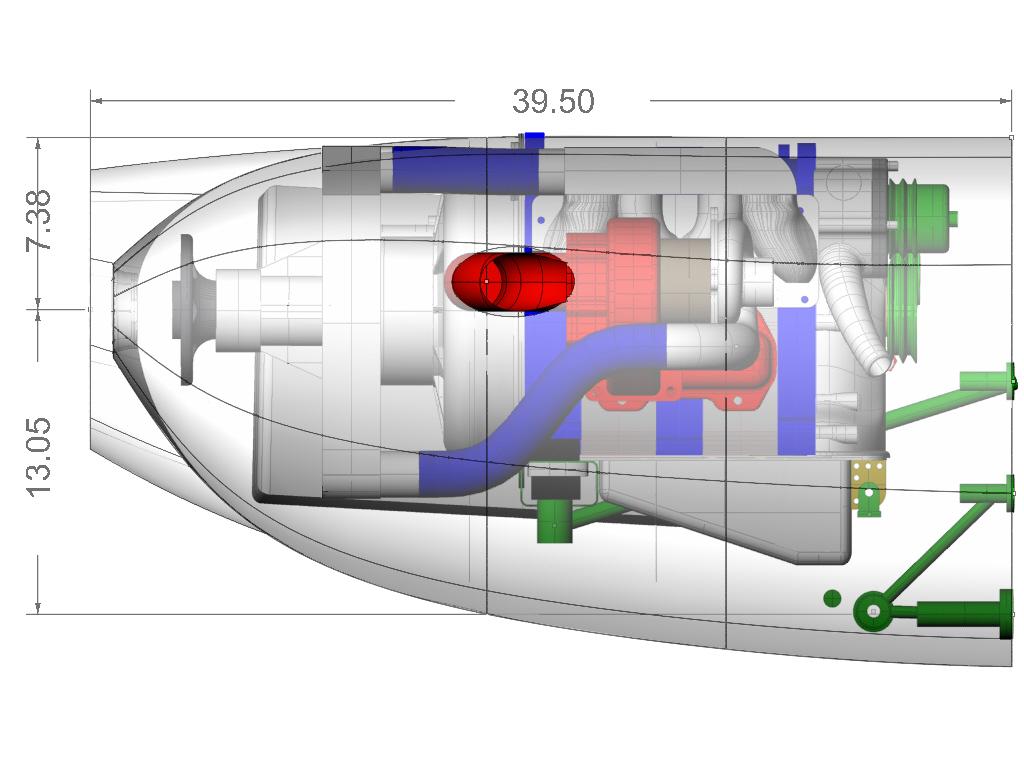
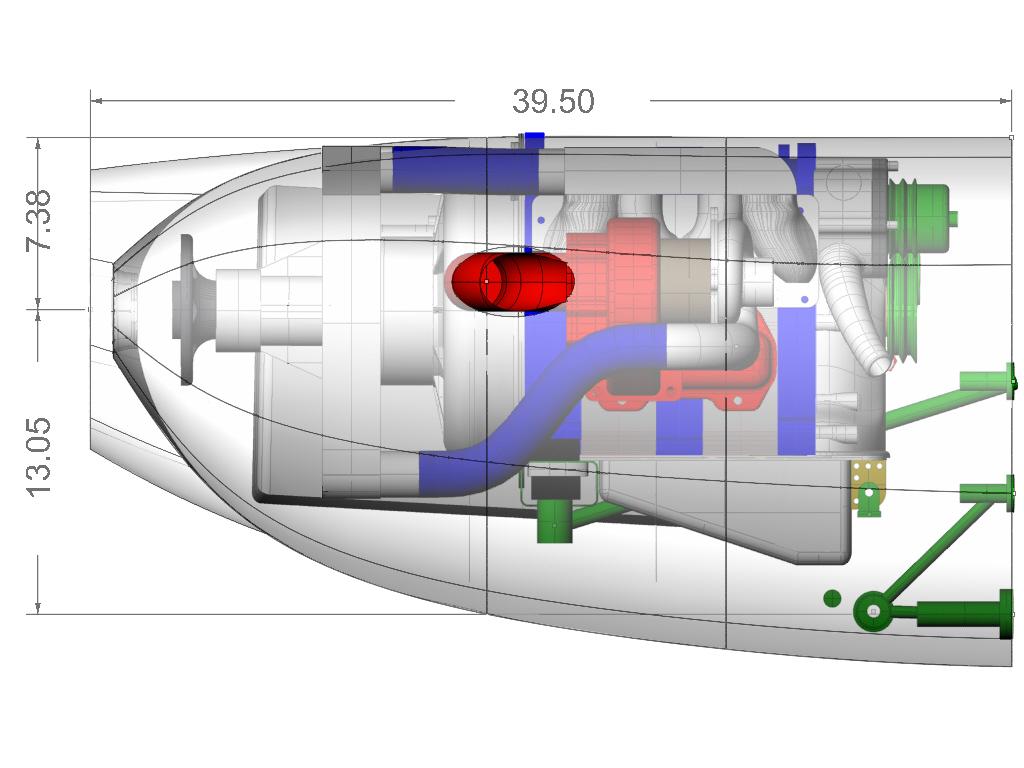
point, 7.61" below the top of the cowl at the firewall? Could we
drop it down a tad and then adjust the front odf the cowl? If not,
no big deal as thesto bsmall bumps.
Cheers,
Steve
Here is a corrected dwg without all the MM tubes. (Those will be along
shortly) I get 7.38" which is pretty close for a guess on the exact shape
of the cowl. So you have another 1/4 inch above the engine to work with.
This has been a fun project. The Lancair 320 360 is probably the hardest
kit to stuff a turbo rotary in the cowl with cooling. I always like an
engineering challenge.
Paul Lamar ...No rotor no motor.
The Rotary Engine NewsLetter. Powered by Linux.
ACRE NL web site.
http://www.rotaryeng.net
Copyright 1998-2007 All world wide rights reserved.