>
>> Hi Paul,
>> My 20B project has gotten delayed for the last 9 months while
trying to
>> build a house, but I'm back at it now. I've decided to go normally
>> aspirated P-Port, but as I started looking for P-Port Housings,
I became
>> concerned about which housing are correct for the 20B. Racing
Beat has
>> several p-port housing available but of course none say they are
for the
>> 20B. The ones listed are:
>>
>> 1) Peripheral Port Housings 1986-92 Racing Beat 13B Non-turbo
>> 2) Peripheral Port Housings 1986-92 Racing Beat 13B Turbo
>> 3) Peripheral Port Housings 1974-1985 Racing Beat 13B Non-turbo
>> 4) Peripheral Port Housings 1974-1985 Racing Beat 13B Turbo
>>
>> Which one is the most appropriate for the 20B? Or, is it better
to have
>> someone convert my original housings? I was planning on using
the 89-91
>> NA high compression rotors (9.7:1). If machining my housings is
best,
>> who can do a quality machining job of this for me?
>>
>> Secondly, I'm trying to decide on 2mm -vs- 3mm Apex seals.
What are
>> your thoughts on this for normally aspirated P-Port aircraft
>> application? If 3mm is best, again, who can do a quality
machining job
>> of this for me?
>>
>> Thanks again for all your knowledge and expertise!!
>> Don Mitchell
>>
>>
>> Number 2 is best but I am sure they are more money.
>> If you had your current housings done Jim Poole can bore
>> the holes but then you would need someone to weld them and finish
>> the the minor porting required. Mazdatrix are capable of the whole
>> job so you might check with them. Two mm stock apex seals are fine.
>> All stock seals are now two piece and based on RX8 technology.
>> I don't recommend after market apex seals except for Ianette
ceramic.
>> No one has the capabilities to make them correctly and some
>> can wear out your rotor housings sooner rather than later.
>>
>> Paul Lamar ...No rotor no motor.
>
> Paul,
> Why the Turbo housings? I thought the non- turbo with higher
compression
> ratio would be best. I guess it all depends of what power you
were wanting
> and if you intended using a turbo or not!
>
> Don the 3mm will withstand a little detonation (so I'm told- no
first hand
> knowledge) but don't seal as well as the 2mm, but if you were
wanting to
> use
> a turbo and wanted a little more insurance against detonation use
the 3mm.
> If your wanting more compression use the RX8 rotors, but they
have their
> own
> set of problems with short side seals.
>
> If you can afford the factory PP it would save a fair bit of work
if you
> do
> it yourself, and may be cheaper than having it done. What are
they asking
> for a factory PP and are they new?
> George (down under)
>
> -------------------------------------------------------------------
>
> The rotor housings have nothing to due with the compression ratio
> George. The rotor controls the compression ratio. You know that :)
> The late turbo rotor housings have a cooling enhancement
> modification.
> Paul Lamar
Paul,
Yep I know that, I wasn't thinking - I do that sometimes. As soon as
I read
turbo and non-turbo, I though compression - silly me!!
That was very interesting info, although I was going cross eyed
trying to
read page 111 - any chance of getting that again?
I notice what I consider a typo in the 'key-to-steel' under acicular
cast
iron. They mention a carbon content of about 3,0%, I'm guessing they
mean
0.3% as not much goes over 1.0% as the benefits are greatly
diminished over
1%.
George (down under)
http://www.key-to-steel.com/Articles/Art63.htm
"Cast iron has higher carbon and silicon contents than steel. Because
of the higher carbon content, the structure of cast iron, as opposed
to that of steel, exhibits a rich carbon phase. Depending primarily
on composition, cooling rate and melt treatment, cast iron can solidify
according to the thermodynamically metastable Fe-Fe3C system or the
stable Fe-Gr system.
When the metastable path is followed, the rich carbon phase in the
eutectic is the iron carbide; when the stable solidification path
is followed, the rich carbon phase is graphite. Referring only to
the binary Fe-Fe3C or Fe-Gr system,
cast iron can be defined as an iron-carbon alloy with more than 2% C.
Important notice is that
silicon and other alloying elements may considerably change the
maximum solubility of carbon in austenite (g). Therefore, in
exceptional cases, alloys with less than 2% C can solidify with
a eutectic structure and therefore still belong to the family
of cast iron. "
--
Paul Lamar ...No rotor no motor.
Thanks Paul and Crew!!
Damn you guys are smart!!
I'm just wondering why #2 is the best option?
Other than the cooling enhancement modification how does #2 differ from
the other options?
Don
---------------------------------------------
Naw!!! I googled it :)
That is the only difference in the rotor housings Don.
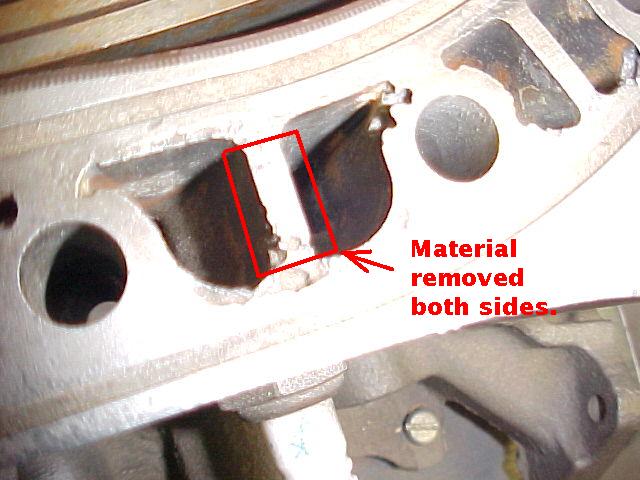
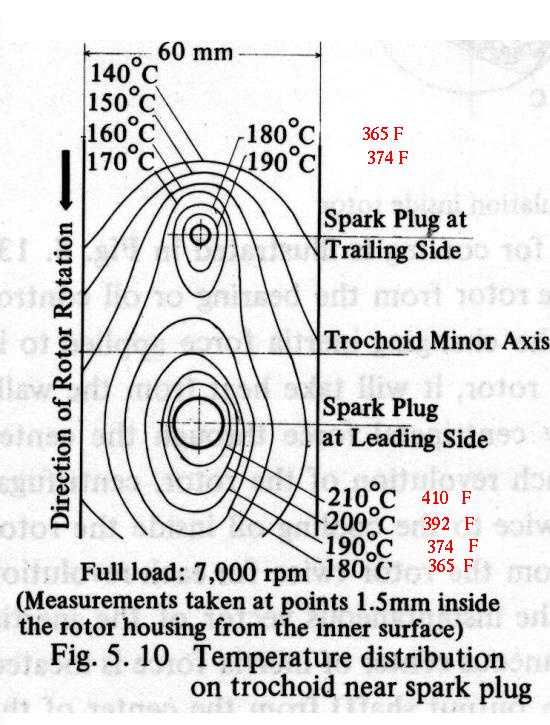
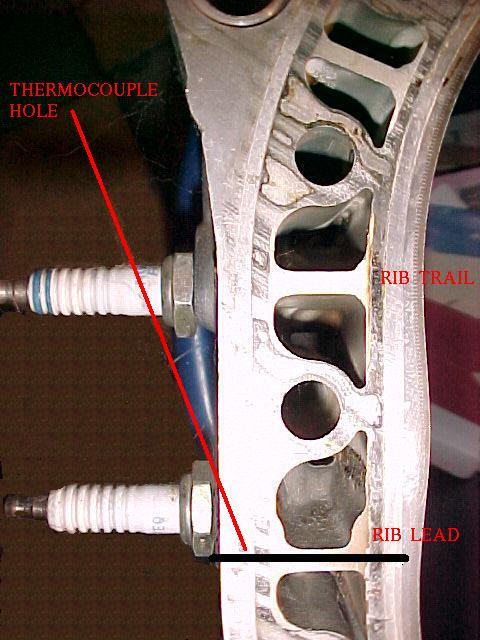
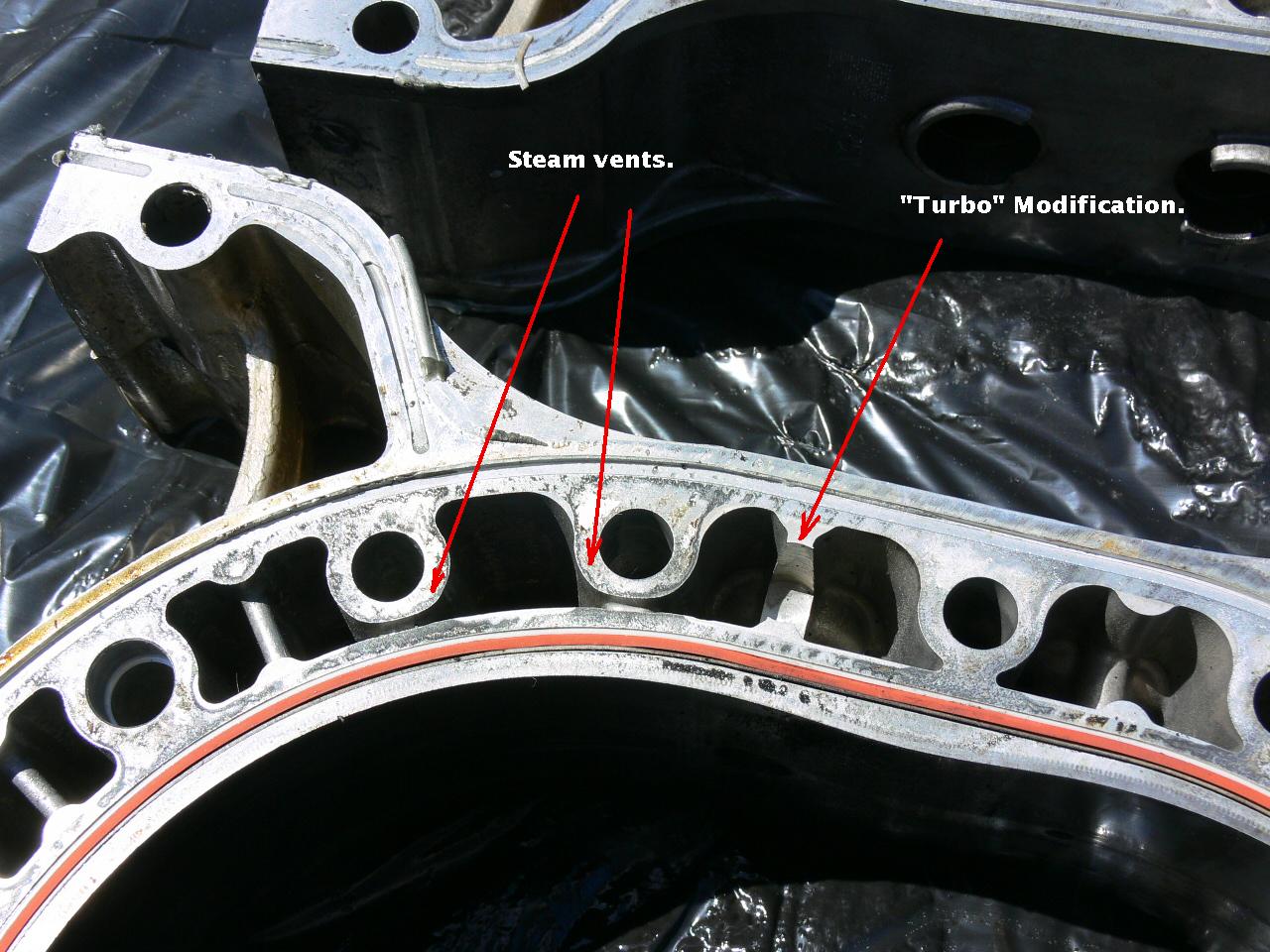
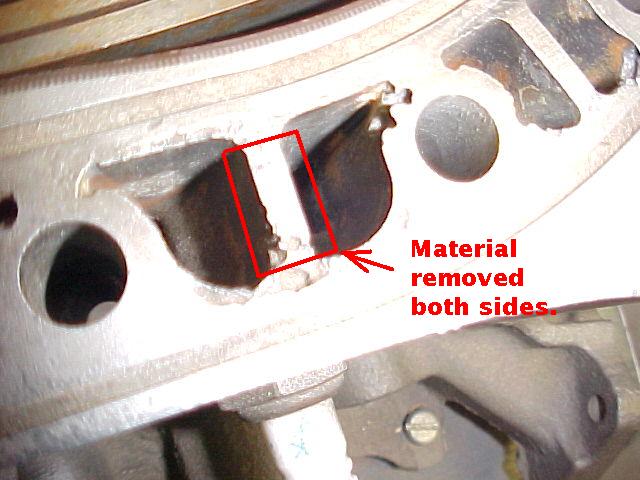
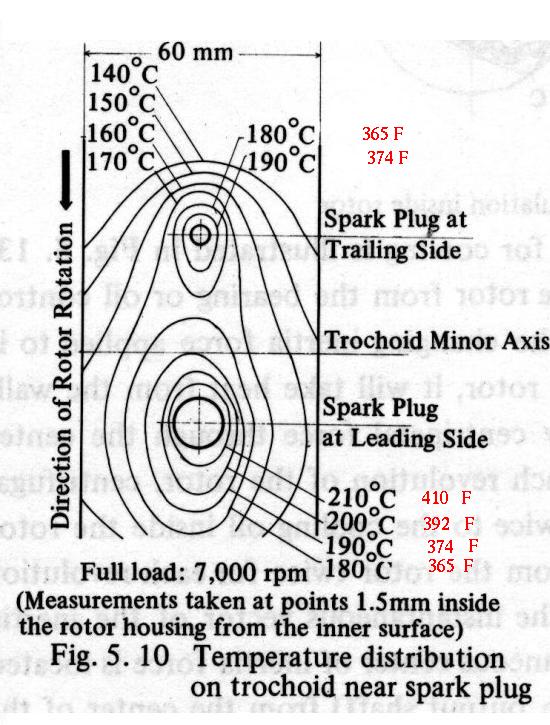
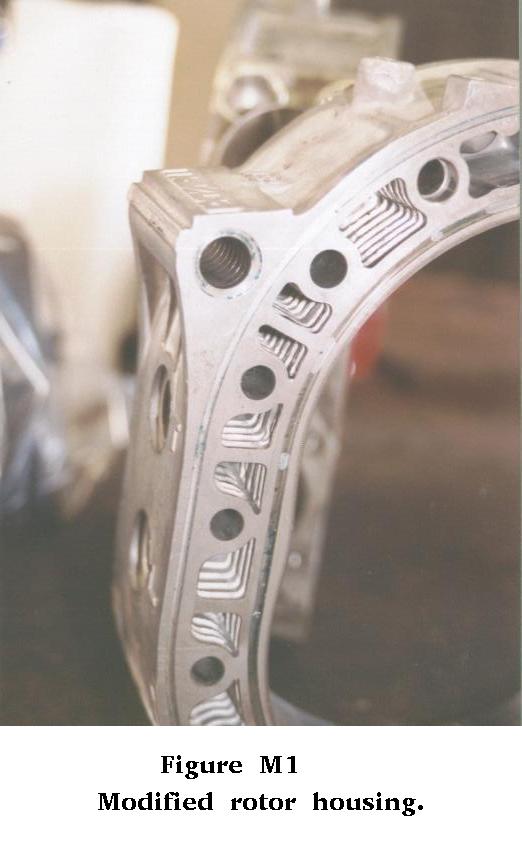
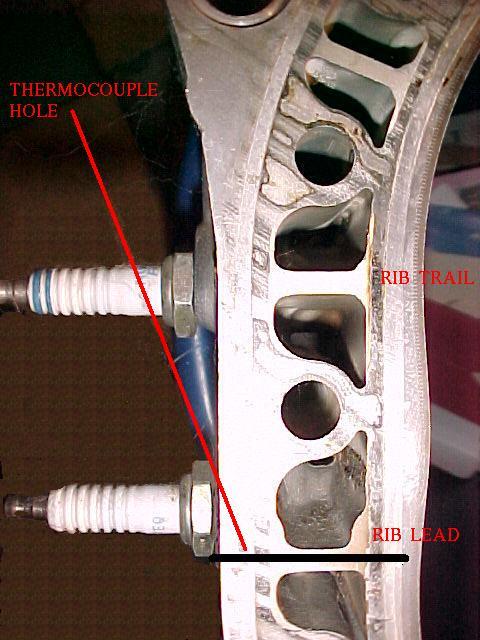
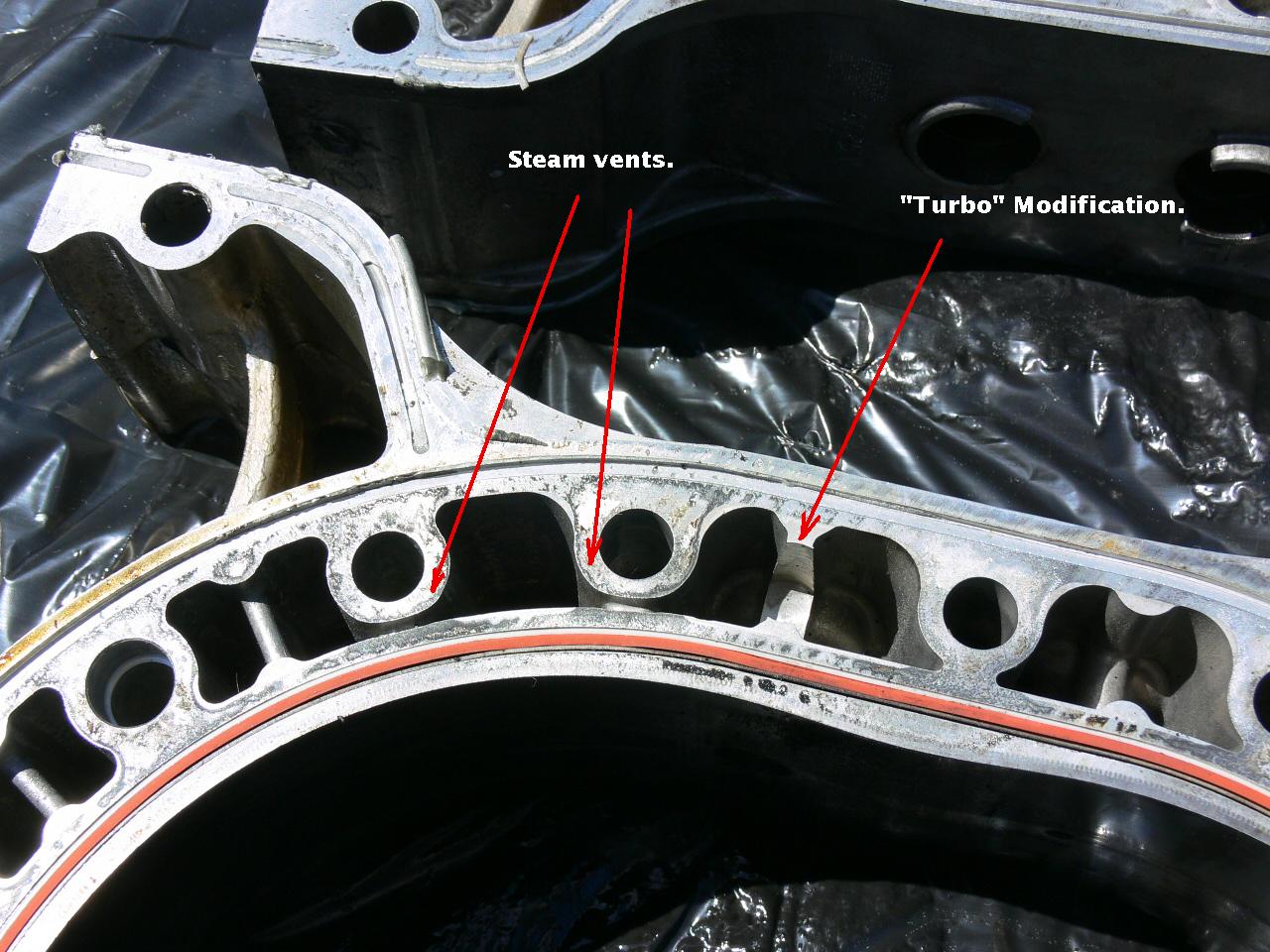
#2 Mazda went in with an end mill and milled out a bit of material
to enhance the cooling around the lower spark plug. The RX8
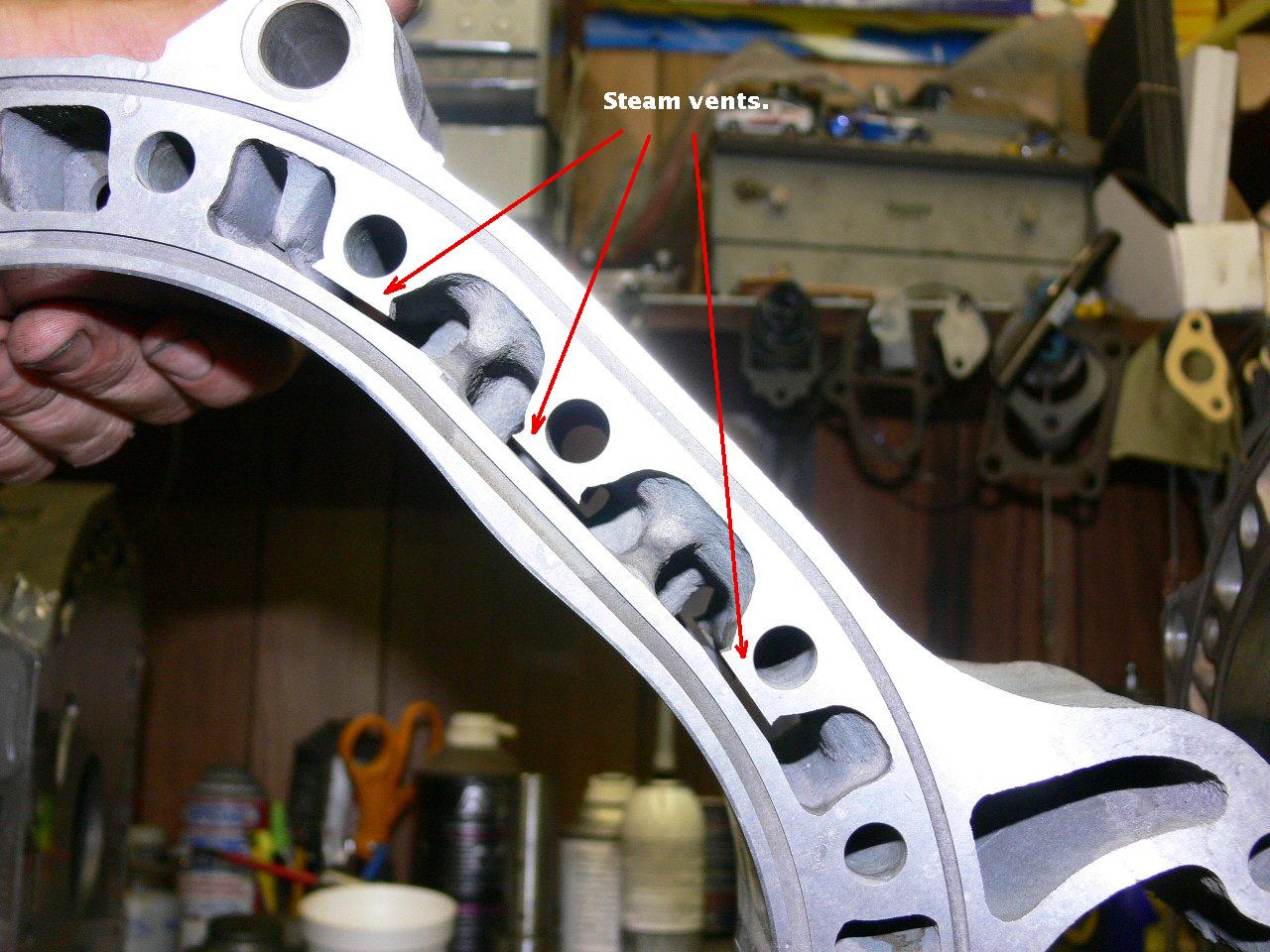
rotor housings also have this mod. See the attachments.
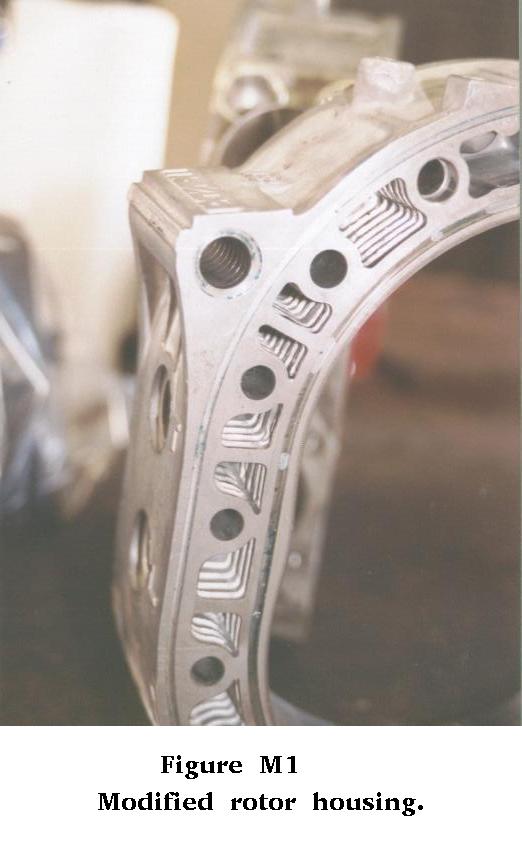
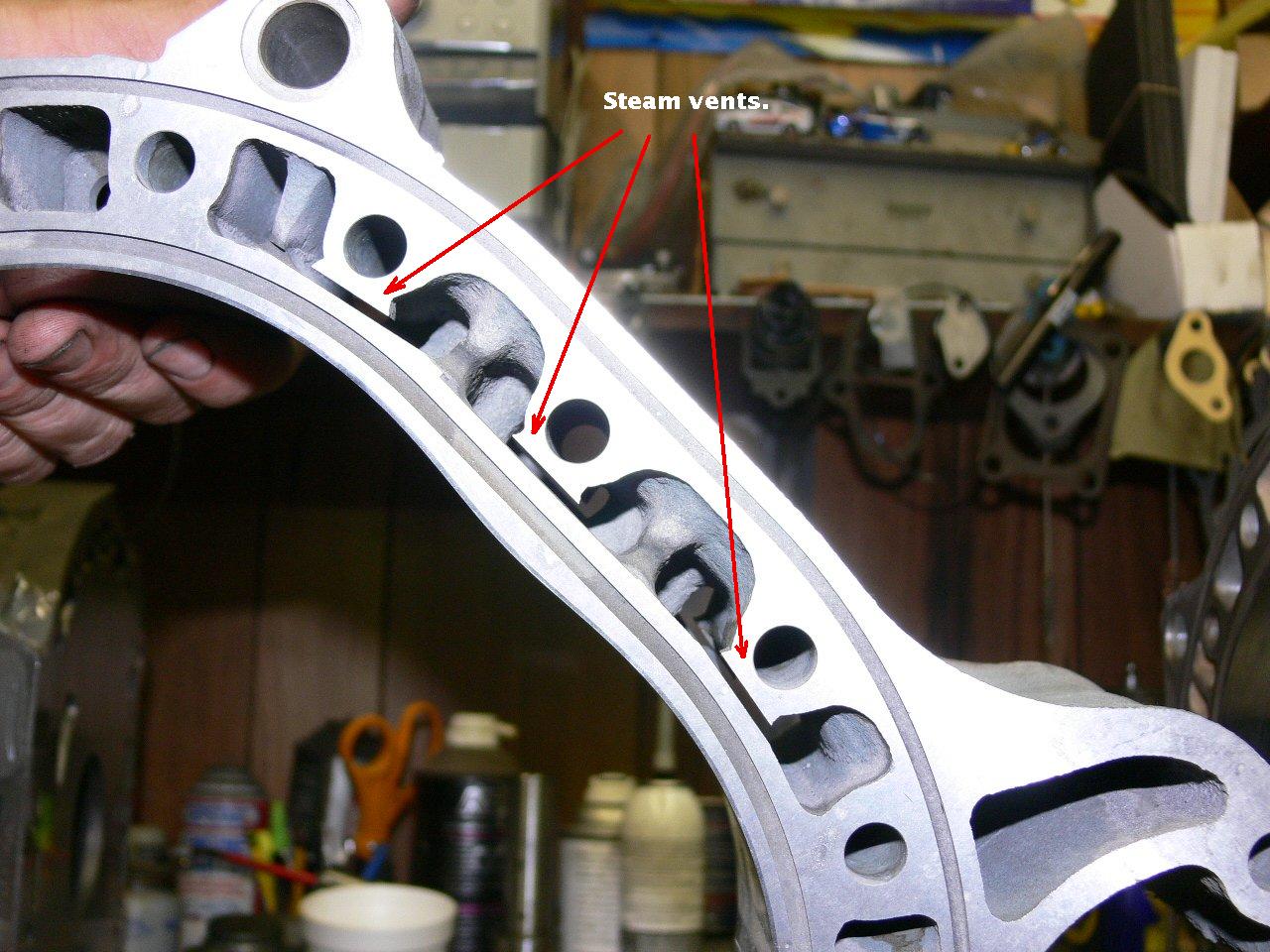
BTW notice the steam vents milled in the sand cast Mazda P-port rotor housing.
This feature was added to the later stock die cast rotor housings including the
RX8 rotor housings. Now all new rotor housings have this feature. Small
details like this can make a large difference in the metal cooling.
Also note. The internal fins added by Racing Beat to an older rotor
housings. Not necessary at the low power levels we are running.
Might be necessary if you were asking 400 HP from each rotor.
--
Paul Lamar ...No rotor no motor.
The Rotary Engine NewsLetter. Powered by Linux.
ACRE NL web site.
http://www.rotaryeng.net
Copyright 1998-2007 All world wide rights reserved.