Paul,
Ok, now I get it. I'll get some of each ordered and try
them to see
what works best/easiest and then post the results to the BMA
list. The
new BMA EFIS uses an instrument module that has two
capacitance
channels, so this is not a problem for the late-comers.
Worth
posting
anyway as there are plenty of us early "Gold Box" owners
still out
there. Appreciate your help.
Thanks,
Mark
Lancair ES-20B, 15 hours
Post it here too Mark. Might be of interest to other people
using the same probes. By the way it is real easy
to build your own probes using two one inch wide long
strips of
brass
separated by nylon nuts and bolts. Takes about an hour
or two.
A 555 will handle the electronics.
--
Paul Lamar ...No rotor no motor.
Paul,
I agree. The only hard part is the end fitting, but a
fitting could
probably be purchased at Home Depot and modified to work. Might
have a
total of $5 in each probe. I ordered the EI probes when I
ordered the
kit and didn't know squat about capacitive fuel probes. I
guess
that's
part of the "education and recreation" of building your own
airplane.
By the way, it is a real thrill, while also a bit scary to be
flying
around above the clouds in an "experimental" airplane that
you put
together in your garage and which uses a car engine along with a
whole
bunch of do-it-yourself parts. You can't help but wonder if you
did
everything correctly as one snafu could easily ruin your
whole day.
With that said, I'm beginning to feel a bit more comfortable
about the
whole experience now. But give me a couple-hundred hours of
trouble-free flying and then ask me how I'm feeling.
Mark
15 hrs (and counting)
My mother told me never to fly anywhere unless I could see the
ground :)
Things happen. Plan on it. I am not supposed to be saying that
on here but never the less always have a plan B.
Judging by what I have seen so far of your excellent
installation
I think you have less to worry about than most.
BTW what are you seeing on the "cylinder head" temperature
gages
so far? You are our only experimenter on those.
How is the muffler working out?
--
Paul Lamar ...No rotor no motor.
Paul,
Thanks for the vote of confidence. I try to fly high so that I
have
more options, just in case.
I haven't looked at the CHT's in a while as you must page through a
number of screens on the EM-2 to get to the EGT/CHT page. Not
much you
can do about it anyway. I like to keep the main page up during the
initial climb, but the most important info is on the top and bottom
lines which don't change when paging. The EGT's typically run
around
1600-1650 in cruise. I'll check the CHT's on my next flight and
let
you
know what they're reading.
The "R.B.Wagner" exhaust tubes seem to be holding up just fine also.
So is my homemade auger muffler, although guys tell me that they can
hear me coming from 5 miles away. I tested a Hush Power II
resonator
muffler and it is amazing how much quieter it is over the auger
muffler. For the first time I could actually hear the prop
above the
exhaust. The body of the muffler is only 12", overall length is
17.5"
but a couple of inches can be cut off both ends to shorten it.
It is
compact enough to fit under the cowl. I couldn't bring myself
to hang a
muffler under that beautiful airframe. This provides a good
alternative. Dennis H. has one of these on his RV-7A and it is the
quietest airplane on the field. Now that's something you don't
hear
often when discussing rotaries.
By the way, a side benefit to the oil/water exchanger is that
the oil
keeps the water hot enough so I don't need a thermostat or cowl
flap.
Yesterday, I flew and the oat was 44*F. The coolant was up around
170-175 in climb and settled down to 150-160 in economy cruise. Oil
temps track 10-15* higher. If it gets much colder, things may
change
and I may have to add a cowl flap. The 20B burns about 12.3 gph in
economy cruise. Not too shabby, especially since I can burn
auto fuel
which is more than $1/gallon cheaper.
Mark S.
16 hrs
There is no cheap replacement for thick RB Wagner SS exhaust
pipes :)
You certainly have plenty of cooling capacity in the winter time :)
12.3 gph is 73.8 pounds per hour so at a well leaned BSFC of
.47 (150 F lean of peak.) that would be about 160 HP. At .5 BSFC it
would
be about 150 HP. At that HP rate the 3 rotor TBO should be 5000
hours :)
How fast are you going at 12.3 gph and what is the EGT?
--
Paul Lamar ...No rotor no motor.
Paul,
That was cruising in overdrive. ;-) Best I recall, it was about
105-110 kts indicated, 123 kts TAS (142 MPH) and about 17" MAP,
highest EGT was
1600 +/- . I'll verify that again on next flight. I'm still
working on
getting the EM-2 fuel totalizer calibrated. I know I'm close, but not
quite there yet. Best cruise speed I've seen so far is 173 kts TAS
(200 MPH).
This was at 1700 prop rpm, 5200 engine rpm, wot and no wheel pants. I
can't wait to see what it will do with the wheel pants installed and
higher prop/engine rpm. That M/T c/s prop sure makes things nice. I
usually set the prop to 2250 for takeoff. That gives me almost 7,000
rpm for takeoff. She's usually airborne before I hit the first
turnoff. Once I'm up to about 110 kts I start dialing the prop speed
down to reduce the stress on the engine and psru, and also to lower the
fuel burn. I usually see about 26-27gph ( 160#/.6 BSFC = 265 HP....
160#/.65 BSFC = 246 HP) on the EC-2 during initial climb. It usually
climbs in excess of 1500 fpm at 105-110 kts. Not too bad for a 4-place
airplane. I haven't done a full-power climb at Vx yet.
Mark
Thanks for the performance data. I'll have to do some data reduction.
I assume you have the 2.85:1 PSRU since you can reach 7000 RPM
or can you do that with a 2.17:1 PSRU?
My C182 cruises at about 150 MPH on about the same 12 gph fuel burn.
Of course
it won't cruise at 200 MPH :)
--
Paul Lamar ...No rotor no motor.
Paul,
I flew again today, my first official cross-country in a rotary-powered
airplane. I flew from Lockhart (50R) to Taylor (T74), staying outside
of the ABIA class C airspace. It took an hour from engine start to
"clear of the active" and I burned approx. 11 gallons according to the
capacitive fuel gauges (on the ground). I managed to snap a couple of
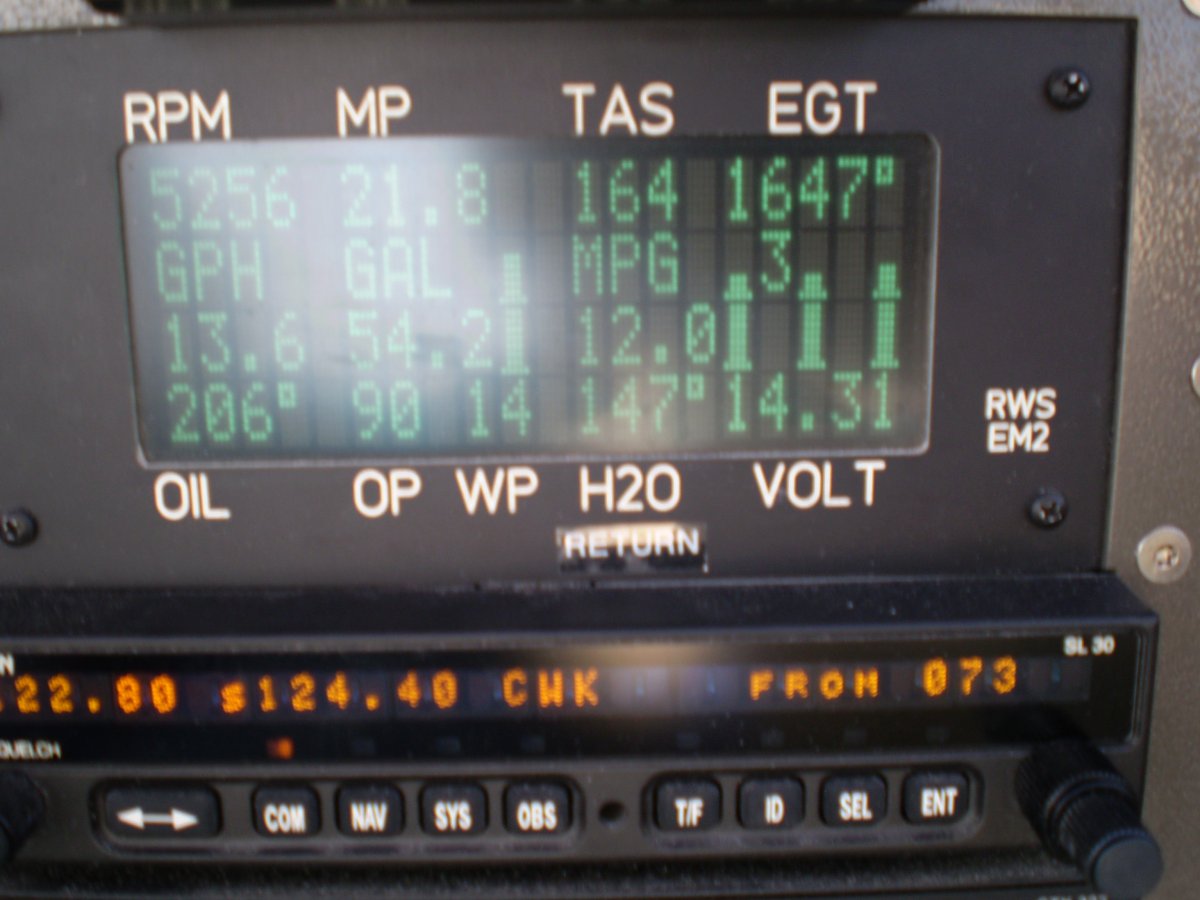
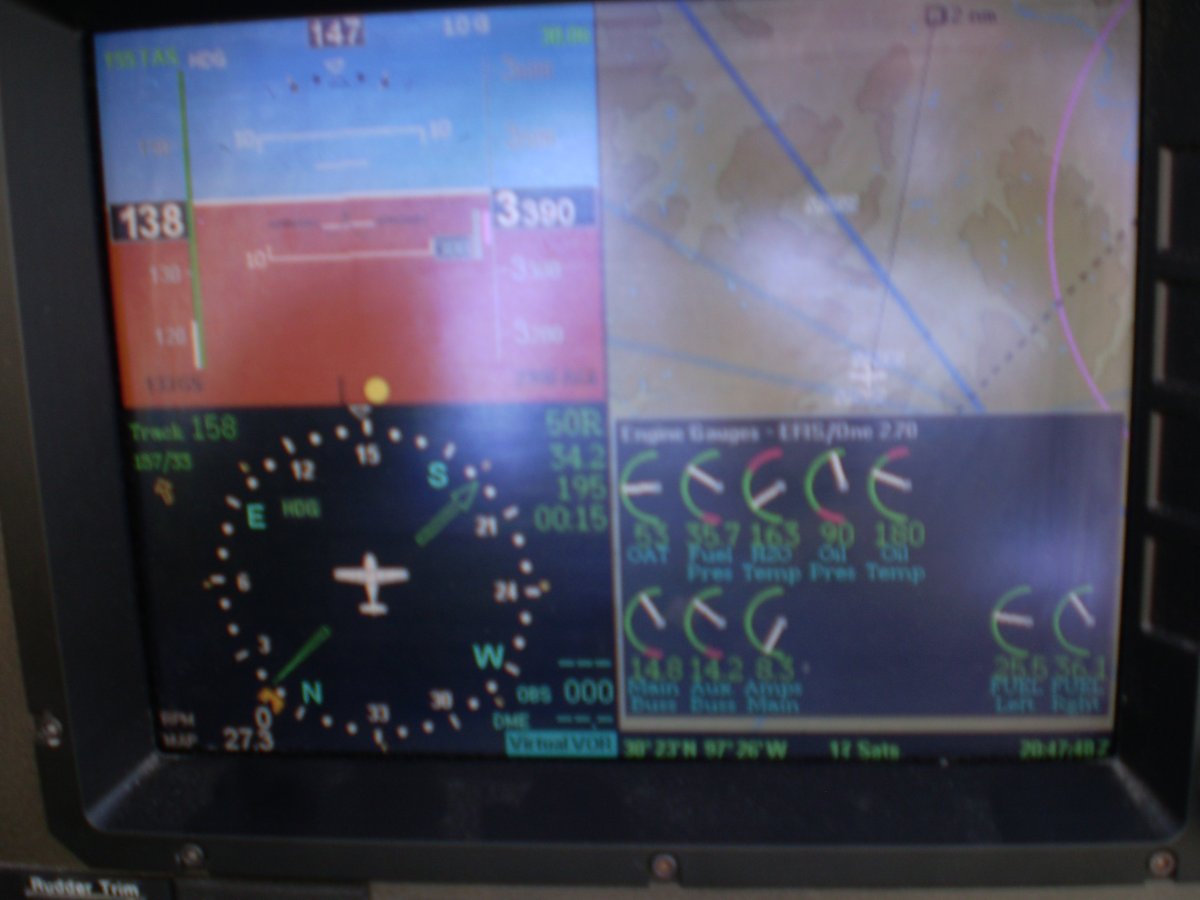
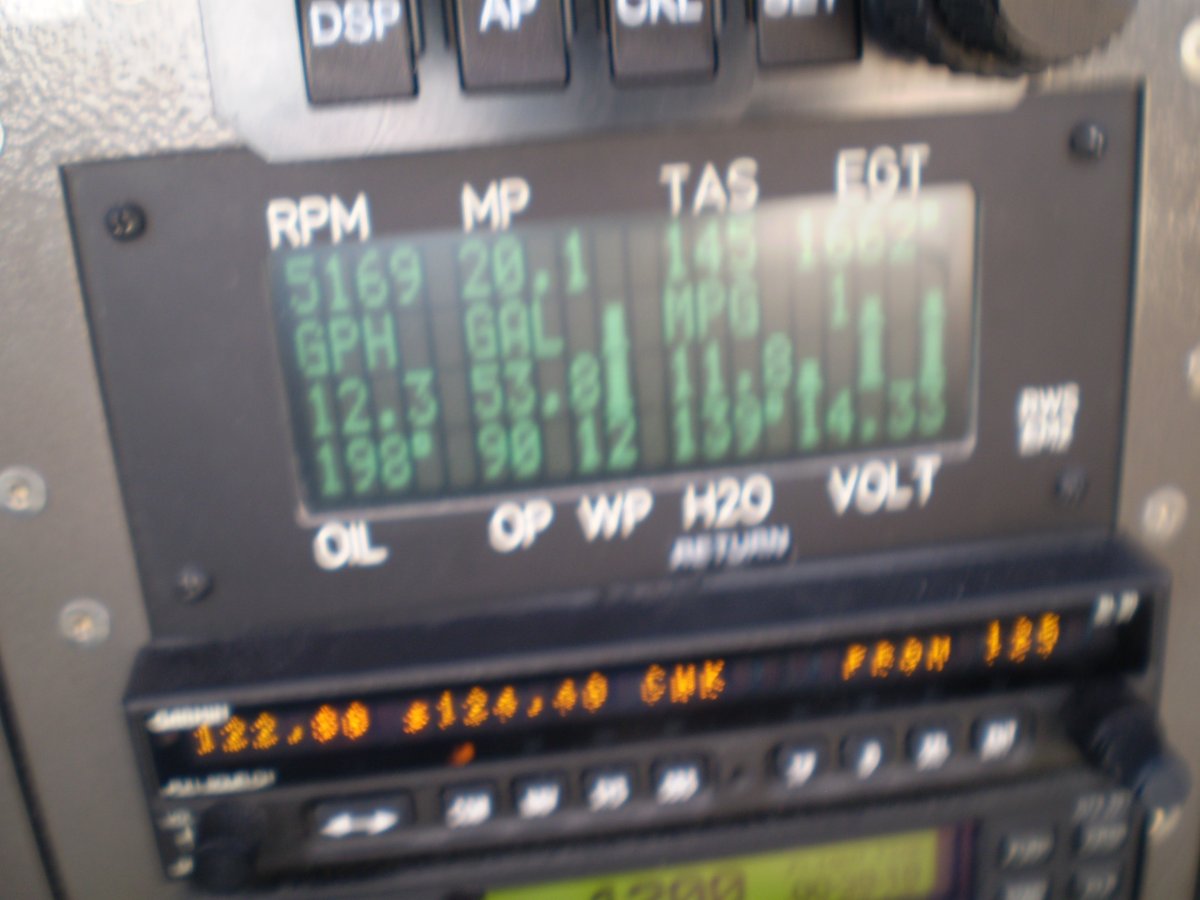
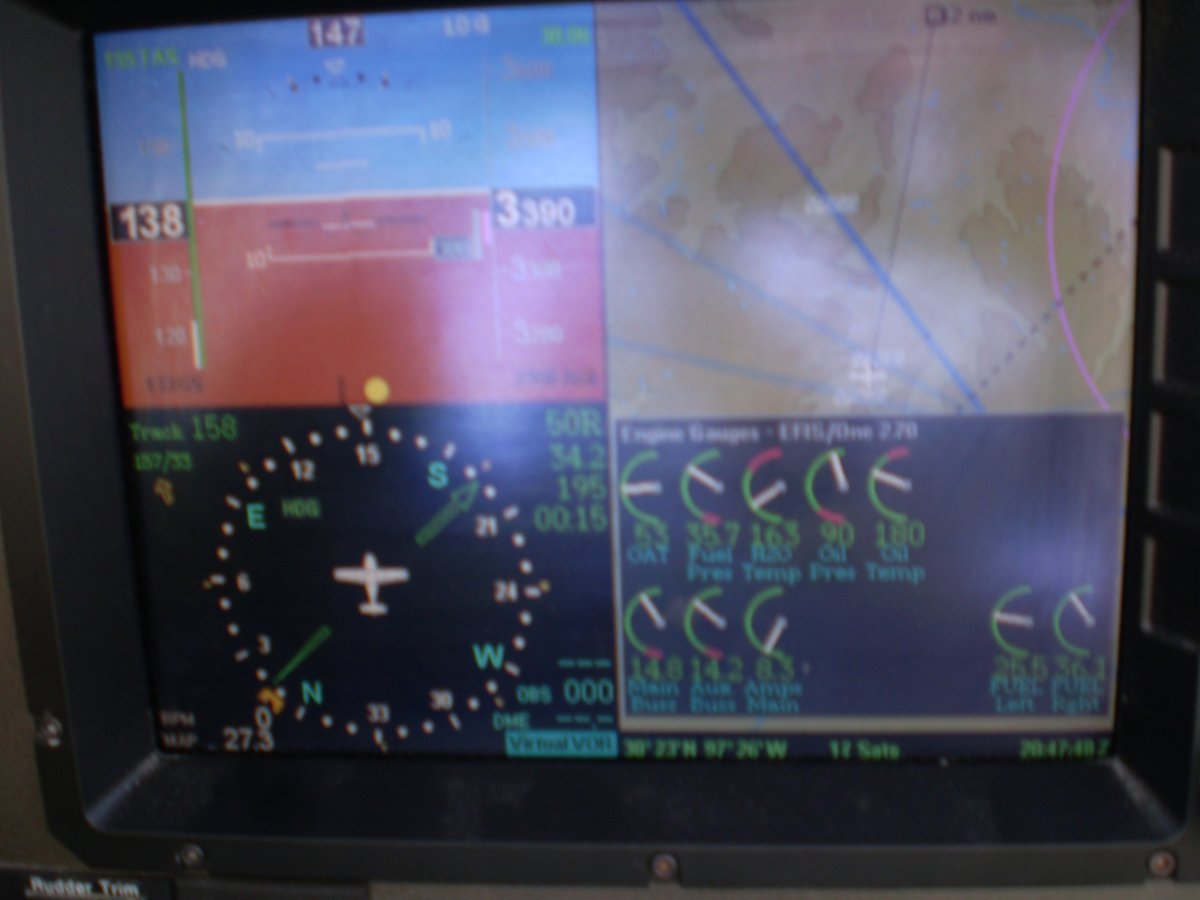
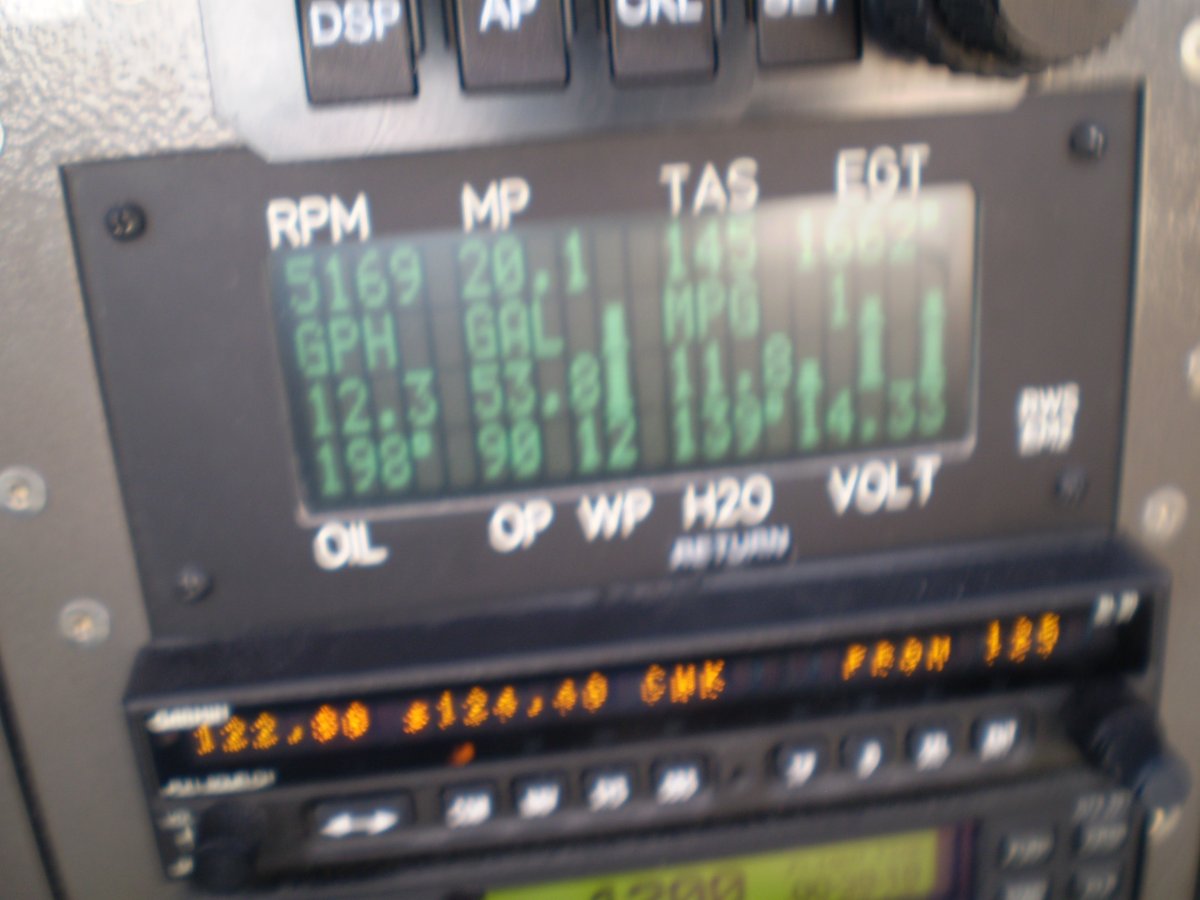
shots of the EM-2 and EFIS for your viewing pleasure. The TAS readings
differ a bit between the EFIS and the EM-2. The oil & coolant temps to
pay attention to are the ones on the EFIS. The EM-2 oil temp is the
temp after the oil/air cooler, but before the oil/water exchanger. The
EM-2 coolant temp is the return coolant temp, after the radiator
(returning to engine). You can see that the coolant and oil temps
(shown on the EFIS) are within about 10* of each other.
The highest EGT is shown on line two and is rotor #1 (nearest the
flywheel) and is at 1647*. The two bars to the right of the #1 show a
graphical representation of the EGTs (#2 is not working as is evidenced
by a gap between the #1 and $3 bars).
I checked the CHT readings and the highest was also #1 (nearest the
flywheel) as I would have expected. It was reading 195-200*.
The fuel readings (lower right of the EFIS) were Left - 33 gallons,
Right 29 gallons when in the hangar before the flight. You can see that
the left is reading 25.5, which is pretty close, but the right has
gained 7 gallons and is reading 36.1 gal. Maybe I should apply for a
patent. :-) All kidding aside, I really need to get this corrected.
I'll be trying out your suggestions soon.
Mark
17 hrs
Congratulations on the first cross country.
Is that 200 C or 200 F Mark.
--
Paul Lamar ...No rotor no motor.
The Rotary Engine NewsLetter. Powered by Linux.
ACRE NL web site.
http://www.rotaryeng.net
Copyright 1998-2007 All world wide rights reserved.